Basic Information
Scientific classification
- Chinese name: Horned Grebe
- Scientific name: Podiceps auritus, Horned Grebe, Slavonian Grebe
- Classification: Waterfowl
- Genus and family: Grebe, order Grebe, family Grebe, genus Grebe
Vital signs data
- Body length: 36.6-39 cm
- Weight: 245-500g
- Lifespan: No verification data available.
Significant features
Distribution and Habitat
The Horned Grebe breeds in Europe, Asia, and northern North America, starting from Iceland and the Faroe Islands in the west, moving east through Norway, Sweden, Denmark, Finland, the North Sea, the Baltic Sea, Belarus, the European part of Russia, Kazakhstan, and northwestern Xinjiang, China, and Siberia, south to the Altai Mountains and Lake Baikal, all the way to the Russian Far East coast, Sakhalin Island, the Kamchatka Peninsula, and then across the Bering Sea to northern North America. It winters in southern Europe, the North Sea, the Aral Sea, the Caspian Sea, Japan, Korea, the Aleutian Islands, California, the Atlantic coast to Mexico, and the southeastern coast of China, from the lower reaches of the Yangtze River to Fujian, occasionally also reaching Taiwan. During its migration, it passes through the provinces of Heilongjiang, Jilin, Liaoning, Hebei, Henan, and Shandong.
Distribution in China: Xinjiang (western Tianshan Mountains) in the northwest, Harbin and Lushun in the northeast, Hebei, Henan and Shandong in North China, and Fujian and Taiwan in the lower reaches of the Yangtze River.
Native distribution: Albania, Austria, Azerbaijan, Belarus, Belgium, Bulgaria, Canada, Mainland China, Taiwan, Croatia, Czech Republic, Denmark, Estonia, Faroe Islands, Finland, France, Georgia, Germany, Greece, Greenland, Hungary, Iceland, Iran, Ireland, Italy, Japan, Kazakhstan, North Korea, South Korea, Kyrgyzstan, Uzbekistan, Latvia, Lithuania, Macedonia, former Yugoslavia, Mexico, Moldova, Mongolia, Netherlands, Norway, Poland, Romania, Saint Pierre and Miquelon, Slovakia, Slovenia, Spain, Sweden, Switzerland, Turkey, Turkmenistan, Ukraine, United Kingdom, United States.
Migratory birds are distributed in Algeria, Armenia, Bermuda, Bosnia and Herzegovina, Cyprus, Gibraltar, Hong Kong, India, Israel, Kuwait, Lebanon, Libya, Luxembourg, Montenegro, Morocco, Pakistan, Portugal, Serbia, Svalbard and Jan Mayen, Syria, and Tunisia.
Undetermined distribution: Afghanistan.
During the breeding season, horned grebes inhabit inland lakes, ponds, and open and marshy areas of varying sizes, especially waters rich in emergent vegetation, and are also found in secluded streams. Outside the breeding season, they mainly inhabit coastal waters, bays, estuaries, and lakes, ponds, and marshes near the coast.
Appearance
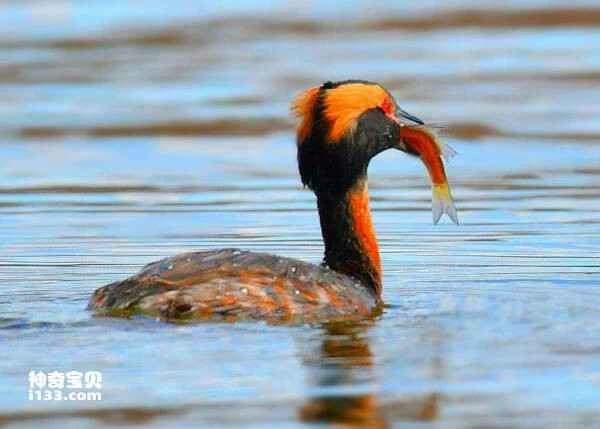
The Horned Grebe's summer plumage features a black head, nape, and upper body with a metallic sheen; pale brown edges on the back and shoulders; a tuft of elongated, chestnut-brown, golden-yellow ear-like plumes extending from the lores, across the eyes, and behind the eyes on either side of the head, resembling two protruding "horns"; chestnut-red foreneck, upper breast, and flanks; and white for the rest of the underparts; white underwing coverts with brown edges, greyish-brown upper wing coverts, and white greater inner coverts with dark brown spots; brown primary flight feathers with black shaft streaks and white bases on the inner webs, white outer secondary flight feathers with brown streaks, pure white middle secondary flight feathers, and black inner secondary flight feathers with white bases.
Winter plumage is blackish-brown from the corner of the beak along the crown above the eyes, back of the neck, back, rump, and upper wing coverts; primary flight feathers are grayish-brown, secondary flight feathers are white, forming a distinct white speculum; chin, throat, cheeks, foreneck, underparts, and flanks are white.
Juveniles resemble adults in winter plumage, but have more brown on their upperparts and less prominent dark stripes on the sides of their head and neck. The iris is red, the bill is black with a yellowish-white tip, the tarsus is pale yellowish-grey on the back and black on the front.
Size measurements: Weight: ♂ 250–500g, ♀ 245–375g; Body length: ♂ 370–390mm, ♀ 366–380mm; Bill length: ♂ 23–27mm, ♀ 23mm; Wing length: ♂ 132–149mm, ♀ 124–140mm; Wingspan: 55–64cm; Tarsus length: ♂ 45mm, ♀ 44mm. (Note: ♂ male; ♀ female)
Detailed introduction
The Horned Grebe (scientific name: *Podiceps auritus*), also known as the Slavonian Grebe, has been subject to some subspecies differentiation. Some scholars believe that the European and Asian populations have darker plumage than the North American population, with more black on the head and back and less gray, thus dividing the species into two subspecies: the nominate subspecies *P. a. Auritus* (Linnaeus, 1758) and the North American subspecies *P. a. Cornutus* (Gmelin, 1789). However, due to the very slight and highly unstable differences between these two subspecies, most scholars do not support this view. In China, only the nominate subspecies is found, distributed in Beijing, Hebei, Liaoning, Jilin, Heilongjiang, Shanghai, Jiangsu, Zhejiang, Fujian, Taiwan, Shandong, Henan, Hunan, and Xinjiang.
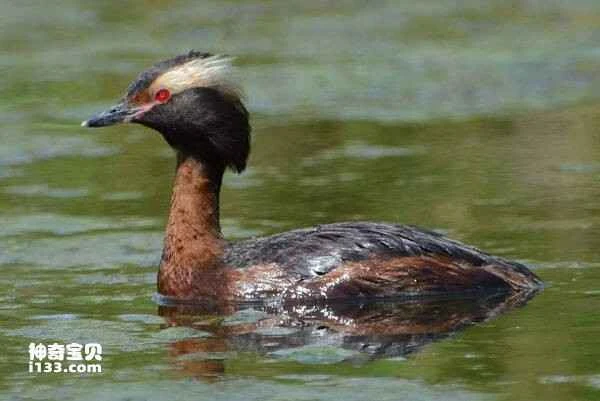
Horned grebes are usually found alone or in pairs, but small groups of 4-12 individuals can also be seen during migration and winter. They are active during the day and rest in the water. They are excellent swimmers and divers, often submerging headfirst into the water, performing a graceful forward roll, then diving at high speed before surfacing far above the surface. Each dive typically lasts 20-30 seconds, but can sometimes remain underwater for up to 50 seconds. When swimming, their necks are held very straight, often perpendicular to the water surface. They are stronger fliers than other grebes, taking off more easily and agilely. When taking off from the water, they skim close to the surface before ascending, their feet splashing through the water. They usually escape danger by flying. Their wings beat very powerfully during flight, often in a straight line at high speed. They are not agile on land, as their legs are positioned too far back, making walking almost impossible.
The Horned Grebe primarily feeds on various small fish, aquatic insects, insect larvae, crustaceans, mollusks, crayfish, frogs, tadpoles, and other aquatic animals, as well as small amounts of plant seeds, grass seeds, and aquatic plants. In summer, they mainly eat insects, while in winter they primarily eat fish and crustaceans. They forage mainly by diving. Foraging activity is mostly during the day, especially in the early morning and afternoon. Sometimes, Horned Grebes will also eat their own feathers, possibly to aid digestion of fish bones or to remove intestinal parasites; adult birds may even feed their chicks with feathers. Outside of the breeding season, they are completely silent. Their trilled duet is similar to that of the Little Grebe but with a heavier nasal tone; they also produce a rough, hoarse call with many guttural sounds.
Horned grebes begin their northward migration in early to late April and in late October to early November to reach their wintering grounds in China. The migration is slow, mainly along coastlines and rivers. They usually migrate in pairs or small groups, but are occasionally seen migrating alone.
The horned grebe's breeding season is from May to August, with the breeding season beginning each summer. Mating occurs not only during the day but also often on moonlit nights. The behaviors exhibited by both sexes during estrus are very complex and varied. Head shaking is the most common action, along with actions such as carrying reeds, preening feathers with their beaks, and displaying their wings. Sometimes, the male and female will first face each other and gaze at each other, then plunge into the water together, surfacing moments later with a tuft of water plants in their beaks, before facing each other again and shaking their heads. At other times, they will gracefully dance on the calm water, performing a complex water ballet.

Horned grebes build their nests in open tundra and forests, in lakes and ponds where reeds and aquatic plants thrive, or along secluded stream banks. They usually breed in single pairs, but in large lakes, they are occasionally seen nesting separately or in small groups. Their nests are relatively large, floating on the water like little boats, hence the name "floating nests." The nests are constructed from aquatic plants. First, some aquatic plants and reeds are bent to form the base, then reed leaves and other aquatic plant leaves are piled on top, creating a slightly concave center. This makes the nest very tight and sturdy, not only waterproof but also able to rise and fall with the water level, so that the eggs or chicks inside will not be submerged during floods. Furthermore, the fermentation of the aquatic plants used for building the nest generates heat, which helps the eggs hatch. During nest building, the male and female birds cooperate, repeatedly diving into the water to retrieve nesting material.
They begin laying eggs in mid-May each year, typically laying 4-5 eggs per clutch, occasionally 3-6, and in Northern Europe and North America, even up to 8 or 9-10. The eggs are oval, smooth and spotless, with a slightly pale white or pale green sheen. After hatching, they gradually turn off-white, or become yellowish-brown due to prolonged immersion in decaying grass. Each egg weighs about 20 grams and measures 29.1-31 mm × 41.3-49.8 mm, with an average of 30.73 mm × 44.5 mm. The parents begin incubating the eggs after the first egg is laid, with both the male and female taking turns, primarily the female. Incubation lasts 20-25 days. When both parents are out foraging, they cover the eggs with aquatic plants to keep them warm and protect them from predators.

Newly hatched horned grebe chicks are covered in downy feathers, with several brownish longitudinal stripes on their necks, quite different from their parents' plumage. After hatching, both parents work together to feed them. When swimming, the parents often let the chicks climb onto their backs, foraging and playing in the water – a very amusing sight. Soon after hatching, the parents begin teaching the chicks to swim. They will suddenly dive underwater, forcing the chicks on their backs to swim alone on the surface. Then the parents will carry the chicks back on their backs, repeating this process until the chicks quickly become proficient in the water and can swim and forage freely behind their parents. When encountering predators, the parents will carry the chicks on their backs to escape, or hide them under their wings and dive away. The parents also frequently prey on their own feathers to feed the chicks; the feathers that form tufts in the chicks' stomachs or the decomposed feathers help with digestion.
The Horned Grebe is not common in China, and its population is small. According to the Asian Midwintering Waterbird Surveys conducted by the International Bureau of Waterfowl Research in 1990 and 1992, only 60 individuals were observed in China in 1990 and only 30 in 1992; 61 were observed in East Asia in 1990, 81 in West Asia in 1992, and 37 in East Asia. In 2006, Wetlands International estimated the global population of the Horned Grebe to be between 140,000 and 1,100,000. In 2009, estimates from some countries were as follows: 50–1,000 Horned Grebes migrated to China, with no more than 50 wintering there; 100–100,000 pairs of adult birds and 50–10,000 individuals migrated to Russia.

The main threats to the horned grebe come from human disturbance (hunting is not the primary cause of endangerment). Forestry and agricultural activities around lakes in their breeding grounds, such as afforestation leading to fluctuations in lake levels and other hydrological changes, and the use of pesticides in agriculture reducing prey populations, are contributing to the horned grebe's shrinking historical distribution range. Eutrophication due to lake acidification and increased humus accumulation is also shrinking the horned grebe's historical distribution range. Accidental drownings caused by entanglement in fishing nets and oil spills in the ocean are also threats to the horned grebe population.
On November 22, 2019, the Horned Grebe, a Class II protected animal in China, was observed for the first time in Ningxia. On January 4, 2023, it was learned from the Poyang Lake National Nature Reserve Administration in Jiangxi Province that staff members of the Duchang Station of the Poyang Lake Nature Reserve Administration discovered a Horned Grebe, a Class II protected animal in China, in the Jishan waters of Poyang Lake during a routine patrol. This was the first recorded discovery of this species in the Poyang Lake Nature Reserve.
It has been included in China's "National Class II Key Protected Wild Animals List" (1988).
It is listed as Least Concern (LC) in the IUCN Red List of Threatened Species ver3.1 (2012).
Protect wild animals and ban the consumption of wild game.
Maintaining ecological balance is everyone's responsibility!