
Basic Information
Scientific classification
- Chinese name: Crested Grebe
- Scientific name: Great Crested Grebe, also known as Podocips cristatus, is a species of crested grebe.
- Classification: Waterfowl
- Genus and family: Grebe, order Grebe, family Grebe, genus Grebe
Vital signs data
- Body length: 45-58 cm
- Weight: 425-1000g
- Lifespan: No verification data available.
Significant features
It is the largest species of grebe.
Distribution and Habitat
Country of origin: Afghanistan, Albania, Algeria, Angola, Armenia, Australia, Austria, Azerbaijan, Bahrain, Bangladesh, Belarus, Belgium, Bhutan, Bosnia and Herzegovina, Botswana, Bulgaria, China, Democratic Republic of Congo, Croatia, Cyprus, Czech Republic, Denmark, Egypt, Estonia, Ethiopia, Finland, France, Gabon, Georgia, Germany, Greece and Hungary, India, Islamic Republic of Iran, Iraq, Ireland, Israel, Italy, Japan, Jordan, Kazakhstan, North Korea, Kenya, South Korea, Kuwait, Kyrgyzstan, Latvia Vassalia, Lebanon, Libya, Liechtenstein, Lithuania, Luxembourg, Macedonia, Malta, Moldova, Monaco, Mongolia, Montenegro, Morocco, Mozambique, Myanmar, Namibia, Nepal, Netherlands, New Zealand, Norway, Pakistan, Poland, Portugal, Qatar, Romania, Rwanda, San Marino, Saudi Arabia, Serbia, Slovakia, Slovenia, South Africa, Spain, Sweden, Switzerland, Syrian Arab Republic, Tajikistan, United Republic of Tanzania, Thailand, Tunisia, Turkey, Turkmenistan, Uganda, Ukraine, United Kingdom, Uzbekistan, Zambia, Zimbabwe. Origin uncertain: Gibraltar.
Migratory birds: Burundi, Faroe Islands, Gambia, Iceland, Indonesia, Lesotho, Mali, Nigeria, Oman, Senegal, Swaziland, United Arab Emirates.
In China, they mainly breed in provinces and autonomous regions such as Heilongjiang, Jilin, Liaoning, Inner Mongolia, northern Hebei, Gansu, Ningxia, Qinghai, and Tibet. When wintering, they pass through provinces such as Hebei, Henan, Shanxi, and Shaanxi, and migrate to southern Tibet, Yunnan, Sichuan, Anhui, as well as vast areas south of the Yangtze River, the southeast coast, and Taiwan. Some great crested grebes also winter in the Liaodong Peninsula and the eastern coastal areas of Northeast China.
During the breeding season, they mainly inhabit open plains, lakes, rivers, ponds, reservoirs, and marshes, especially lakes and ponds rich in emergent plants and fish. They also appear in mountain lakes and ponds. In winter, they mostly inhabit coastal bays, estuaries, large inland lakes, dry and stable rivers, and coastal marshes.
Appearance
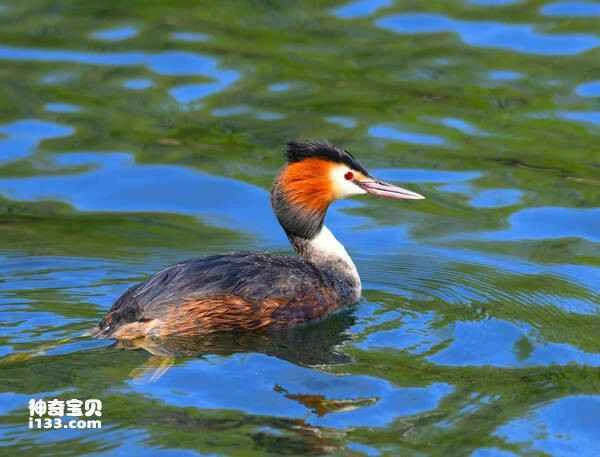
The Great Crested Grebe is a type of waterfowl. It is also the largest grebe species. Males and females are quite similar, about the size of a duck, with a long, pointed beak and a black stripe running from the corner of the beak to the eye. Its neck is very long and holds upright, usually perpendicular to the water surface.
In summer plumage, the forehead and crown are black. The feathers on both sides of the crown elongate, forming two tufts of long, black crest feathers at the back of the head. A ring of long ornamental feathers forms a ruff on either side of the black crest, extending from the ear area to the throat. The base of the ruff is chestnut brown, and the tips are black. The rest of the head, face, and chin are white. The nape, back, rump, and inner scapulars are blackish-brown; the outer scapulars, wing coverts, and lesser wing coverts are white. The primary and tertiaries are also blackish-brown, with the inner tips of the primarys white; the secondarys are also white. The foreneck, breast, abdomen, and the rest of the underparts are white; the flanks and sides of the breast are chestnut brown. The underwing coverts and axillaries are white. Winter plumage is largely similar to summer plumage, but the upperparts are darker, the crest feathers on the crown are shorter and less prominent, and the ruff disappears.
The iris is orange-red, the beak is dark brown (red in winter), red at the base and pale at the tip, the inner side of the tarsus is yellowish-green, and the outer side is olive-green.
The beak is straight, thin, and laterally compressed, with a pointed tip; the nostrils are open and located near the base of the beak; the lores (the area in front of the eyes) are bare; the neck is relatively long and slender; the wings are short, with 12 primary flight feathers, but the first primary feather is vestigial, and the fifth secondary flight feather is missing. The tail is even shorter, with only a few soft down feathers, or almost none. The feet are positioned at the rear of the body, near the rump, with laterally compressed tarsi adapted for diving; all four toes have broad, petal-like webbing. The claws are blunt and broad, nail-like, with the inner edge of the middle toe serrated, and the hind toe short, positioned higher than the other toes, or absent. The body feathers are short and dense, moisture-resistant and waterproof; there are accessory feathers, and the preen gland is also feathered. The digestive tract lacks a cecum; chicks are precocial.
Size measurements: Weight: ♂ 650-1000 g, ♀ 425-950 g; Body length: ♂ 520-580 mm, ♀ 450-546 mm; Bill length: ♂ 50-53 mm, ♀ 38-50 mm; Wing length: ♂ 180-197 mm, ♀ 165-190 mm; Tail length: ♂ 40-48 mm, ♀ 36-46 mm; Tarsus length: ♂ 61-64 mm, ♀ 51-67 mm. (Note: ♂ male; ♀ female)
Detailed introduction
The Great Crested Grebe (scientific name: Podiceps cristatus) has three subspecies.
The Great Crested Grebe migrates to its breeding grounds in Northeast China as early as mid-to-late March, with large numbers arriving from mid-July to the end of April. They leave their breeding grounds in autumn around mid-October, though some may not leave until early November. During migration, they often travel in pairs or small groups. They are most active in open water. They are adept swimmers and divers. When swimming, they extend their necks very straight, maintaining a vertical posture to the water surface. They frequently dive, each dive lasting 20-30 seconds, with some remaining underwater for up to 50 seconds. They fly relatively fast with powerful wingbeats, but walking on land is difficult for them. Their diet consists mainly of various fish. They also eat insects, insect larvae, shrimp, calamari, crustaceans, mollusks, and other aquatic invertebrates. Occasionally, they also consume small amounts of aquatic plants.

The Great Crested Grebe's breeding season is from May to July. They typically nest in reed beds and aquatic plants not far from the open water surface. They nest in pairs or in small groups, creating floating nests that drift on the water. They usually use a bent section of reed or aquatic plant as the nest base, then pile up the reeds and plants. The nest is truncated cone-shaped, resembling a truncated cone with a slightly concave top. The outer diameter of the upper part of the nest is 26-30 cm, the inner diameter is 20-28 cm, the lower diameter is 60-69 cm, and the nest height is 52-62 cm. 5-9 cm of the nest protrudes above the water, and the nest depth is 3-4 cm. Egg laying occurs from mid-May to the end of May. Each clutch typically contains 7-5 eggs. The eggs measure 31.5-36.5 × 51.5-55.0 mm, with an average of 34.3 × 53.4 mm. They weigh 30-33.5 grams, with an average of 32.2 grams. The eggs are pure white when first laid, gradually turning off-white after hatching. The eggs are oval in shape. Incubation begins immediately after the first egg is laid. Both parents take turns incubating. The chicks are precocial; they can swim and hide shortly after hatching.

Listed as Least Concern (LC) in the IUCN Red List of Threatened Species 2019 ver 3.1.
It is listed in the "List of Terrestrial Wild Animals of Beneficial or Important Economic and Scientific Research Value under State Protection" (Item 5) issued by the State Forestry Administration of China on August 1, 2000.
Protect wild animals and ban the consumption of wild game.
Maintaining ecological balance is everyone's responsibility!


