Basic Information
Scientific classification
- Chinese name: Columbia Grebe
- Scientific name: Columbia Grebe, Podicepsandinus
- Classification: Waterfowl
- Genus and family: Grebe, order Grebe, family Grebe, genus Grebe
Vital signs data
- Body length: No verification information available.
- Weight: No verification information available.
- Lifespan: No verification data available.
Significant features
Extinct
Distribution and Habitat
It is distributed in South America (including Colombia, Venezuela, Guyana, Suriname, Ecuador, Peru, Bolivia, Paraguay, Brazil, Chile, Argentina, Uruguay and the Falkland Islands).
They inhabit the plant communities of freshwater lakes and marshes, spending almost their entire lives in the water.
Appearance
The beak is straight, laterally compressed, and pointed; the nostrils are open and located near the base of the beak; the wings are short, with 12 primary flight feathers, the first one vestigial, and the fifth secondary flight feather missing. The tail has only some short, soft down feathers, or almost none. The feet are located near the rump. The tarsi are laterally compressed, adapted for diving; all four toes have broad, webbed flaps; the claws are blunt and broad, the inner edge of the middle toe is serrated, the hind toe is short and positioned higher than the other toes, or is absent. The body plumage is short and dense, providing excellent moisture resistance; the feathers have accessory feathers, and the preen gland is feathered; the sexes are similar. The skull is either cleft palate or fully nasal; both lack basal wing processes; the digestive system lacks a cecum; the chicks are precocial.
Detailed introduction
The Colombian grebe, scientifically known as *Podiceps andinus*, was a species of grebe that lived in the eastern Andes Mountains of Colombia. They were still abundant in 1945. They were sometimes classified as a subspecies of the black-necked grebe. They are now extinct.
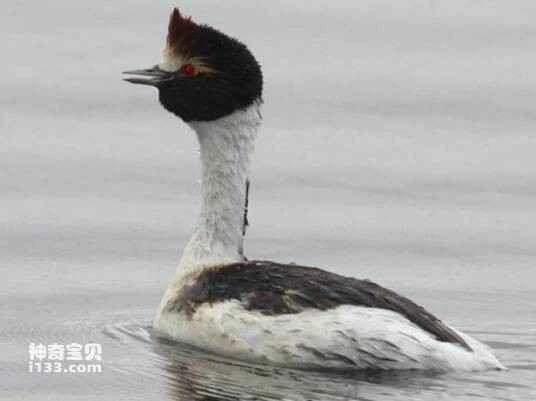
Columbian grebes typically live in flocks. They are not good fliers. They swim using their legs instead of their wings and rarely walk on land. They can dive to forage, generally diving to depths of only 1–4 meters. Their diet consists mainly of aquatic insects and larvae, crustaceans, mollusks, small fish, and small plants.
The disappearance of the Columbian Grebe was due to wetland loss, siltation, pesticide pollution, hunting, and predation of chicks by rainbow trout. The primary cause was habitat loss, with wetland reduction and siltation leading to pollutant accumulation. This destroyed pondweed, allowing the genus *Elodea* to dominate. By 1968, the Columbian Grebe population had dwindled to 300 individuals. Only two observations of them were made in the 1970s: one in 1972 and another in 1977. Studies from 1981 to 1982 confirmed their extinction.
Protect wild animals and ban the consumption of wild game.
Maintaining ecological balance is everyone's responsibility!


