Basic Information
Scientific classification
- Chinese name: North American Grebe
- Scientific name: Western Grebe, Aechmophorus occidentalis
- Classification: Waterfowl
- Family and genus: Grebes, order Grebes, family Grebes, genus *Gnaphalium*
Vital signs data
- Body length: 56-74 cm
- Weight: About 1.4kg
- Lifespan: No verification data available.
Significant features
It is the longest of the grebes.
Distribution and Habitat
It is distributed throughout North America, including the United States and Canada, from southeastern Alaska to California and Chihuahua in northern Mexico. It is commonly found along the Pacific coast of Canada and the United States in winter.
It inhabits lakes, ponds, canals, marshes, and slow-moving rivers and coastal reed marshes. It is a migratory bird, breeding in freshwater lakes rich in cattails and reeds. It typically stops at grassland lakes in British Columbia, Canada, and California, USA, and sometimes also in Mexico. In winter, it migrates to the Pacific coast.
Appearance
The North American grebe is a waterfowl. It measures approximately 56 to 74 centimeters in length and weighs 1400 grams, making it the longest of the grebe species. Its crest and nape are black, its back is brownish-grey, and the lower body is white. It has a dark yellow or olive-colored beak, and red eyes surrounded by dark eye rings. White wing stripes are visible in flight.
The neck is long and slender, with females slightly smaller than males. The bill is long and yellowish-green, straight, laterally compressed, and pointed; the nostrils are open and located near the base of the bill; the wings are short, with 12 primary flight feathers, the first vestigial, and the fifth secondary flight feather missing. The tail has only some short, soft down feathers, or almost none. The feet are located near the rump. The tarsi are laterally compressed, adapted for diving; all four toes have broad, webbed flaps; the claws are blunt and broad, the inner edge of the middle toe is serrated, and the hind toe is short and positioned higher than the other toes. The ankle and toe joints are very flexible, aiding in movement in the water. The body plumage is short and dense, providing resistance to moisture; the feathers have accessory feathers, and the preen gland is feathered; the sexes are similar. The skull is of the cleft palate type and the entire nasal type; both lack basal pterygoid processes; the digestive system lacks a cecum; the chicks are precocial.
Detailed introduction
The Western Grebe (scientific name: Aechmophorus occidentalis) has two subspecies.
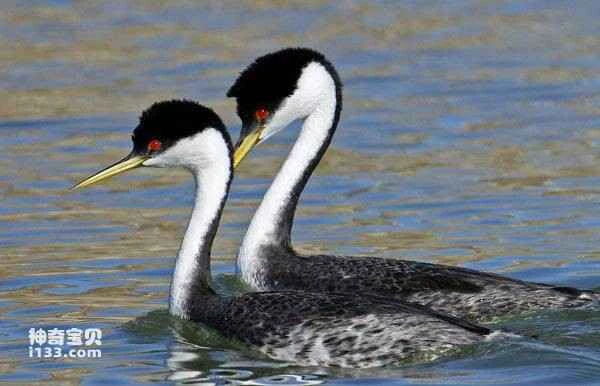
The North American grebe spends almost its entire life in water, often living in groups, usually in pairs or small flocks on open water. It is not a good flier. When swimming, it uses its legs instead of its wings and rarely walks on land. It is active during the day, but during the breeding season, it is mostly active in or near emergent vegetation, hiding among aquatic plants when it encounters humans. Its active days are long, from dawn to dusk, almost entirely spent in the water, and it generally does not come ashore. It frequently dives, with each dive lasting 30-50 seconds.
The North American grebe primarily forages by diving, typically at depths of only 1-4 meters. It is a carnivorous waterbird that preys on insects, shellfish, fish, and other marine life.

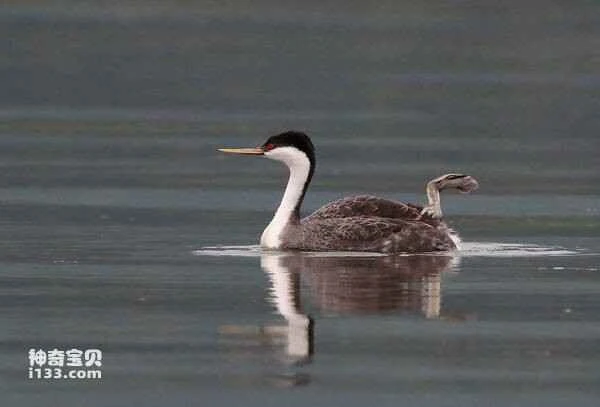
The most spectacular part of the North American grebe's life is undoubtedly its courtship dance, a highly complex and elegant spectacle. During this time, the male and female grebes display their affection on the water's surface, exchanging kisses, gifts, feeding, and dancing. At the climax, the grebes even rise from the water's surface in incredible poses, chasing each other with incredible speed, often covering distances of over a hundred meters. The female uses this dance to test the male's stamina and loyalty. For breeding, they build floating nests in the grass near the water's edge, constructed from reeds, weeds, and some clay. They lay 2-4 eggs at a time, rarely 1-6, which are pale blue or white, often stained with dirt. Both parents take turns incubating the eggs. The eggs hatch after about 24 days, but the hatching is asynchronous; the last hatched may be abandoned in the nest. The chicks are precocial, covered in downy feathers immediately after hatching, and can swim and move freely in water by the second day. For 2-3 weeks after hatching, the parent birds often carry the chicks on their backs, and if startled and diving, they tuck them under their wings. They can take their first flight after 10 weeks. They brood about one bird per year.
The North American grebe breeds during seasons when food is plentiful. They typically lay 2 to 6 white or cream-colored eggs, with an incubation period of 20 to 30 days. The nest is usually constructed from a pile of aquatic plants. Parents often carry their chicks on their backs, including when diving or escaping danger. North American grebes can dive for 10 to 40 seconds.
Listed as Least Concern (LC) on the IUCN Red List of Threatened Species 2012 ver 3.1.
Protect wild animals and ban the consumption of wild game.
Maintaining ecological balance is everyone's responsibility!