Basic Information
Scientific classification
- Chinese name: Pacific Black Duck
- Scientific name: Anas superciliosa, Pacific Black Duck, Gray Duck
- Classification: Waterfowl
- Family: Anseriformes, Anatidae, Anatidae
Vital signs data
- Body length: 47-61 cm
- Weight: 560-1400g
- Lifespan: Approximately 20 years
Significant features
The overall plumage is mainly mottled brown, tan, and light yellow, with dark brown to light yellow stripes and spots all over the body.
Distribution and Habitat
Origin: American Samoa, Australia, Cook Islands, Fiji, Society Islands of French Polynesia, Indonesia (southern Sumatra, Java and Sulawesi), Marshall Islands, Caroline Islands of the Federated States of Micronesia, New Caledonia, Cook Islands of New Zealand, Palau, Papua New Guinea (New Britain and New Ireland), Solomon Islands, Vanuatu, New Caledonia (French), Samoa, Solomon Islands, East Timor, Fiji, Tonga and Vanuatu.
The Pacific Common Black Duck is a common wild duck in Australia, with a wide tolerance for breeding and rearing in terrestrial, marine wetlands, and estuaries. It is distributed throughout the wetlands of Australia. It typically inhabits freshwater lakeshores, but also flocks in rivers, lakes, reservoirs, forest ponds, tidal flats, bays, and coastal salt flats. It prefers shallow, well-vegetated marshes, wetlands, protected estuaries, and sheltered coastal waters. Its habitat ranges from creeks and rivers to small freshwater ponds and (more rarely) secluded marine areas; it can utilize very small bodies of water, including urban ponds, farm dams, and drainage ditches.
Appearance
The Pacific Black Duck measures 47-61 cm in length, with males weighing 642-1400 grams and females 560-1400 grams, and a wingspan of 82-93 cm. It is a relatively large duck. Its overall plumage is primarily mottled brown, tan, and pale yellow. The body has dark brown to pale yellow stripes and spots, with white or yellow edges on the feathers. The head is pale with distinct dark stripes, featuring a dark brown central line that runs above and below the eyes. The dark brown crown borders cream, forming a long and striking broad stripe. The crown is black, the face is white to pale yellow, and the throat is white. The upper wing coverts are the same color, and the secondary flight feathers are bright and glossy with an iridescent green speculum. The white underwing inner side is very prominent in flight.
The female Pacific Black Duck has the same plumage as the male, but its crest is brown instead of black. Young Pacific Black Ducks have plumage similar to that of adults.
Iris brownish-grey, beak lead-colored. Legs and feet grayish-yellowish-green.
A hybrid of the Pacific Common Black Duck and the Mallard produces a species with lighter plumage, distinctive facial stripes, and blue speculum.
Detailed introduction
The Pacific Black Duck (scientific name: Anas superciliosa), also known as the Grey Duck, is a medium-sized waterfowl belonging to the genus Anas in the family Anatidae.
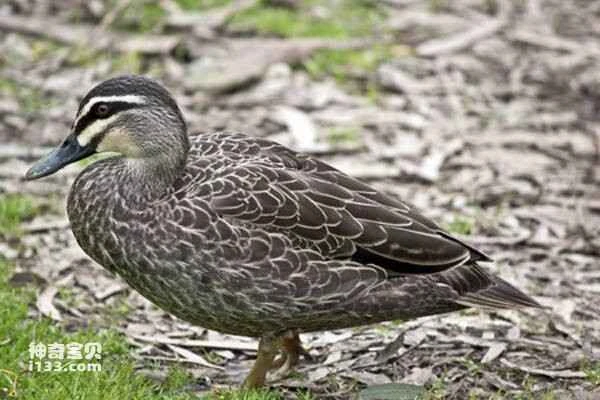
Pacific Black Ducks typically appear in pairs or small groups and easily mix with other duck species. They are common sightseeing spots on lakes and in urban ponds, where they become very docile. They generally stay in pairs or small groups, often choosing to inhabit the grassy areas of marshy regions near water. They mainly float on the water's surface, foraging underwater. Their toes are webbed, but they rarely dive; their tails are above water when swimming. They are adept at foraging, playing, and courtship in the water. They are clean animals and frequently preen their feathers both in the water and on land.
The Pacific Black Duck primarily feeds on plants, including roots, seeds, leaves, cardamom, and rice from marsh and lake areas. It also occasionally consumes animal matter, including invertebrates and arthropods such as insects, snails, and crayfish. Its call is a loud, rapid quacking sound that begins very loudly and gradually decreases.
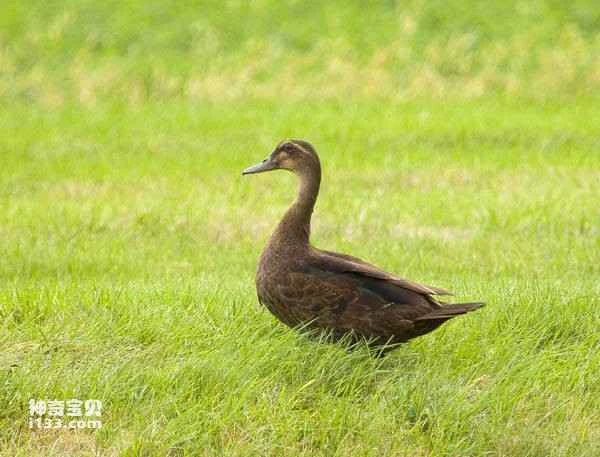
The peak breeding season for Pacific Black Ducks is during the rainy season, with pairings occurring in late summer or early autumn. Courtship rituals include the male flapping its wings and chasing the female. Nests are typically chosen away from water, usually built in tree cavities. Sometimes, they are selected above nearby water, hidden among aquatic plants, and constructed as a bowl-shaped nest using plant stems. Each nest contains 4-12 eggs, with incubation lasting 21-25 days. The female usually incubates the eggs alone, while the male guards the nest. After hatching, the female continues to care for the ducklings, who follow her to forage. The chicks leave the nest at 49 days old. Ducklings can reproduce after one year of age, but the survival rate is only about 35%. The average lifespan of an adult Pacific Black Duck in New Zealand is 21 months, but the longest-lived species in the wild can live at least 20 years.
Due to a combination of competition and hybridization with mallards, the Pacific Black Shelduck is believed to be declining in numbers across its entire range. This introduced species is most common in developed areas, and its numbers are still increasing, at least in New Zealand. Also in New Zealand, loss of wild habitat is considered a major cause of the species' decline, and a slow decline in Melanesia is also attributed to hunting and habitat degradation. Habitat destruction is also occurring in Australia, but there the Pacific Black Shelduck has demonstrated a greater ability to utilize artificial habitats.
Listed as Least Concern (LC) in the IUCN Red List of Threatened Species 2018 ver 3.1.
Protect wild animals and ban the consumption of wild game.
Maintaining ecological balance is everyone's responsibility!