Basic Information
Scientific classification
- Chinese name: Philippine anemone shrimp (Vir philippinensis)
- Scientific name: Vir philippinensis
- Classification: Arthropoda
- Genus and family Palaemonidae Vir
Vital signs data
- Body length: 1.5–2.5 cm (excluding antennae)
- Weight: Extremely light, small crustacean, no uniform data.
- Lifespan: Approximately 1–2 years
Significant features
They live in symbiosis with sea anemones; they have a semi-transparent body; they are used for both cleaning and foraging; females carry eggs and larvae are planktonic.
Distribution and Habitat
Tropical Indo-Pacific coral reefs and lagoons; 1–25+ m; dependent on cnidarians such as sea anemones as hosts.
Appearance
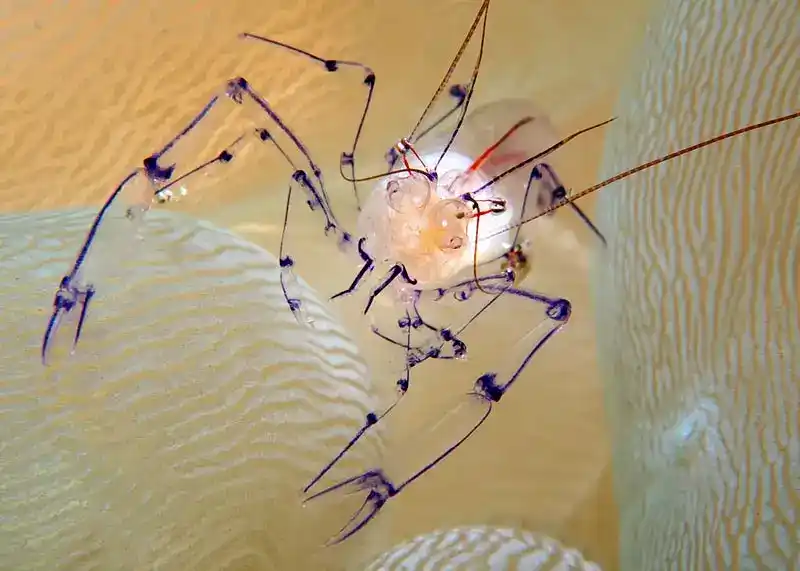
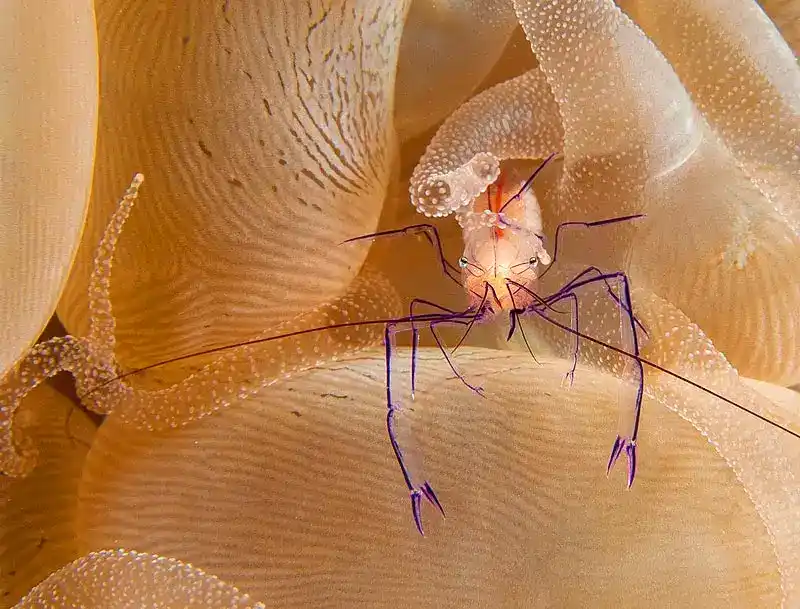
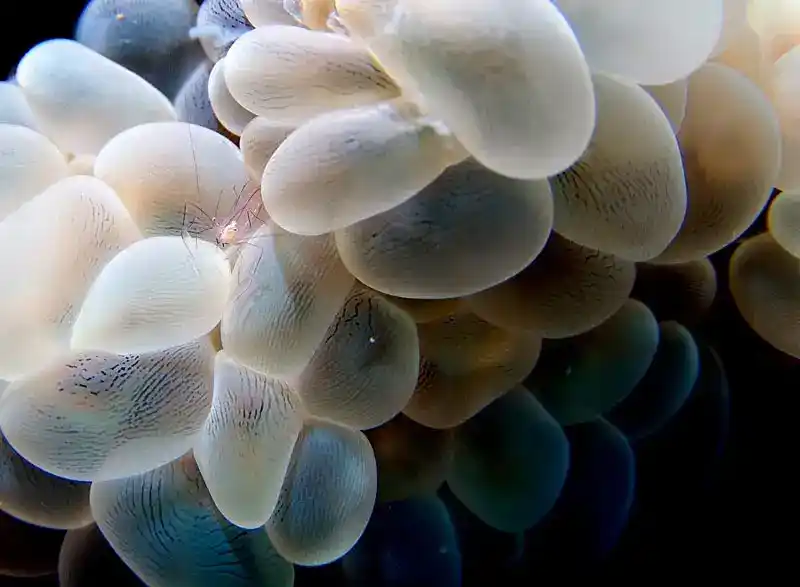
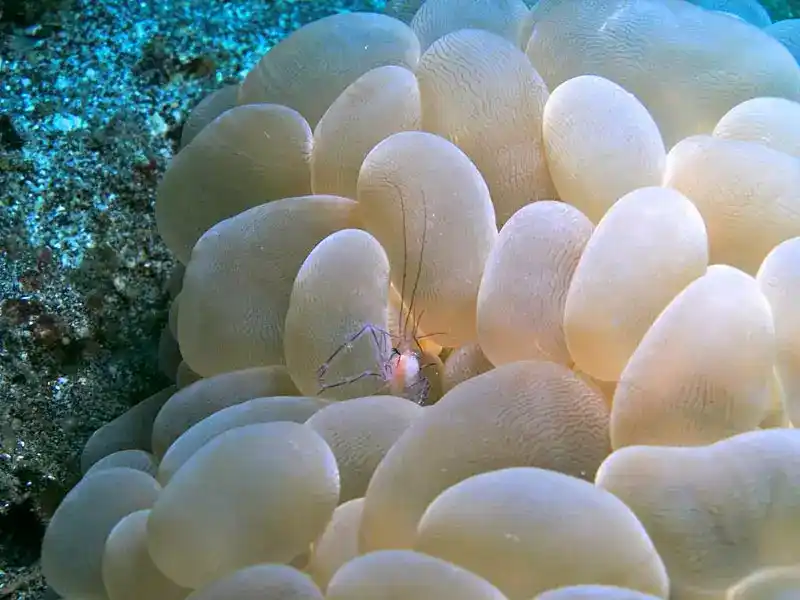
Slender and transparent, often with dotted/linear white spots; the second cheliped is slightly developed; the antennae and walking legs are long and slender.
Detailed introduction
Vir philippinensis, commonly known as the Philippine anemone shrimp , belongs to the order Decapoda and the family Palaemonidae . Members of this genus mostly live in symbiosis with invertebrates such as sea anemones, soft corals, or sea squirts. They are small in size, highly transparent, and adept at hiding among the tentacles of their hosts to feed, exhibiting both cleaning and scavenging characteristics.
Ecology and Biology
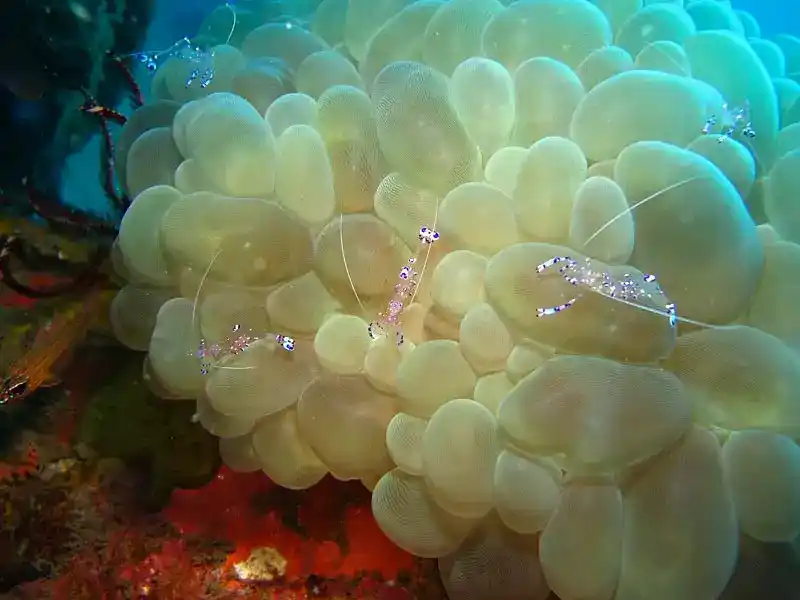
Symbiotic relationship: They usually live with sea anemones , using their tentacles for protection from predators; occasionally they are seen on sea squirts or soft corals.
Diet: It preys on small plankton, parasites, and organic debris, and also pecks at the adhering particles on the host's tentacles, exhibiting some cleaning behavior .
Reproduction: The female shrimp carries eggs. The larvae are planktonic and after several molts, they settle in the reef area and find a host.
Behavior: During the day, they mostly hide on the tentacles or the edge of the umbrella, and are more active at night; when disturbed, they quickly hide inside the host's body or in crevices.
Morphology and Recognition
Slender and translucent body; large eyes, relatively long antennae and legs; slightly developed second pair of chelipeds; small white/milky white spots or lines are commonly seen on the body surface, which may vary slightly in visibility depending on the background. Differences from closely related genera are mostly found in fine features such as the morphology of the frontal scutes, the number of frontal spines , and the ratio of chelipeds.
Body size and lifespan
Body length: Commonly 1.5–2.5 cm (excluding antennae).
Lifespan: Usually 1–2 years , depending on environment and predation pressure.
Distribution and Habitat
Distributed in the tropical Indo-Pacific (especially in the Western Pacific and Southeast Asia), it usually inhabits coral reefs, reef slopes and lagoons at depths of 1–25+ m , with sea anemones as its main host, and moves between its tentacles and base.
Conservation and Threats
Threats: Coral reef degradation, sea anemone reduction, harvesting and water quality deterioration.
Recommendation: When observing underwater, avoid touching the host ; minimize the disturbance to the individual when taking close-up photos with flash.
IUCN: Most global categories are classified as Unevaluated (NE) ; this site treats them as NE, focusing on popular science and identification.
Frequently Asked Questions
Q1: How do I find it on a sea anemone? Observe the transparent shrimp at the base of the tentacles and the edge of the umbrella , and pay attention to the tiny white spots/lines and long tentacles.
Q2: Will it harm sea anemones? They are usually mutualistic or symbiotic ; they feed on parasites and detritus, and have limited impact on their hosts.
Q3: How to distinguish it from other genera of "sea anemone shrimp"? It is necessary to compare the morphology of the frontal scalpel and frontal spine, the ratio of chelipeds, etc.; in practice, preliminary screening can be done based on host type and body shape.
Q4: Can it be artificially raised? It has a high dependence on stable water quality and host, so it is not recommended for beginners.