Basic Information
Scientific classification
- Chinese name: South Sydney funnel-web spider
- Scientific name: *Atrax montanus* Rainbow, 1914
- Classification: Arthropoda
- Family: Atrax montanus
Vital signs data
- Body length: Adults are about 2–3.5 cm in length, with females slightly larger than males, and their leg span can reach about 5–7 cm.
- Weight: Medium to large terrestrial spiders, typically weighing several grams, depending on individual size.
- Lifespan: Similar to other funnel-web spiders, they can live for many years; females are estimated to live 10–20 years in the wild.
Significant features
The funnel-web spider, endemic to New South Wales, Australia, is highly venomous and resembles the Sydney funnel-web spider in appearance. It digs silk-lined burrows and lays a "funnel web" and radial tripping lines at the entrance. Its venom is a neurotoxin that is highly sensitive to humans.
Distribution and Habitat
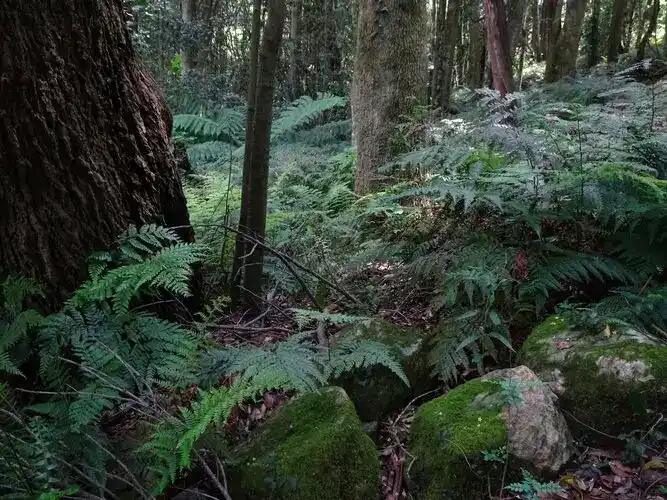
It is distributed in the Blue Mountains region of New South Wales and the damp mountain and rainforest areas south and west of Sydney. It is commonly found in damp soil under rocks, fallen logs and tree roots, and can also be found in suburban gardens and the edges of yards.
Appearance
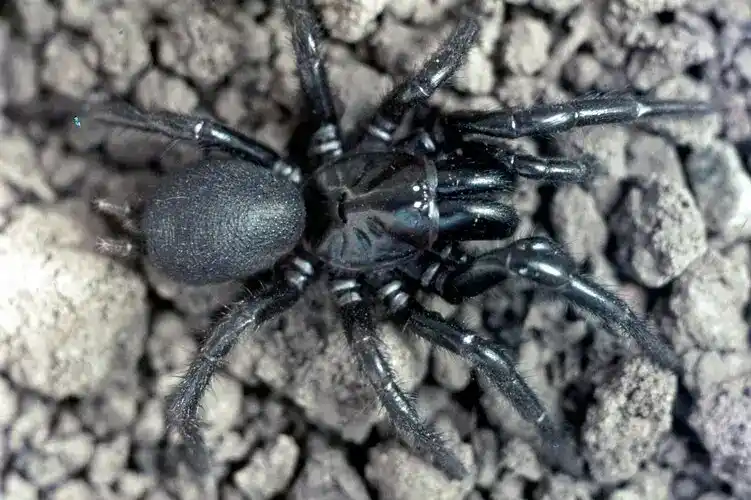
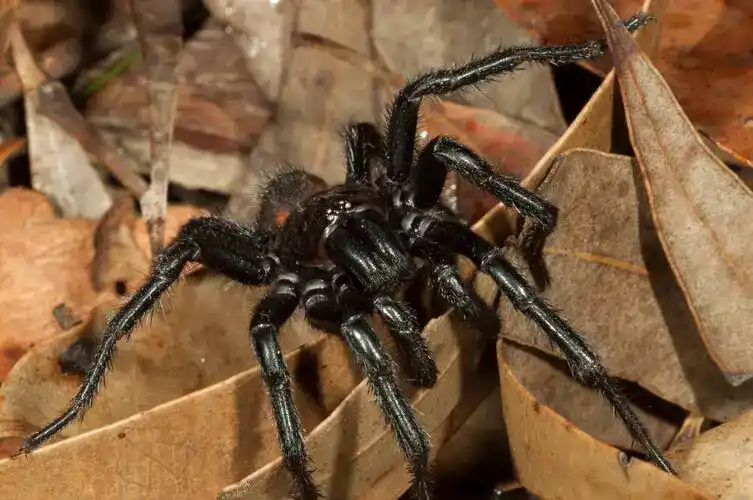
The overall body color is dark blue-black or blackish-brown, the cephalothorax is smooth and shiny, the abdomen is slightly darker and grayish-black, and there are finger-like spinnerets at the end of the abdomen; the female spider is stout, while the male spider is slightly slender, both of which have strong fangs.
Detailed introduction
The Southern Sydney Funnel-web Spider ( Atrax montanus ) is one of Australia's most notorious highly venomous spiders, belonging to the family Atracidae and the genus Atrax . Together with the Sydney Funnel-web Spider ( Atrax robustus ) and the Newcastle Funnel-web Spider ( Atrax christenseni ), it forms the recently redefined "Sydney Funnel-web Spider Complex," which is extremely similar in appearance but differs in distribution and subtle anatomical structures.
Classification and nomenclature
Common Chinese name: South Sydney funnel-web spider
English name: Southern Sydney Funnel-web Spider
Scientific name: *Atrax montanus * Rainbow, 1914
Belongs to: Phylum Arthropoda → Class Arachnida → Order Araneae → Family Atracidae → Genus Atrax
Appearance and Identification Features
The South Sydney funnel-web spider is a medium to large-sized, glossy black terrestrial spider whose overall morphology is very similar to the classic Sydney funnel web.
Size: Adults are about 2–3.5 cm long. Females are slightly larger and more robust, while males are relatively slender with a leg span of 5–7 cm.
Body color: The head, thorax and legs are dark blue-black or blackish-brown with a distinct glossy sheen, while the abdomen is slightly darker and grayish-black.
Surface texture: The cephalothorax and dorsum are almost hairless, smooth and shiny, while the abdomen and feet are covered with shorter downy hairs.
Spinnerets: The "finger-like" protrusions at the end of the abdomen are a major characteristic of the funnel-web spider;
Sexual differences: Male spiders have prominent pedipal copulatory organs and tibiae spines, and they leave the nest during the breeding season, making them more likely to come into contact with humans.
Distribution range and habitat
The South Sydney funnel-web spider is endemic to New South Wales, Australia . Its distribution is generally located in the highlands and foothills south and west of Sydney, including the Blue Mountains and further south and west in humid forests and rainforests.
Typical habitats include:
Humid forests, rainforests, and valleys in mountainous and hilly areas;
Forest edges, along trails, and in areas with concentrated boulders and fallen trees;
Beneath the stones and planks at the edges of gardens and lawns in rural and suburban areas;
Slopes and courtyards with thick soil, good drainage, and constant moisture.
They prefer cool, damp microenvironments with digging soil , which is beneficial for burrowing and also helps maintain body surface moisture, preventing dehydration in dry climates.
Caves and funnel-shaped structures
Similar to other funnel-web spiders, the South Sydney funnel-web spider digs a silk-lined burrow in the ground. The burrow entrance is connected to a short, funnel-shaped silk tube, from which multiple radial "tripping lines" extend outwards.
Caves are often located under rocks, tree roots, fallen logs, or in the gaps of retaining walls;
The entrance to the hole was surrounded by silk, forming a slightly funnel-shaped opening;
Multiple silk threads, like "signal lines," are laid on the ground around the cave entrance. When a small animal passes by, it will generate a vibration signal.
Female spiders spend most of their lives in or near their burrows, while male spiders leave their burrows during the breeding season to search for females.
Lifestyle and Diet
The South Sydney funnel-web spider is a typical nocturnal ambush predator .
During the day, they mostly hide inside the cave, and the cave entrance is often partially sealed with silk and mud to reduce water loss;
They wait near the cave entrance from dusk to night, sensing ground vibrations by touching the radial threads with their feet.
They mainly prey on insects that live on the ground, such as beetles, cockroaches, snails, small myriapods, and occasionally small lizards and frogs that pass by.
Once the prey touches the silk, the spider will quickly rush out, bite it, and drag it back to its burrow to feed.
Male spiders are more active during warm, humid seasons, especially on nights after rain, and are therefore more likely to be found in residential yards, garages, or indoor corners.
Toxicity and Medical Importance
The South Sydney funnel-web spider, belonging to the same genus *Atrax* as the Sydney funnel-web spider, has venom believed to have similar neurotoxic components and is highly toxic to humans and other primates. Although clinical statistics on *Atrax montanus* are currently limited, research suggests it may be no less dangerous than the classic Sydney funnel-web spider.
Its typical bite characteristics include:
The bite was extremely painful, and the marks of the two fangs being embedded were clearly visible.
Symptoms of poisoning may appear in a short period of time, including localized severe pain, sweating, drooling, and muscle spasms.
If not treated promptly, it may lead to serious neurological symptoms, which is especially dangerous for children and the frail.
The antivenom currently used for the Sydney funnel-web spider ( Atrax robustus ) is believed to be effective for the entire Atrax complex. In Australia, funnel-web spider bites are considered a medical emergency and require immediate application of pressure bandages and limb immobilization according to snake bite standards, followed by prompt medical attention and possible antivenom treatment.
Relationship with humans and protection recommendations
The South Sydney funnel-web spider is a closely related species to one of the world's most studied highly venomous spiders , and it is of great significance in popular science, toxicology, and the development of antivenom.
Within the distribution area, the following measures can be taken to reduce risk:
When out at night in gardens, woods, or lawns, wear well-fitting shoes and socks, and avoid walking barefoot on fallen leaves and piles of stones.
Before moving stones, planks, or gardening tools, use tools to turn them over to avoid putting your hands directly into the crevices.
If you suspect you have been bitten by a funnel-web spider, immediately apply pressure bandage, keep the injured limb still, and seek medical attention as soon as possible.
Taking photos or preserving individual spiders in a safe environment can help doctors make a diagnosis and take appropriate action.
References
Isbister, G, Gray, M, Balit, C, Raven, R, Stokes, B, Porges, K, Tankel, A, Turner, E, White, J, and Fisher, M. 2005. Funnel-web spider bites: a systematic review of clinical case records. Australian Medical Journal 182(8): 407-411.
Gray, M. 2010. Revised edition of the funnel-web spider of Australia (Hexagonal spider family: Funnel-web subfamily). Australian Museum Records 62: 285-392.
Loria, SF, Frank, SC., Dupérré, N., et al. The world’s most venomous spider is a species complex: the systematics of the Sydney funnel-web spider (Funnel-web spiders: *Strong Funnel-web Spider*). BMC Ecology and Evolution 25, 7 (2025). https://doi.org/10.1186/s12862-024-02332-0
Crossman S, Li O. Surface hydrological polygon (national). Geoscience Australia, Canberra. 2015. https://pid.geoscience.gov.au/dataset/ga/83135
Frequently Asked Questions
Q1: What is the difference between the South Sydney funnel-web spider and the "Sydney funnel-web spider"?
The two are very similar in appearance and were long considered to be the same species.
Recent morphological and genetic studies have classified it as a separate species: *Atrax robustus* is the Sydney funnel-web spider.
Atrax montanus is mainly distributed in the mountains south and west of Sydney, the Blue Mountains and surrounding areas.
Commonly known as the South Sydney funnel-web spider.
Q2: How dangerous are funnel-web spiders in South Sydney to humans?
It belongs to the same highly venomous group as the Sydney funnel-web spider, and its venom contains neurotoxins that are highly sensitive to humans.
Theoretically, the risk is comparable to the latter. Any suspected funnel-web spider bite should be treated as a medical emergency .
Q3: What should I do if I encounter what appears to be a funnel-web spider in my home or garden?
Do not catch it with your bare hands. Instead, carefully cover it with a glass or plastic box along with a piece of cardboard.
Under the premise of ensuring safety, hand it over to a professional agency or place it in a safe location away from residential areas.
In areas where funnel-web spiders are prevalent, it is recommended that family members learn basic first aid for bites.
Q4: Will the funnel-web spider in South Sydney attack people on its own initiative?
They usually do not actively seek out humans, but when cornered, startled, or accidentally touched, they will adopt a defensive posture and may bite.
Therefore, be extra careful when moving stones, planks, or cleaning damp corners.