Basic Information
Scientific classification
- Chinese name: Copper-winged Duck
- Scientific name: Spectacled Duck, Bronze-winged Duck, Speculanas specularis
- Classification: Waterfowl
- Family: Anseriformes, Anatidae, Anatidae
Vital signs data
- Body length: 46-54 cm
- Weight: No verification information available.
- Lifespan: No verification data available.
Significant features
It is a spectacled duck with a very distinctive head and neck.
Distribution and Habitat
They are distributed in South America, including Colombia, Venezuela, Guyana, Suriname, Ecuador, Peru, Bolivia, Paraguay, Brazil, Chile, Argentina, Uruguay, and the Falkland Islands (also known as the Malvinas Islands).
They typically inhabit rivers, fast-flowing streams, densely wooded areas, and lakes.
Appearance
The Copper-winged Duck, measuring 46-54 cm in length, is a medium-sized duck with a highly distinctive head and neck. It is generally dark brown with a striking pure white patch in front of the eyes, and an expanding white neck patch extending from the neck and throat. The upperparts are typically dark chocolate brown, while the underparts are pale gray to light brown. The black wings have a metallic copper sheen, with purplish-red spectacle and vibrant plumage. Sexes are similar in appearance, but the female's plumage is slightly paler, and the white markings on the cheeks of young ducks are generally less pronounced.
Detailed introduction
The Bronze-winged Duck (scientific name: Anas specularis) is a medium-sized waterfowl belonging to the genus Anas in the family Anatidae.
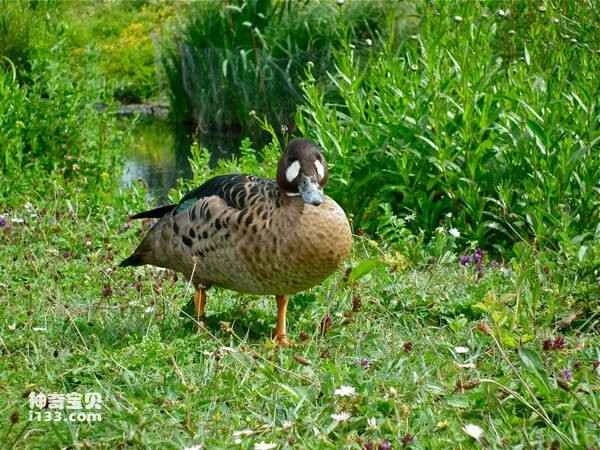
The Copper-winged Shelduck primarily floats on the water's surface, foraging underwater. Its diet consists mainly of plants, but it also occasionally consumes animal matter. While its toes are webbed, it rarely dives, keeping its tail above water when swimming. It is adept at foraging, playing, and courtship in the water. It is a clean animal, frequently preening its feathers both in the water and on land. It typically lives in pairs or small groups. Its diet consists of plant seeds, leaves, and the stems of aquatic plants, as well as some aquatic invertebrates.
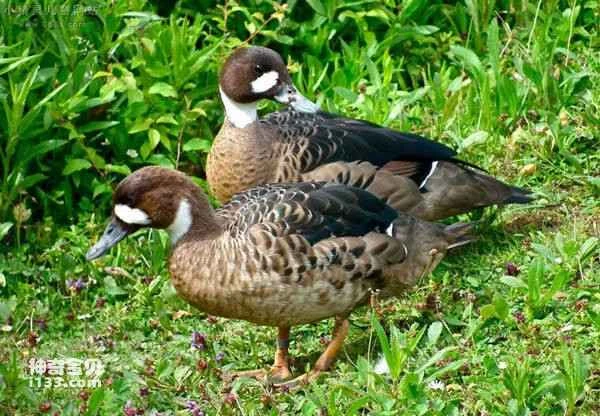
The Bronze-winged Teal breeds from September to October, with egg-laying peaking in October and November. They build a bowl-shaped nest using plant stems, placing it above nearby water and concealing it among aquatic plants. Each nest contains 4 to 8 eggs, with incubation lasting about 30 days. The female usually incubates the eggs alone, and continues to care for them after hatching, with the ducklings following her as they forage.
Listed as Near Threatened (NT) in the IUCN Red List of Threatened Species, 2009 ver 3.1.
Protect wild animals and ban the consumption of wild game.
Maintaining ecological balance is everyone's responsibility!