
Basic Information
Scientific classification
- Chinese name: Ring-necked Duck
- Scientific name: Callonetta leucophrys, Ringed Teal
- Classification: Waterfowl
- Family and genus: Anseriformes, Anatidae, *Rhododendron*
Vital signs data
- Body length: 35-38 cm
- Weight: 190-360g
- Lifespan: No verification data available.
Significant features
A wide black line runs from the top of the head to the back of the neck.
Distribution and Habitat
Distributed in Central America, between North and South America, including Guatemala, Belize, Honduras, El Salvador, Nicaragua, Costa Rica, Panama, the Bahamas, Cuba, Haiti, Jamaica, Dominican Republic, Antigua and Barbuda, Saint Vincent and the Grenadines, Saint Lucia, Barbados, Grenada, Trinidad and Tobago, and other countries and regions.
They inhabit tropical swamp forests and marsh clearings, and swim in wooded lowlands, as well as secluded streams and ponds.
Appearance
The Ring-necked Duck measures 35-38 cm in length and weighs 190-360 g. Males have brightly colored chestnut wings, light grey underparts, and a salmon-colored breast with black spots. A broad black stripe runs from the top of the head to the back of the neck. Females have olive-brown spotted wings, white stripes on the head and cheeks, and a pale breast and abdomen with markings. Both sexes have black tails, white rumps, distinctive white spots on the wings, grey bills, pink legs and feet, and brown irises.
Detailed introduction
The Ringed Teal (scientific name: Callonetta leucophrys) is a bird belonging to the family Anatidae in the order Anseriformes.

Ring-necked ducks forage by diving. Their diet consists mainly of insects and their larvae, worms, crustaceans, mollusks, small fish, frogs, tadpoles, and other freshwater and saltwater aquatic animals that they can utilize.
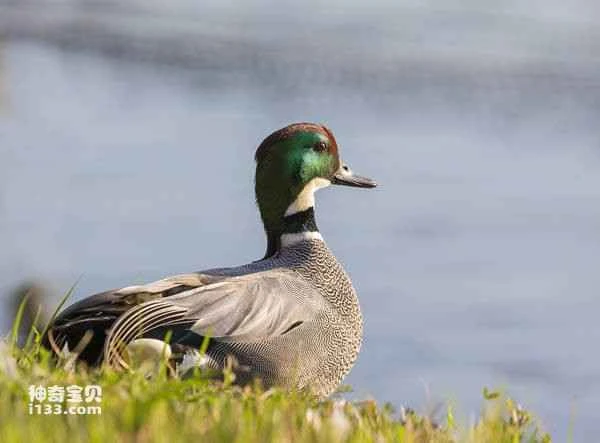
Ring-necked ducks typically breed in lakes, rivers, ponds, and marshes rich in aquatic life. They usually nest in natural tree cavities along the water's edge, laying 5 to 12 white eggs per clutch, with incubation lasting 23 to 26 days. During the initial incubation period, the female leaves the nest to forage in the morning and afternoon, covering the eggs with downy feathers before leaving. Later in incubation, she rarely leaves the nest or stays there at all. The chicks are precocial; the day after hatching, they can jump out of the tree cavity and enter the water independently to swim and dive.
Listed in the International Union for Conservation of Nature (IUCN) Red List of Birds, 2009 ver 3.1.
Protect wild animals and ban the consumption of wild game.
Maintaining ecological balance is everyone's responsibility!


