
Basic Information
Scientific classification
- Chinese name: Australian Greylag Goose
- Scientific name: Cape Barren Goose, Cereopsis novaehollandiae
- Classification: Waterfowl
- Family and genus: Anseriformes, Anatidae, Amur Grey Geese
Vital signs data
- Body length: 75-100 cm
- Weight: 4-5kg
- Lifespan: No verification data available.
Significant features
It is a large goose species from southern Australia.
Distribution and Habitat
Its distribution is limited to the southern coastal areas of Australia, including New Zealand, Tasmania and its nearby islands.
Appearance
The Australian Greylag Goose, measuring 75-100 cm in length, with a wingspan of 150-190 cm and weighing 4000-5000 grams, is a large goose. It has a robust, stocky body, with grey wings and black round spots. The tail and flight feathers are black, and the short, downward-curving black beak is almost entirely covered by a yellowish-green cere. The primary flight feathers and tail coverts are black. The legs are flesh-colored to reddish-brown, with a lowered hock, and the toes and feet are dark green. The iris is reddish-brown.
Young goslings resemble adult geese, but the black spots on their shoulders and wings are more pronounced. Their feathers are light and dull gray. Their legs are green or dark green. Their irises are slightly different, being grayish-brown.
The tarsal scales are shield-like; the male's trachea has an asymmetrical enlargement; the calls of the two are different, and their plumage and behavior are usually different as well; the mating relationship and family life are short-lived; they molt twice a year; the male often molts once for "erosion feathers" and once for bright nuptial feathers; the chicks' down feathers have obvious patterns; the female has a "teasing" performance.
Detailed introduction
The Australian Greylag Goose (scientific name: Cereopsis novaehollandiae), also known as the Cape Barren Goose, has two subspecies.
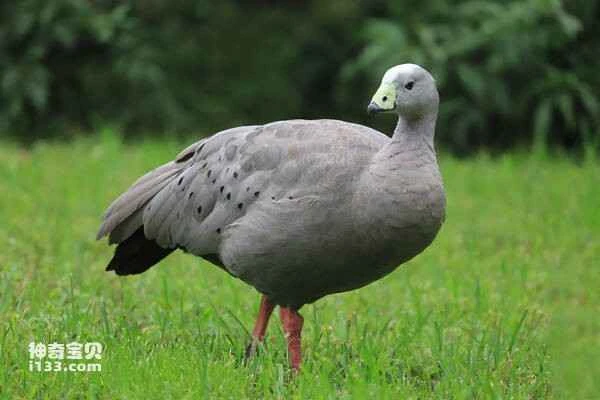
Australian greylag geese live in the Southern Hemisphere and generally live in small flocks, rarely exceeding 300 individuals. Although they frequent the coast, they rarely swim or play in the water. If danger threatens their goslings, like most other waterbirds, adult geese will feign injury or flap their wings to create noise and lure away predators.
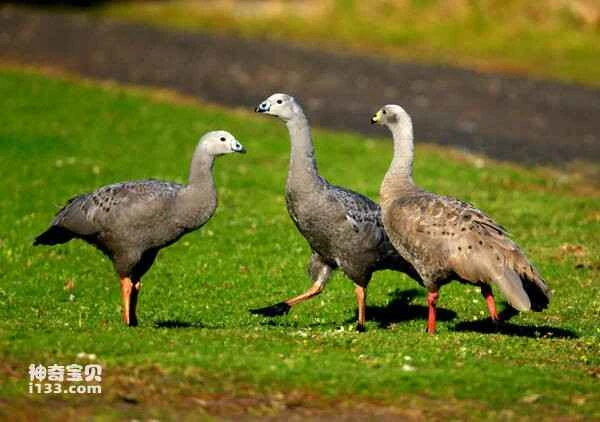
Australian Greylag Geese primarily inhabit shrublands during the breeding season; outside of the breeding season, they reside in open coastal grasslands. They live in pairs. They return to their breeding grounds around February and begin nesting in late May or early June, building nests on the ground using grass. Eggs are laid from late June to mid-July, with each clutch containing 4-5 white eggs. The female incubates the eggs, covering them with grass when she leaves the nest. The incubation period is approximately 35 days. The chicks stay with their parents for about a month and a half before forming their own flocks, sometimes reaching up to 200 birds.
Listed as Least Concern (LC) on the IUCN Red List of Threatened Species 2012 ver 3.1.
Protect wild animals and ban the consumption of wild game.
Maintaining ecological balance is everyone's responsibility!


