Basic Information
Scientific classification
- Chinese name: Pink-billed Duck
- Scientific name: Rosy-billed Pochard, Netta peposaca
- Classification: Waterfowl
- Family and genus: Anseriformes, Anatidae, Stenoptera
Vital signs data
- Body length: No verification information available.
- Weight: No verification information available.
- Lifespan: No verification data available.
Significant features
The male duck has a beautiful, bright red scutes located at the base of its bill. The size and color vary with the breeding season.
Distribution and Habitat
They are distributed in South America, including Colombia, Venezuela, Guyana, Suriname, Ecuador, Peru, Bolivia, Paraguay, Brazil, Chile, Argentina, Uruguay, and the Falkland Islands (also known as the Malvinas Islands).
The pink-billed pochard migrates to certain areas, inhabiting open freshwater lakes, slow-flowing rivers, and estuaries. It is also frequently seen in ponds along roadsides, especially in freshwater lakes with aquatic vegetation and deeper water. It is also occasionally seen in fishing areas with frequent human activity.
Appearance
The male Pink-billed Pochard has a beautiful red scute above the base of its bill. Its size and color vary with the breeding season. The male has a purplish head, a black neck, a black breast and back, fine black and white streaks on the belly and sides, and yellow to orange legs and feet. The female is almost entirely brown with dark feather coverts. She has a blue bill and orange-grey legs and feet.
Detailed introduction
The Rosy-billed Pochard (scientific name: Netta peposaca) is a bird belonging to the family Anatidae in the order Anseriformes.
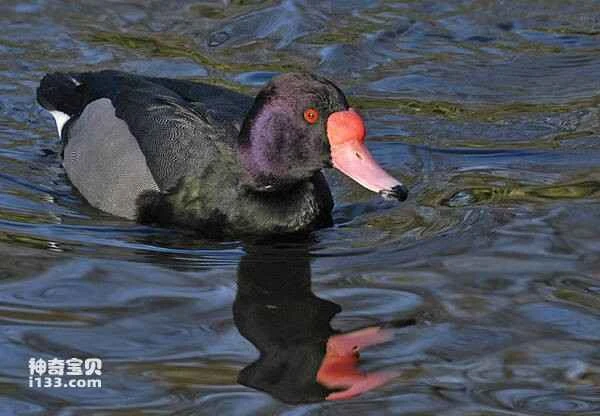
The pink-billed pochard is slow-witted but not particularly afraid of humans. It is not good at calling and usually lives in pairs or small groups, sometimes forming large flocks of hundreds. When resting, it often perches in groups on sandbars and islands in lakes with aquatic plants. Its flight is clumsy and slow.
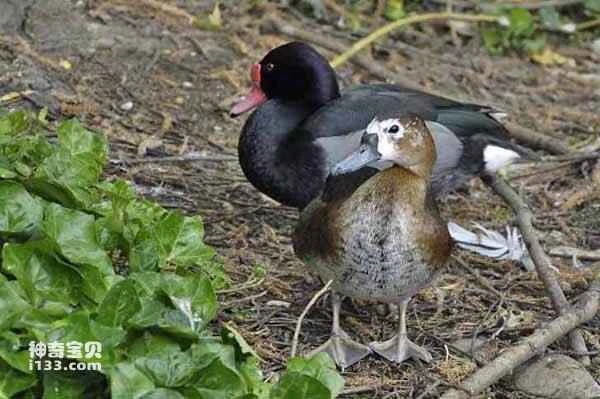
The breeding season for the Pink-billed Pochard is from April to June. They usually pair up while wintering in their habitat and begin nesting after arriving at their breeding grounds in mid-April. They typically nest on reed-covered islands in lakes, in grassy areas along the water's edge, and in dry reed beds, sometimes also in piles of dry reeds along the lakeshore. The nests are usually well-hidden. They are constructed from reed leaves and sedges, lined with soft grass and feathers. Each clutch contains 10-14 eggs, which are light gray. The incubation period is about 27 days. The female primarily incubates the eggs, but the male can also incubate them while the female is away foraging. Chicks hatch in early June.
Listed in the International Union for Conservation of Nature (IUCN) Red List of Birds, 2009 ver 3.1.
Protect wild animals and ban the consumption of wild game.
Maintaining ecological balance is everyone's responsibility!