Basic Information
Scientific classification
- Chinese name: Grey-billed Pochard
- Scientific name: Southern Pochard, Netta erythrophthalma
- Classification: Waterfowl
- Family and genus: Anseriformes, Anatidae, Stenoptera
Vital signs data
- Body length: 48-51 cm
- Weight: 763-799g
- Lifespan: No verification data available.
Significant features
With a round body, large head, and infrequent vocalizations, it is a deep-water bird.
Distribution and Habitat
Distributed in south-central Africa, including the southern Arabian Peninsula and the entire African continent south of the Sahara Desert (Tropic of Cancer). South America, including Colombia, Venezuela, Guyana, Suriname, Ecuador, Peru, Bolivia, Paraguay, Brazil, Chile, Argentina, Uruguay, and the Falkland Islands (also known as the Malvinas Islands).
They inhabit open freshwater lakes, slow-flowing rivers, and estuaries. They are also often found in ponds along roadsides, especially in freshwater lakes with aquatic plants and deeper water. They are also occasionally seen in fishing areas with frequent human activity.
Appearance
The Grey-billed Pochard measures 48-51 cm in length, with males weighing 799 grams and females 763 grams. The male has a black head and neck, predominantly black underparts, a chestnut face and upper neck, and richly chestnut wings. The upperparts and upperwings are dark brown with broad white edges. The outer primary and secondary flight feathers are brown. The flight feathers under the wing coverts are pale white. The female is similar but has darker markings, and her plumage is not as deep black as the male's. Her underparts are pale yellow with weak brown markings and lack white. The female's head is distinctive and striking, with a white stripe extending from the ear coverts to the back of the throat, and a white patch at the base of the beak on each side of the head.
Detailed introduction
The Southern Pochard (scientific name: Netta erythrophthalma) has two subspecies.
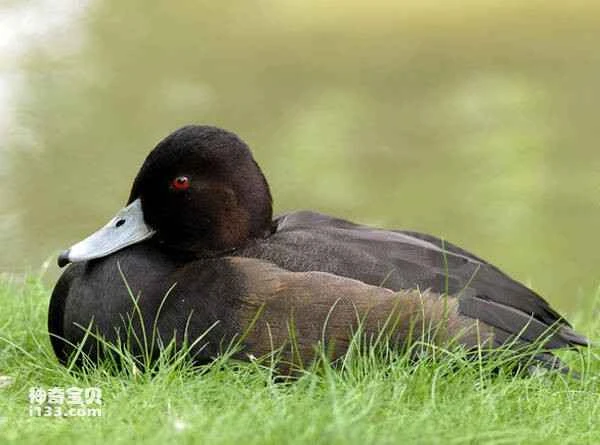
The Grey-billed Pochard is slow-witted but not particularly afraid of humans. It is not good at calling and usually lives in pairs or small groups, sometimes forming large flocks of hundreds. When resting, it often perches in groups on sandbars and islands in lakes with aquatic plants. Its flight is clumsy and slow.
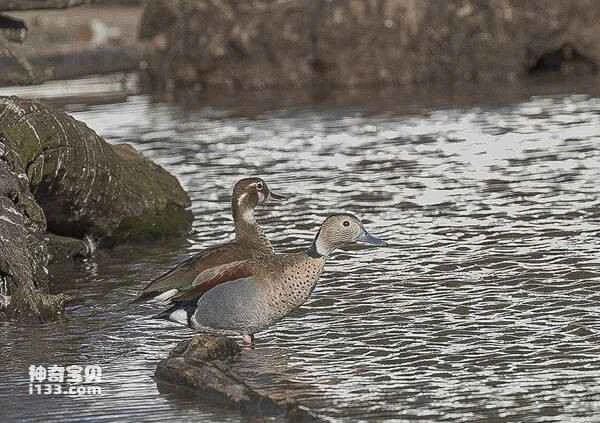
The Grey-billed Pochard breeds from April to June. They usually pair up in their wintering grounds and begin nesting after arriving at their breeding grounds in mid-April. They typically nest on reed-covered islands in lakes, in grassy areas along the water's edge, and in dry reed beds, sometimes also in piles of dry reeds along the lakeshore. The nests are usually well-hidden. The nest is constructed of reed leaves and sedges, lined with soft grass and feathers. Each clutch contains 6-15 eggs, which are light grey or pale green. Incubation lasts 26-28 days, primarily carried out by the female, but the male may also incubate the eggs while the female is away foraging. Chicks hatch in early June.
Listed in the International Union for Conservation of Nature (IUCN) Red List of Birds, 2009 ver 3.1.
Protect wild animals and ban the consumption of wild game.
Maintaining ecological balance is everyone's responsibility!