
Basic Information
Scientific classification
- Chinese name: Manewood Duck
- Scientific name: Australian Wood Duck, Chenonetta jubata, Australian Wood Duck
- Classification: Waterfowl
- Family: Anseriformes, family Anatidae, genus
Vital signs data
- Body length: 44-56 cm
- Weight: 800-815g
- Lifespan: No verification data available.
Significant features
It has a plump body, relatively long lower legs compared to other ducks, and a short, stout beak.
Distribution and Habitat
The Woodduck is found in Australia and Tasmania, with the largest population in the eastern region. Woodducks are often bred in parks and botanical gardens in Australia and are endemic to the country.
Origin: Australia. Migratory bird: New Zealand, Papua New Guinea.
They inhabit various types of water bodies such as rivers, lakes, ponds, estuaries, bays, and swamps, generally avoiding dense forest areas, and especially prefer to live on the edges of wetlands, swamps, or woodland marshes.
Appearance
The Chenonetta is 44-56 cm long with a wingspan of 78-80 cm. Males weigh 815 grams, and females weigh 800 grams. It is the sole member of the genus *Chenonetta*. The species is named for the mane-like appearance of the male's mane-like plumes that stand up on the back of its head during the breeding season.
The Wood Duck is plump and has relatively long legs compared to other ducks, with a short, stout beak. Sexes differ; the male has a tuft of dark brown feathers down the back of its neck, and in flight, black, gray, green, and white are visible under its wings. It has a spotted chest, light gray body feathers, and a black back, belly, and tail. Its beak is black, and its legs and feet are dark gray. The female has a gray head and neck, and white eye stripes above and below her eyes. She has a mottled chest. Overall, her color is grayish-brown. Her beak, legs, and feet are dark gray. On the gray wings, the male and female have black and white speculum, respectively. The beak color also differs; the male's is darker, almost black, while the female's is lighter, almost gray.
Detailed introduction
The Australian Wood Duck (scientific name: Chenonetta jubata) has no subspecies.
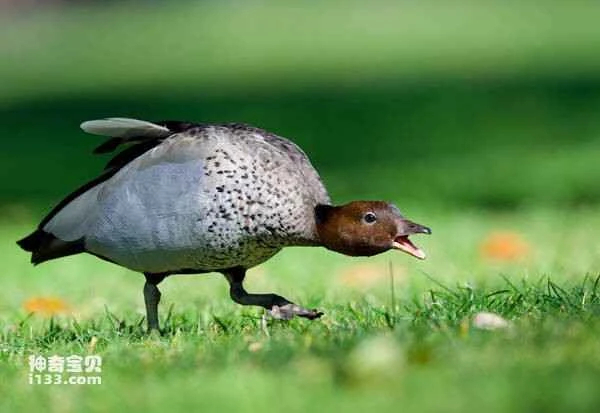
These ducks can be seen in many parks and grassy areas along rivers in Australia. They are gregarious animals, and you'll often spot them in large flocks, making them hard to miss. Moreover, these ducks are not afraid of people; they will immediately come over if someone offers them food, and they have a very harmonious relationship with humans.
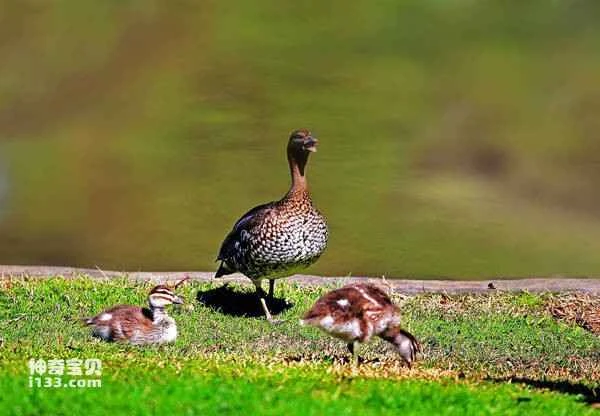
The Woody Duck's breeding season in the Northern Hemisphere begins in mid-April and can last until June. They typically nest along the banks of water in natural tree cavities in large trees, often reusing old nests, which can be used for many years if undisturbed or undamaged. The nest is lined with a small amount of sawdust and bark fibers. After laying eggs, the female plucks a large amount of down feathers and places them in the nest. Each clutch contains 8-12 cream-colored eggs. Incubation lasts 28-34 days. The ducklings are able to fly at 57 days old. Afterward, the parents usually continue to lead and feed the ducklings for another two weeks.
Listed as Least Concern (LC) on the IUCN Red List of Threatened Species 2013 ver 3.1.
Protect wild animals and ban the consumption of wild game.
Maintaining ecological balance is everyone's responsibility!


