Basic Information
Scientific classification
- Chinese name: White Grass Goose
- Scientific name: Chloephaga hybrida, Kelp Goose
- Classification: Waterfowl
- Family and genus: Anseriformes, Anatidae, Aperturei
Vital signs data
- Body length: 52-65 cm
- Weight: No verification information available.
- Lifespan: No verification data available.
Significant features
Adult male geese are almost entirely white with black beaks and orange legs and feet, while female geese have black feathers with bright white stripes.
Distribution and Habitat
They are distributed in South America, including Colombia, Venezuela, Guyana, Suriname, Ecuador, Peru, Bolivia, Paraguay, Brazil, Chile, Argentina, Uruguay, and the Falkland Islands (also known as the Malvinas Islands).
Appearance
White-tailed geese are 52–65 cm in length. Adult males are almost entirely white with a black beak and orange legs and feet. Females have black plumage with bright white stripes. The upper body, head, and neck are chocolate brown, the belly has large blackish-brown and white stripes, while the rump, tail feathers, and underwings are also white. The beak is pink, the legs are orange, and there is a thin white ring around the eyes.
Detailed introduction
The white-grass goose, scientifically known as *Chloephaga hybrida*, has two subspecies.
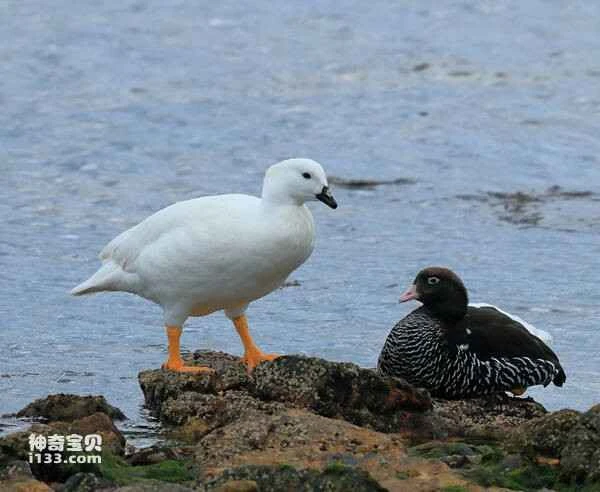
White-tailed Geese have a relatively small range, extending from southern Chile, through Tierra del Fuego to the southernmost tip of Argentina. They inhabit rocky or pebble areas along the coast, frequently venturing into nearby freshwater areas and coastal lagoons. They are primarily terrestrial, wary, and timid, easily frightened by humans, often flying away or swimming away at the sight of them. They forage along the coast, mainly feeding on green seaweed such as Ulva procumbens.
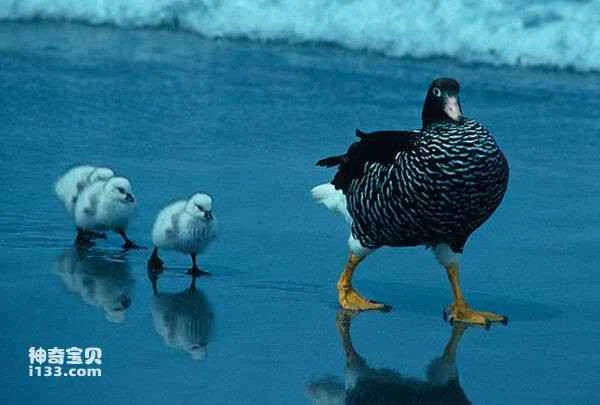
White-winged geese typically breed near the edges of lakes, rivers, ponds, and marshes. Egg-laying occurs from late October to early November. They usually nest in concealed grasses or bushes along the water's edge or on sandy beaches. After laying eggs, the female plucks a large amount of down feathers from her own body and places them in the nest. Each clutch contains 3-6 white eggs. The female incubates the eggs, while the male leaves shortly after the female begins incubation to molt in a lake or at sea. The incubation period is 30 days. In the early stages of incubation, the female leaves the nest in the morning and afternoon to forage, covering the eggs with down feathers before leaving. In the later stages of incubation, she rarely leaves the nest or stays there. The chicks are precocial; the day after hatching, they can jump from tree holes into the water to swim and dive. With the female's guidance, they can fly after 50-70 days. They reach sexual maturity at two years old.
Listed in the International Union for Conservation of Nature (IUCN) Red List of Birds, 2009 ver 3.1.
Protect wild animals and ban the consumption of wild game.
Maintaining ecological balance is everyone's responsibility!