
Basic Information
Scientific classification
- Chinese name: Yellow-throated bee-eater
- Scientific name: Merops apiaster, European Bee-eater
- Classification: Climbing birds
- Family and genus: Coraciiformes, Nematodae, Nematodae
Vital signs data
- Body length: 23-30 cm
- Weight: 50-60g
- Lifespan: No verification data available.
Significant features
Its most prominent feature is the bright yellow feathers on its throat.
Distribution and Habitat
Distributed in Afghanistan, Albania, Algeria, Angola, Armenia, Austria, Azerbaijan, Bahrain, Belarus, Belgium, Benin, Bosnia and Herzegovina, Botswana, Bulgaria, Burkina Faso, Burundi, Cameroon, Central African Republic, Chad, China, Democratic Republic of Congo, Ivory Coast, Croatia, Cyprus, Czech Republic, Denmark, Djibouti, Egypt, Eritrea, Ethiopia, Finland, France, Gabon, Gambia, Georgia, Germany, Ghana, Gibraltar, Greece, Guinea, Guinea-Bissau, Hungary, India, Islamic Republic of Iran, Iraq, Israel, Italy, Jordan, Kazakhstan, Kenya, Kuwait, Kyrgyzstan, Latvia. Lebanon, Lesotho, Liberia, Libya, Macedonia, Malawi, Mali, Mauritania, Moldova, Montenegro, Morocco, Mozambique, Namibia, Netherlands, Nigeria, Oman, Pakistan, Palestine, Poland, Portugal, Qatar, Romania, Rwanda, Saudi Arabia, Senegal, Serbia, Sierra Leone, Slovakia, Slovenia, Somalia, South Africa, South Sudan, Spain, Sri Lanka, Sudan, Swaziland, Sweden, Switzerland, Syrian Arab Republic, Tajikistan, United Republic of Tanzania, Togo, Tunisia, Turkey, Turkmenistan, Uganda, Ukraine, United Arab Emirates, United Kingdom, Uzbekistan, Western Sahara, Yemen, Zambia, Zimbabwe.
Migratory birds: Cape Verde, Estonia, Iceland, Ireland, Liechtenstein, Luxembourg, Madagascar, Maldives, Niger, Norway, Seychelles.
They breed in northwestern Africa and southern Europe, extending eastward to western Siberia, Central Asia, and northwestern India, and overwinter in India and Africa.
They mainly inhabit tree-lined cliffs, steep slopes, and river valleys at the foot of mountains and in open plains. In winter, they sometimes appear in plain forests, shrublands, and even reed marshes. They are active in open areas such as the foot of mountains, farmland, and around lakes.
Appearance
The Yellow-throated Bee-eater has a white to blue-green forehead connected to a thin supercilium; its crown and upper back are chestnut, with the shoulders being more yellowish-brown; its lower back is pale yellowish-chestnut; its rump is more green; its tail is blue-green with narrow blackish-brown to black feather tips. The lesser wing coverts are green, the middle and greater coverts are chestnut; the primary coverts and wing edges are pale blue-green; the base of the primary flight feathers is green, gradually turning blue, until the tips are black; the outer secondary flight feathers are chestnut with black tips; the inner secondary flight feathers are blue-green, but the underside of the inner feathers is pale chestnut. The lores and ear coverts are black, while the cheeks, chin, and throat are yellow, surrounded by a black semi-ring; the rest of the underparts are pale blue-green, the breast being the darkest and most intense, while the vent and undertail coverts are the least colored. The underwing coverts and axillaries are pale buff.
Juveniles have very little chestnut coloration on their heads and napes; their wings and shoulders are more grey; their cheeks and throat are a pale yellowish-brown, with a narrow, less distinct black band below them. The coloration below the breast is also paler than that of adults. Juveniles that have not yet left the nest are entirely green on their upper bodies, with only a slight yellowish-brown tinge on their shoulders.
Iris reddish-brown; mouth dark brown to black; feet dark brown.
The beak is slender, laterally compressed, and curved downwards. The wings are long and pointed. The tail is long with 12 tail feathers, square in shape, and the preen gland is bare. The bases of the fore toes are fused together, and the hind claw is shorter than the middle claw.
Size measurements: Weight ♂ 50-60 g; Body length ♂ 240-300 mm, ♀ 230-295 mm; Bill length 34-38 mm; Wing length ♂ 140-157 mm, ♀ 138-150 mm; Central tail feathers 98-117 mm; Outer tail feathers 88-90 mm; Tarsus length 12-13 mm. (Note: Male – ♂; Female – ♀)
Detailed introduction
The yellow-throated bee-eater, scientifically known as *Merops apiaster*, is also called the European Bee-eater and has no subspecies.
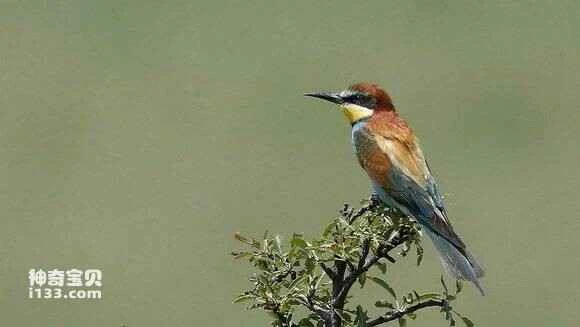
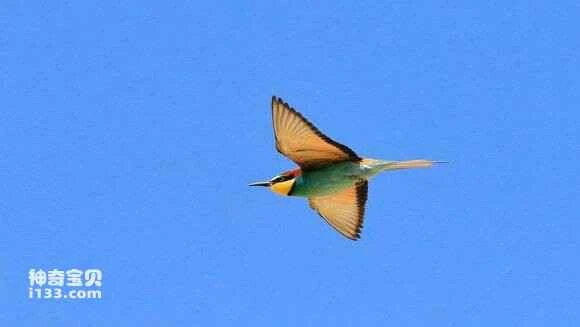
The Yellow-throated Bee-eater is a summer migratory bird. It arrives in April and leaves in September or October. They are often found in flocks. During the day, they spend most of their time flying, their flight straight and fast, with rapid wing flapping, sometimes accompanied by gliding. They are not afraid of people and sometimes enter villages, around houses, and in orchards. When resting, they often perch on power lines, dead branches, or bushes. They hunt in flight.

The yellow-throated bee-eater primarily feeds on various insects. It particularly favors bees, but its diet varies depending on location and season. Besides bees, it also preys on weevils, elm moths, horseflies, dragonflies, termites, butterflies, and other lepidopteran insects, as well as crustaceans. It often perches on branches or power lines, waiting patiently for insects to approach before swooping down to catch them. It also hunts in the air, sometimes while flying.

The Yellow-throated Bee-eater breeds from May to July. They usually breed in flocks, ranging from a few pairs to nearly a hundred pairs, rarely breeding alone. They typically nest on steep riverbanks, cliffs, and in valleys. The nest is tunnel-shaped, dug by both parents using their beaks, and the excavated soil is then shoveled back with their feet. The nest burrow is generally 0.5-1.5 meters long, sometimes reaching up to 2 meters. The burrow is 8-10 centimeters in diameter, widening at the end to form the egg-laying chamber, which is usually 15-20 centimeters in diameter and 12-15 centimeters high. Each nest burrow takes approximately 10-20 days to complete. The egg-laying chamber is unlined; the eggs are laid directly on the ground inside. They breed once a year, laying 4-8 eggs per clutch, occasionally up to 9 or 10, but usually 5-6. The eggs are white, measuring 24-29 mm × 20-23 mm. Both parents take turns incubating the eggs, with the female primarily incubating for approximately 20 days. The chicks are altricial, and both male and female parents raise them together.
Listed as Least Concern (LC) on the IUCN Red List of Threatened Species 2012 ver 3.1.
Protect wild animals and ban the consumption of wild game.
Maintaining ecological balance is everyone's responsibility!


