Basic Information
Scientific classification
- Chinese name: Black Rock Scorpion
- Scientific name: Urodacus manicatus
- Classification: Arthropoda
- Family and genus: Urodacidae Urodacus
Vital signs data
- Body length: Adults 45–65 mm
- Weight: Medium-sized scorpion; varies from individual to individual.
- Lifespan: Approximately 5–8 years (can be longer under suitable husbandry conditions)
Significant features
Nocturnal; hiding under rocks/dead trees; strong claws and mechanical subjugation; viviparous, young scorpions briefly live on their backs.
Distribution and Habitat
Rocky slopes, forest edges, and grasslands in southeastern Australia; mostly inhabits under rocks/dead wood or shallow burrows.
Appearance
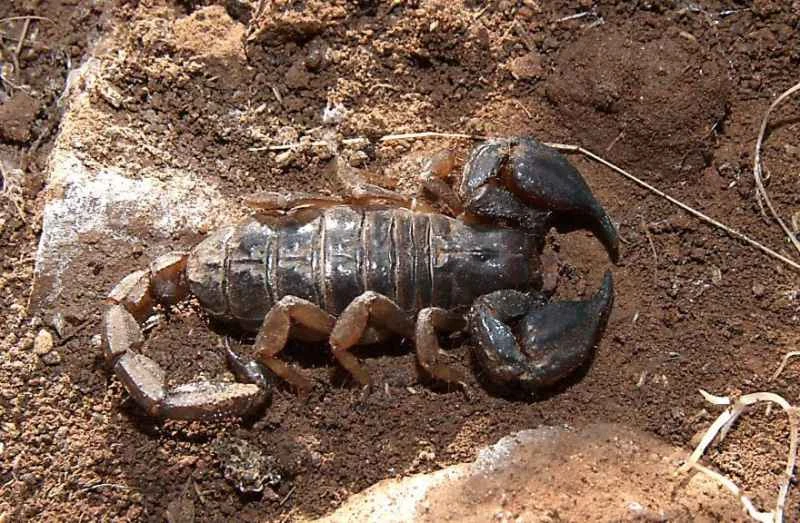
Dark brown to jet black; claws firmly attached to the body; stout tail segment with sharp venomous spines.
Detailed introduction
The Black Rock Scorpion ( Urodacus manicatus ; Black Rock Scorpion) belongs to the Urodaceae family and is a common medium-sized scorpion in southeastern Australia. It is known for its strong claws and its predatory hunting methods that rely on mechanical subjugation . It usually hides under rocks, dead wood, or in shallow burrows and hunts small arthropods at night.
Ecology and Biology
Daily routine: Nocturnal , hiding under rocks or digging shallow caves during the day to avoid heat and enemies.
Diet: It preys on insects, centipedes, spiders, etc.; it usually uses its chelicerae to clamp down on prey and supplements it with its tail stinger.
Reproduction: viviparous ; after birth, scorpion larvae climb onto their mother's back, molt after a few days, and then disperse to become independent.
Morphology and Recognition
Body length: 45–65 mm for adults (individual/regional variation).
Body color: Overall dark brown to jet black , with sturdy claws and body; the tail segment is relatively thick and the venomous stinger is sharp.
Characteristics: Well- developed chelicerae (strong pincers), its toxicity is lower to moderate compared to some "fine-chelicered and highly venomous" groups.
Distribution and Habitat
Native to southeastern Australia (New South Wales, Victoria, South Australia, Australian Capital Territory, etc.), it is often found on rocky slopes, woodland edges, grasslands and farmlands ; it prefers to live at the bottom of rocks, under dead wood and leaf litter , or by digging shallow burrows.
Humanity and Safety
Medical significance: Generally low to moderate for humans; stings cause severe pain and short-term redness/tingling, but rarely serious systemic symptoms.
Treatment recommendations: Wash with soap and water , apply cold compresses and rest after stinging; if an allergic reaction or persistent severe pain occurs, seek medical attention as soon as possible.
IUCN: Not evaluated (NE) .
Frequently Asked Questions
Q1: Is the black rock scorpion "fatal"? It is usually not fatal to adults; it mainly causes localized severe pain and swelling.
Q2: Where can I find it during the day? It is often found under rocks/dead trees or in shallow burrows. Avoid turning over rocks to prevent being stung and damaging its micro-habitat.
Q3: Can I keep them? You must comply with local regulations; you need to provide dry substrate, a sanctuary and shallow water , and avoid handling them with bare hands.
Q4: How to distinguish it from the "fine-clawed, highly venomous" scorpion? The black rock scorpion has large and powerful claws and relatively mild venom; many highly venomous scorpions have fine claws and more developed stingers .