
Basic Information
Scientific classification
- Chinese name: Upturned-nosed Muscovy Duck
- Scientific name: Common Shelduck, Common Shelduck, Common Shelduck
- Classification: Waterfowl
- Family: Anseriformes, Anatidae, Anatidae
Vital signs data
- Body length: 52-63 cm
- Weight: 500-1750g
- Lifespan: Approximately 16 years
Significant features
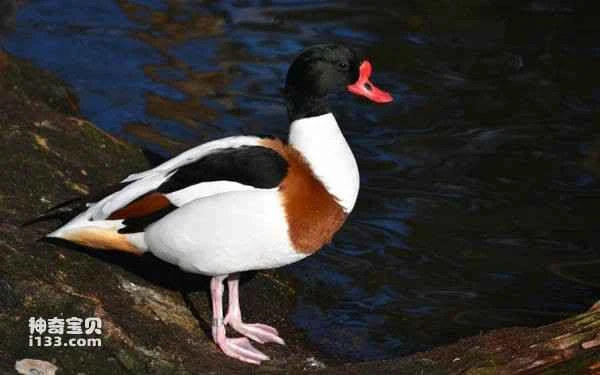
The body feathers are mostly white, the head and upper neck are black with a green sheen, and the beak is upturned and red.
Distribution and Habitat
Country of origin: Afghanistan, Albania, Algeria, Armenia, Austria, Azerbaijan, Bangladesh, Belarus, Belgium, Bhutan, Bosnia and Herzegovina, Bulgaria, China, Croatia, Cyprus, Czech Republic, Denmark, Egypt, Estonia, Finland, France, Germany, Greece, Hong Kong, Hungary, Iceland, India, Islamic Republic of Iran, Iraq, Ireland, Israel, Italy, Japan, Jordan, Kazakhstan, South Korea, North Korea, Kuwait, Kyrgyzstan, Latvia, Lebanon, Libya, Lithuania, Macedonia, Malta, Moldova, Mongolia, Montenegro, Morocco, Netherlands, Norway, Oman, Pakistan, Palestine, Poland, Portugal, Qatar, Romania, Saudi Arabia, Serbia, Slovakia, Slovenia, Spain (Canary Islands), Sweden, Switzerland, Syrian Arab Republic, Tajikistan, Tunisia, Turkey, Turkmenistan, Ukraine, United Arab Emirates, United Kingdom, Uzbekistan, Yemen.
Migratory birds: Bahrain, Ethiopia, Ghana, Gibraltar, Guinea-Bissau, Lao People's Democratic Republic, Liechtenstein, Luxembourg, Mauritania, Myanmar, Nepal, Philippines, Senegal, Sudan, Thailand, Vietnam.
It is distributed in Heilongjiang, Jilin, Inner Mongolia, Gansu, Qinghai and Xinjiang in China.
It inhabits various habitats including rivers, lakes, estuaries, ponds, and nearby grasslands, wastelands, swamps, beaches, farmlands, and sparse forests on plains, with a particular preference for lake areas on plains. It mainly lives in inland freshwater, but is sometimes also found on coastal beaches, in saltwater lake areas, and in open grasslands far from water bodies.
Appearance
The male Muscovy duck has a blackish-brown head and upper neck with a green sheen; the lower neck, back, rump, tail coverts, and tail feathers are all white, with black bars on the tail feathers. The scapulars and primary flight feathers are blackish-brown, while the outer webs of the secondary flight feathers are metallic green, forming a distinct green speculum on the wings; the outer webs of the tertiaries are chestnut, and the wing coverts are white; a broad chestnut band runs from the upper back to the breast; a blackish-brown longitudinal band runs along the center of the chestnut band on the breast, extending posteriorly through the abdomen to the vent; the undertail coverts are brownish-white, and the rest of the underparts are white. The bill is bright red, with a prominent red dermal tubercle at the base of the upper bill during the breeding season. The female's plumage is slightly paler than the male's. The head and neck lack the green metallic sheen; there is a small white spot on the forehead; the chestnut-brown breast band is narrow and pale; the black longitudinal band on the abdomen is also not very distinct; there is no dermal tubercle at the base of the bill. The iris is brownish-brown or brown; the bill is bright red or purplish-red; the legs are flesh-red or pink; and the claws are black.
Size measurements: Weight: ♂ 500-1750 g, ♀ 620-1200 g; Wings: ♂ 306-339 mm, ♀ 270-308 mm; Tail: ♂ 98-136 mm, ♀ 95-117 mm; Tarsus: ♂ 50-65 mm, ♀ 44-54 mm. (Note: ♂ male; ♀ female)
Detailed introduction
The Common Shelduck (scientific name: *Tadorna tadorna*) is a large duck species with no subspecies.
In early March, Muscovy ducks begin to leave their wintering grounds and migrate to their northern breeding grounds. They arrive at their breeding grounds in Northeast China between early and mid-April, and in their Northwest breeding grounds between late April and early May. In autumn, they begin leaving their breeding grounds for their wintering grounds in late September, arriving in their southern wintering grounds between late October and early November. During migration, they often form family groups or small flocks, mainly following the coast and rivers, stopping frequently to rest and forage. In particular, the Shuangtaizi River estuary area in Liaoning Province sees thousands of Muscovy ducks migrating through and stopping for extended periods each spring and autumn.
The Muscovy duck mainly feeds on animal foods such as aquatic insects, insect larvae, algae, mollusks, snails, oysters, sea snails, sandworms, leeches, lizards, locusts, crustaceans, terrestrial insects, small fish, and fish eggs. It also eats plant foods such as plant leaves, buds, and seeds.
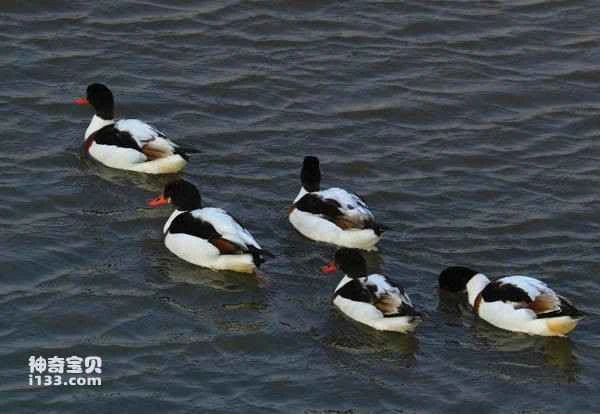
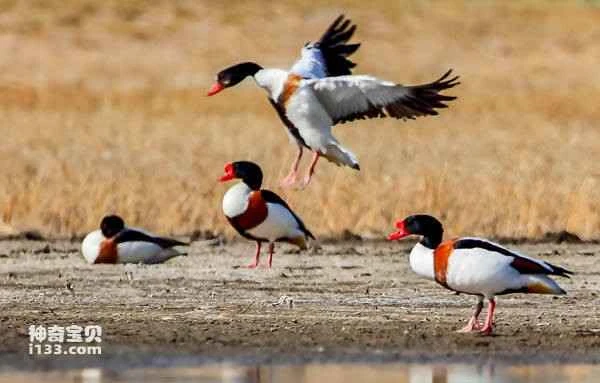
Muscovy ducks prefer to live in flocks, especially in winter, often forming large groups of dozens to hundreds. During the breeding season, they live in pairs. They fly quickly, flapping their wings rapidly. They are good swimmers and divers, and also walk well, able to run nimbly on the ground. They are alert, constantly stretching their necks to look around, and will take flight from a hundred meters away from people.
The Muscovy duck reaches sexual maturity at two years of age. Pairing usually occurs in the wintering grounds, but can also happen during migration or after reaching the breeding grounds. Mating takes place in water, but sometimes also on land. The breeding season is from May to July. Nests are built on sand dunes or rock faces along coastlines and lakeshores, and sometimes in natural burrows in open grasslands or abandoned burrows of animals such as foxes and rabbits. Some burrows are up to 4 meters deep. The nest is disc-shaped, mostly constructed of grasses, reeds, bird bones, and fish bones, and lined with abundant down feathers. The nest is 8 cm high, 6 cm deep, with an inner diameter of 17.5 cm and an outer diameter of 26 cm. Each clutch contains 7-12 eggs, usually 8-10. The eggs are oval, pale yellow or creamy white, measuring 62-70 mm × 42-51 mm, and weighing 69-78 grams. Typically, the female lays one egg per day. After laying the last egg, she begins incubation, a task undertaken solely by the female. The male guards the nest, immediately issuing an alarm call and flying back to the nest if danger is detected. When the female leaves the nest to forage each day, she usually covers the eggs with her down feathers, even when incubating in relatively deep burrows. During the last two days of incubation, the female remains in the nest, which lasts 27-29 days. The chicks are precocial, becoming active soon after hatching and emerging independently from the nest to enter the water under the guidance of their parents. After a little over a month, the chicks are capable of flight but remain with their parents until the following spring.
The Muscovy duck has always had a rich population in China and is one of the country's main hunting targets. However, no specific surveys have been conducted on their population size in the past. According to the Asian waterbird survey organized by the International Waterfowl Research Bureau in 1990, there were 19,188 in China, 475 in Japan, 177 in South Korea, 359 in Bangladesh, 656 in India, and 416 in Pakistan, totaling approximately 25,000 in Asia. The figure for Europe was 130,000. The global population was approximately 150,000.
In October 2020, the National Forestry and Grassland Administration issued the "Notice on Regulating the Scope of Classified Management of Wild Animals Prohibited for Consumption," which prohibits the breeding of these animals for consumption purposes and guides farmers to cease breeding, except in special circumstances such as reserving a suitable amount of breeding stock.
Listed as Least Concern (LC) on the IUCN Red List of Threatened Species 2016 ver 3.1.
It is listed in the "List of Terrestrial Wild Animals of Beneficial or Important Economic and Scientific Research Value under State Protection" issued by the State Forestry Administration of China on August 1, 2000.
Protect wild animals and ban the consumption of wild game.
Maintaining ecological balance is everyone's responsibility!


