Basic Information
Scientific classification
- Chinese name: Green Woodpecker with Flower-shaped Belly
- Scientific name: Red-bellied Woodpecker, Picus vittatus, Scaly-bellied Green Woodpecker, Laced woodpecker
- Classification: Climbing birds
- Classification: Order Versiformes, Family Woodpeckers, Genus *Leptochloa*
Vital signs data
- Body length: Approximately 30 centimeters
- Weight: No verification information available.
- Lifespan: No verification data available.
Significant features
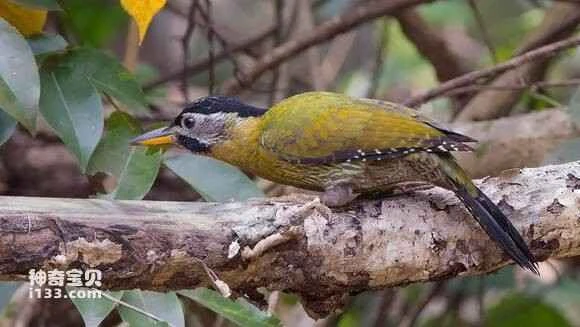
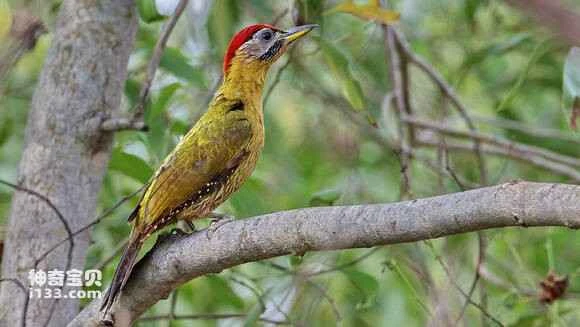
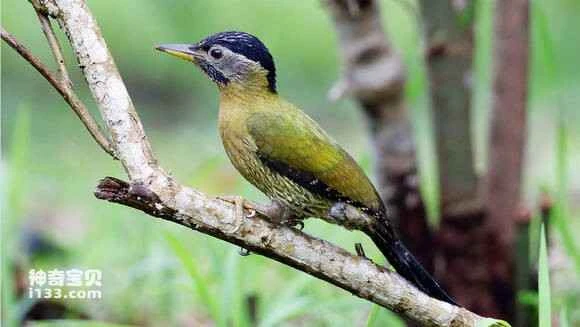
The forehead, top of the head, and nape are bright red; the back of the neck and sides of the neck are greenish-yellow; the upper body is mostly green; the lower body is also mostly green, and the abdomen has U-shaped scale-like markings.
Distribution and Habitat
In my country, it is only found in Xishuangbanna, southern Yunnan. Abroad, it is distributed in Myanmar, Thailand, the Malay Peninsula, Indonesia, and the Indochina Peninsula.
They inhabit the foothills and low-altitude tropical rainforests. Their diet consists of insects. They nest in tree trunks or large branches.
Appearance
The adult male has a bright red forehead, crown, and back of the head; dark brown lores; greyish-white supercilium; greyish-brown ear coverts; black malar stripe with white markings; greenish-yellow nape and sides; dark olive green upper back, shoulders, and upper wing surface, the same color as the lower back and undertail coverts but more yellow; black primary flight feathers with a series of white spots on the outer vanes; pure black tail feathers, with brownish-white transverse bars at the base of the inner vanes of the central tail feathers. The chin and throat are leathery yellow, the breast is tinged with green, all solid colors without spots; the belly is pale green, covered with blackish-brown scaly spots; the undertail coverts turn blackish-brown with white spots.
Iris red; upper mandible black, lower mandible brownish-gray; tarsus dark brown.
Detailed introduction
The Scaly-bellied Green Woodpecker, scientifically known as *Picus vittatus*, is also called the Laced Woodpecker. It has four subspecies, but only one subspecies exists in my country.
The Green Woodpecker is rare; it feeds on pests and is beneficial to humans, so it should be protected.
Protect wild animals and ban the consumption of wild game.
Maintaining ecological balance is everyone's responsibility!