
Basic Information
Scientific classification
- Chinese name: Scale-throated Green Woodpecker
- Scientific name: Scaly-throated Woodpecker, *Picus xanthopygaeus*
- Classification: Climbing birds
- Classification: Order Versiformes, Family Woodpeckers, Genus *Leptochloa*
Vital signs data
- Body length: No verification information available.
- Weight: No verification information available.
- Lifespan: No verification data available.
Significant features
Distribution and Habitat
The Scaled-throated Green Woodpecker is found in the Himalayas, India, southwestern China, and Southeast Asia. It is a very rare resident bird in the open lowland forests of western Yunnan, China.
The Scaled-throated Green Woodpecker primarily inhabits open forests in low mountains and foothill plains below 1500 meters in altitude, and also appears in bamboo groves, orchards, and secondary forests. It is usually solitary in trees, but also frequently ventures to the ground to forage. It inhabits open birch and bamboo forests in mountainous areas.
Appearance
Adult male: Red crown, sometimes with orange tips on the back feathers, and black protrusion on the nape; back and upper wing coverts grass-green, sometimes tinged with yellow, sometimes more olive; rump bright yellow, rarely tinged with orange; primary flight feathers dark brown, with white spots at the base of the outer and inner vanes; innermost secondary flight feathers tinged with dark green with indistinct greenish-yellow transverse bars, the outer flight feathers gradually becoming the same color as the primary flight feathers; tail feathers greenish-brown with indistinct white spots at the base, the outermost tail feathers light brown, the entire plumage with relatively broad markings; a white supercilium from the eye to the nape, above which is a black stripe; lores dark yellowish-white; ear coverts pale grayish-brown with whitish longitudinal stripes; cheeks grayish-white with indistinct black longitudinal stripes; chin and throat yellowish-gray with white longitudinal stripes; foreneck and breast more green with indistinct dark scaly markings; flanks and undertail coverts pale greenish-yellow with broad black scaly markings. Underparts exhibit greater variation in plumage.
Adult female: Similar to the male, but with a black crown and darker brownish plumage on the sides of the head.
The iris is red with a pink outer ring; the corners of the mouth are yellow, and the upper lip is darker and browner; the tarsus is olive green or olive gray.
Size measurements: Body length 280-300 mm; bill 25-30 mm; wing 120-130 mm; tail 83-93 mm; tarsus 25-26 mm.
Detailed introduction
The Scaly-throated Woodpecker, scientifically known as *Picus xanthopygaeus*, has no subspecies.
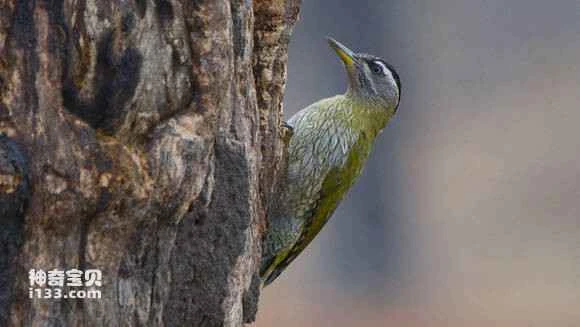
The scaly-throated green woodpecker is mostly found on the ground. It primarily feeds on animal matter such as ants and insects. A climbing bird, the woodpecker has two toes pointing forward and two pointing backward, each with sharp claws, adapted for gripping trees. Its tail feathers are stiff and straight, allowing it to brace itself against the tree trunk and support its weight. Therefore, the woodpecker can not only climb trees but sometimes even climb by circling the trunk. During its climb, the woodpecker rapidly taps the wood with its strong, chisel-like beak, producing a "tap! tap! tap!" sound. If it finds an insect in a part of the trunk, the woodpecker clings tightly to the tree, pecks open the bark with its beak, and uses its long, hooked tongue to hook out and eat the insect.
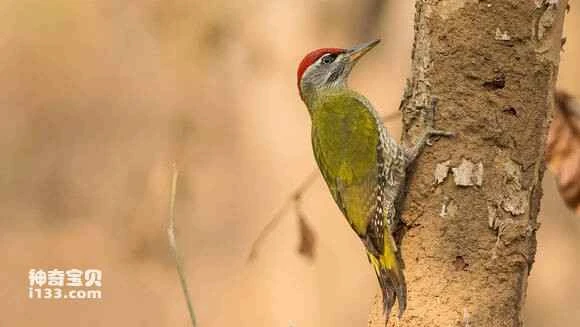
The breeding season for the Scaled-throated Green Woodpecker is from April to June. They nest in tree cavities. Each clutch contains 3-5 white, oval eggs, measuring 26-27 mm × 20-21 mm.
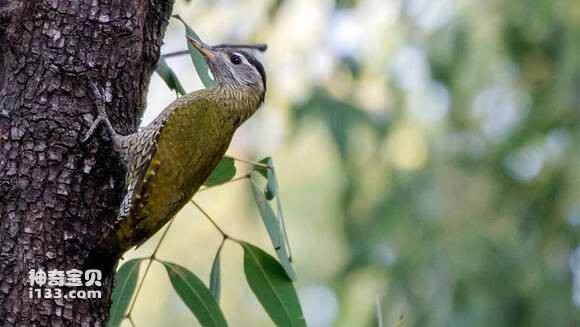
Listed as Least Concern (LC) on the IUCN Red List of Threatened Species 2012 ver3.1.
Protect wild animals and ban the consumption of wild game.
Maintaining ecological balance is everyone's responsibility!


