Basic Information
Scientific classification
- Chinese name: Scorpion
- Scientific name: Scorpiones (scorpiones)
- Classification: Arthropoda
- Family and genus: Scorpions
Vital signs data
- Body length: Most scorpions are about 2.5–12 cm in length, with a few large species exceeding 20 cm.
- Weight: ranges from a few grams to tens of grams, depending on the species and individual size.
- Lifespan: Most species can live 2–8 years, while larger species can live over 10–20 years under captive conditions.
Significant features
It possesses a pair of large chelicerae and a segmented tail with venomous stingers; it is a nocturnal predator; it can fluoresce under ultraviolet light; and it is one of the oldest terrestrial arachnid groups.
Distribution and Habitat
They are found almost all over the world except Antarctica, ranging from deserts and grasslands to forests, farmlands and areas surrounding human settlements, with the highest biodiversity in warm and dry regions.
Appearance
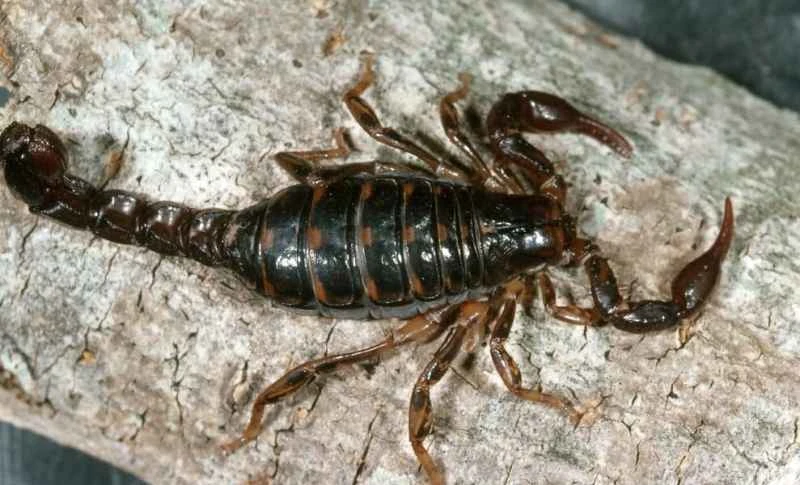
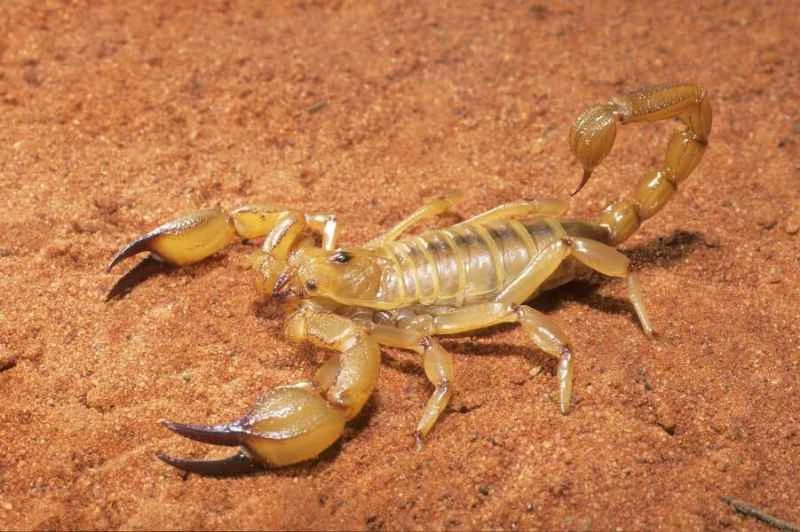
The body consists of a cephalothorax, anterior abdomen, and posterior abdomen (tail), with a venomous stinger at the end; the body color is mostly yellowish-brown, brown, or black, adapted for camouflage in arid and rocky environments.
Detailed introduction
Scorpions belong to the order Scorpiones within the class Arachnida of the phylum Arthropoda. They are among the oldest terrestrial predators, with a fossil record dating back over 400 million years. They are known for their well-developed chelicerae, segmented "tails," and venomous stingers at the end, making them dominant small predators in many arid and nocturnal ecosystems.
Basic Information
Taxonomic classification: Phylum Arthropoda → Class Arachnida → Order Scorpiones
Species diversity: More than 2,500 species have been described, and new species are constantly being discovered.
Size range: Most scorpions are about 2.5–12 cm long, while a few large species can exceed 20 cm.
Lifespan: Most wild species can live for 2–8 years, while some large species can live for more than 10–20 years in captivity.
Appearance and morphological characteristics
The scorpion's body consists of three main parts: the cephalothorax, the anterior abdomen, and the posterior abdomen (tail).
Chelicerae (Tentacles): The pair of large chelicerae at the front resemble "pincers" and are used to clamp and tear prey, as well as to dig and defend themselves;
Legs: There are four pairs of legs, used for walking and climbing;
"Tail": It is actually composed of five posterior abdominal segments and the terminal venom gland segment (venom needle segment), which can be raised forward or quickly flicked to stab;
Stinger: A spiky structure located at the end of the tail, connected to a venom gland, which can inject venom into prey or enemies.
Most scorpions are predominantly yellowish-brown, sandy brown, brown, or black , adapted for camouflage in desert or rocky environments. Under ultraviolet (UV) light, their bodies fluoresce , displaying a blue-green or yellowish-green glow, one of their most well-known characteristics.
Distribution and Habitat
Scorpions are found on almost every continent except Antarctica , from tropical rainforests to arid deserts, but their species diversity is highest in warm, dry regions.
Typical habitats include:
Sandy, gravelly, and rocky crevices in desert and semi-desert regions;
Grasslands, savannas, and rocky mountains;
The ground surface and leaf litter layer of tropical or subtropical forests;
Farmland, village edges, piles of stones and logs near houses, and cracks in walls, etc.
Lifestyle and Diet
Most scorpions are nocturnal predators , hiding under rocks, in burrows, or in crevices of tree bark during the day and coming out to hunt at night. They primarily feed on:
Insects (cockroaches, crickets, beetles, etc.);
Other arachnids (spiders, centipedes, etc.);
Small lizards, young frogs, or other small vertebrates (large scorpion species).
Scorpions use their keen sensory organs (such as the comb-like structures on their abdomen) and highly developed chelicerae to sense ground vibrations and chemical signals, quickly pinpointing the location of their prey.
Toxicity and its effects on humans
Scorpion venom is primarily used for hunting and defense. The toxicity varies greatly among different species.
Most scorpion species are only as venomous as bee stings or slightly stronger to humans, and the main symptoms after a sting are local pain, redness, swelling and temporary discomfort.
A few species are of high medical importance (mainly distributed in parts of North Africa, the Middle East, South Asia, and Central and South America). The neurotoxins in their venom can cause severe pain, muscle spasms, difficulty breathing, and even death, requiring timely medical intervention and antitoxin treatment.
Overall, only a small percentage of known scorpion species pose a long-term fatal threat to healthy adults. However, children, the elderly, and those with underlying health conditions should remain highly vigilant against stings from highly venomous scorpions.
Relationship with humans
In human culture, scorpions are often seen as symbols of the desert, nocturnal activity, and mystery, appearing in many myths, constellations, and traditional patterns. Modern scientific research focuses on the bioactive peptides and proteins in scorpion venom, exploring their potential applications in painkillers, anti-tumor drugs, insecticides, or neuroscience research.
In daily life, basic methods to prevent scorpion stings include:
In areas with a high scorpion population, wear closed shoes and avoid going barefoot when going out at night;
Clear away clutter inside and outside the house to reduce the hiding places under stones and planks;
Before using your sleeping bag at a hotel or campsite, check your shoes, clothing, and sleeping bag to ensure no scorpions are hiding inside.
References
MS Harvey & AL Yen. 1989. From Worms to Wasps: An Illustrated Guide to Terrestrial Invertebrates of Australia. Oxford University Press: Melbourne.
LE Koch. 1977. Classification, geographical distribution and evolutionary radiation of Australian-Papuan scorpions, Western Australian Museum Records: 5(2).
A. Locket. 1994. Nightcrawler. Australian Natural History 24(9): 54-9.
Scorpion. Western Australian Museum brochure.
Scorpions, centipedes, and millipedes. Queensland Museum brochure.
P. Lawless. 1998. "Look, what light is this…", *Australian Wildlife Magazine*, Winter Issue. [Article about scorpion bioluminescence]
Frequently Asked Questions
Q1: How many species of scorpions are there in the world?
More than 2,500 species of scorpions have been described, and new species are constantly being discovered.
They are extremely diverse in terms of size, color, toxicity, and living environment.
Q2: Are all scorpions dangerous?
No. The vast majority of scorpion stings only cause localized pain and swelling.
Only a few highly toxic species pose a serious threat to humans, mainly concentrated in certain specific regions.
Q3: Why do scorpions glow under ultraviolet light?
The cuticle layer on the surface of a scorpion's body contains a substance that can produce fluorescence, emitting blue-green or yellow-green light under ultraviolet light.
The specific biological significance is not yet fully understood, but this phenomenon is often used to investigate scorpions at night.
Q4: What should I do if I get stung by a scorpion?
Try to remain calm, clean the wound, and avoid cutting or sucking out the venom yourself.
If the pain is severe, accompanied by difficulty breathing, palpitations, or if a child has been stung, seek immediate medical attention.
And, if it is safe to do so, record or photograph the scorpion's appearance for the doctor's reference.