Basic Information
Scientific classification
- Chinese name: Flat-billed Mountain Toucan
- Scientific name: Plate-billed Mountain Toucan, Plain-billed mountain-toucan, Laminated mountain-toucan, Laminated hill-toucan
- Classification: Climbing birds
- Family and genus: Toucanidae, order Toucanidae, genus Toucan
Vital signs data
- Body length: No verification information available.
- Weight: No verification information available.
- Lifespan: No verification data available.
Significant features
The flat-billed toucan has a raised pale yellow spot on the upper side of its reddish-black beak.
Distribution and Habitat
The flat-billed toucan inhabits damp forests and feeds on fruits, insects, and small animals. It is distributed across South America (including Colombia, Venezuela, Guyana, Suriname, Ecuador, Peru, Bolivia, Paraguay, Brazil, Chile, Argentina, Uruguay, and the Falkland Islands).
The Mountain Toucan inhabits the humid forests and temperate forest edges of the Andean slopes. These humid forests are rich in epiphytes and mosses. They receive an average annual rainfall of 14 feet and have canopies ranging from 6 to 10 meters in height. Their habitat ranges from 1600 to 2600 meters in altitude, and they have also been observed multiple times at 3100 meters in Imbabura, Ecuador. Due to this altitudinal range, the Mountain Toucan shares its habitat with the Andean Rock Rooster, with an estimated area of 14,300 square kilometers.
Appearance
The Flat-billed Mountain Toucan is a medium-sized climbing bird, somewhat resembling a hornbill in appearance. It has an extremely large beak, but is relatively lightweight, with the beak accounting for one-third of its body length. The beak has serrated edges, resembling a knife. The beak is black with a bright golden-yellow patch at the base. Its plumage is predominantly black, with a blue chest and abdomen. Its contrasting colors, combined with the golden-yellow plumage below its eyes and a touch of red on the tip of its tail, create a harmonious and colorfully beautiful picture.
They have reddish-brown irises, with yellow below the exposed eye area and turquoise above.
Despite its large beak, this bird weighs less than 30 grams. Its beak structure is unique; it's not a dense solid but rather has a thin outer shell with extremely fine fibers running through it. The porous, sponge-like tissue is filled with air, so it feels no pressure whatsoever.
Detailed introduction
The Flat-billed Mountain Toucan, scientifically known as *Andigena laminirostris*, is a medium-sized climbing bird.

The Flat-billed Toucan is a gregarious bird that prefers to perch in the treetops; it is also one of the noisiest forest birds, capable of producing loud rumbling sounds, horn-like calls, and piercing screeches. Its nest is built high in tree cavities. When eating, it first pecks at its food with the tip of its beak, then tilts its neck back, tosses the food upwards, and then opens its large beak to accurately swallow the food, avoiding the time spent swallowing through its long beak. This bird is omnivorous, feeding on fruits, seeds, and insects, and sometimes raids nests of smaller birds, eating the eggs and chicks.

The breeding season for the Flat-billed Toucan runs from March to October, peaking from May to August. They nest in tree cavities about 30 meters above the ground. They lay 2-3 white eggs, which incubate for about 16 days, and the chicks mature in 46 to 60 days. Once the chicks leave, the pair may begin raising a second batch.
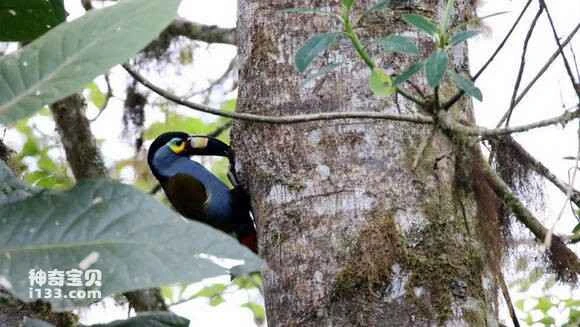
The Flat-billed Mountain Toucan is one of two threatened species of mountain toucans. Although still a fairly common species, it is listed as Near Threatened by the IUCN due to habitat loss from deforestation and declining numbers. They are also poached for the bird trade. The Flat-billed Mountain Toucan is the flagship bird of the La Planada Nature Reserve in Colombia.
Protect wild animals and ban the consumption of wild game.
Maintaining ecological balance is everyone's responsibility!