Basic Information
Scientific classification
- Chinese name: Thresher shark
- Scientific name: Alopias (genus)
- Classification: Large fish
- Family and genus: Thresheridae, Thresherus
Vital signs data
- Body length: Commonly 2.5–4.5 m; Maximum >5 m
- Weight: Approximately 100–350+ kg
- Lifespan: Approximately 15–30+ years
Significant features
The upper lobe has an extremely long caudal fin; it uses its tail to strike and hunt; it is ovoviviparous and has a high rate of egg production; it matures late and has few offspring; it is an upper-level predator in the outer ocean.
Distribution and Habitat
Temperate to tropical ocean surface to upper layers; associated with fronts, upwelling, and prey fish aggregation.
Appearance
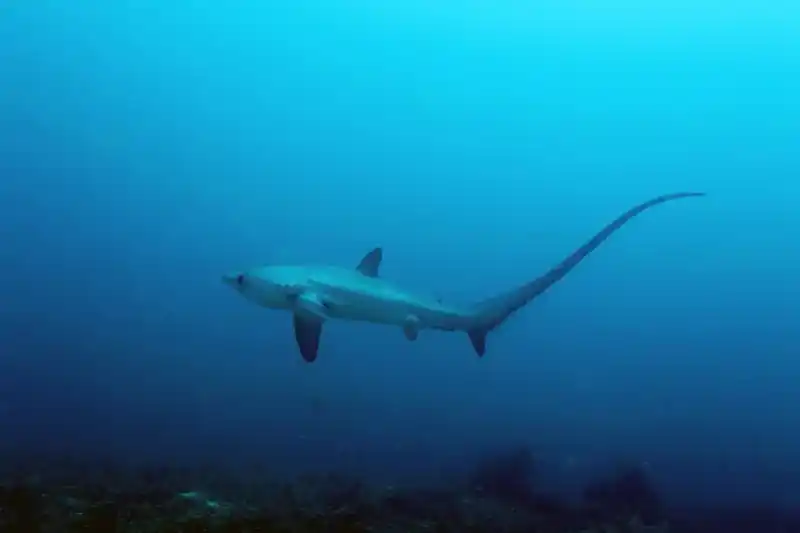
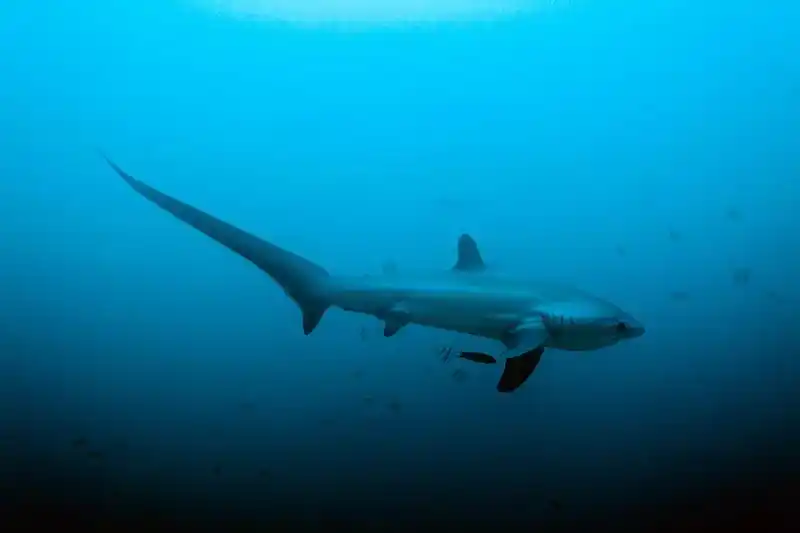
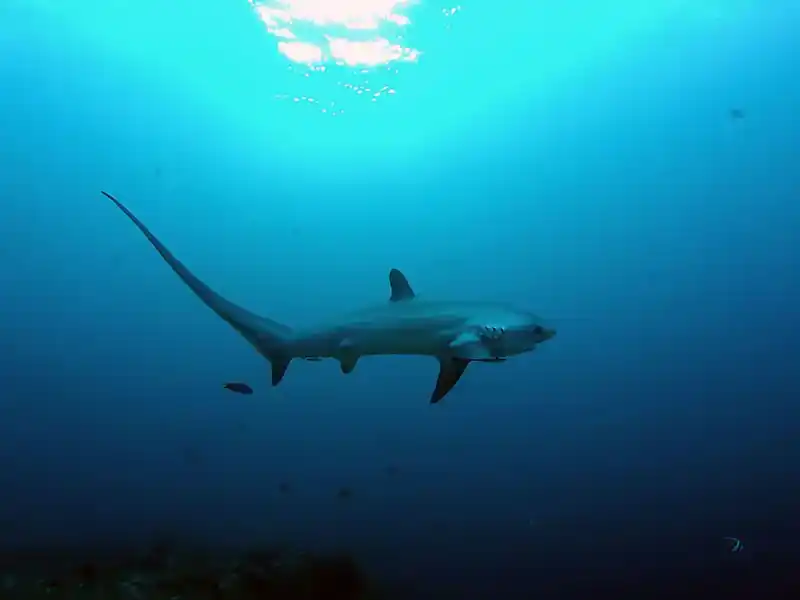
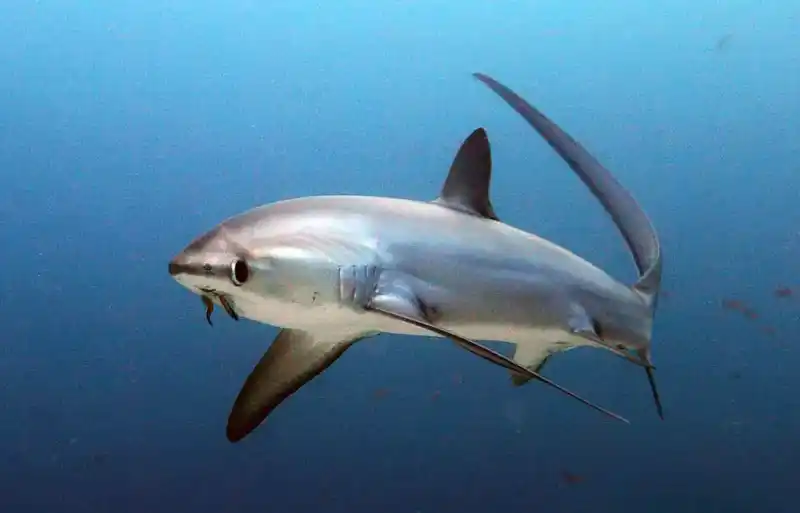
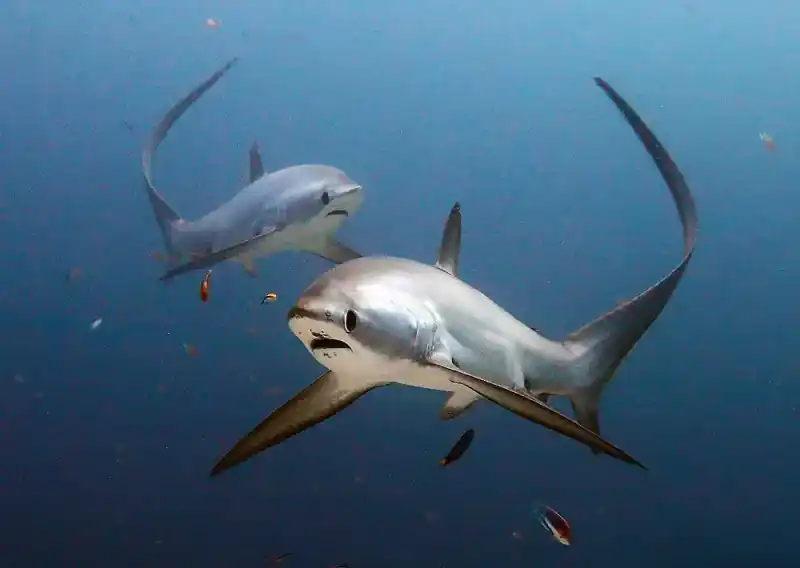
The body is elongated and streamlined; the upper lobe of the caudal fin is extremely long; the pectoral fins are long and narrow; the first dorsal fin is located in the middle and slightly posterior; the large-eyed species has a giant eye and a supraorbital groove.
Detailed introduction
The genus * Alopias * belongs to the family Alopiidae , order Lamniformes . It comprises three main extant species: *A. vulpinus* (common thresher shark), *A. superciliosus* (bigeye thresher shark), and *A. pelagicus * (peytic thresher shark). This genus is known for its exceptionally long upper lobe caudal fin , which it uses to whip its tail against schools of prey before turning back to swallow them. It is an important predator in the mid-to-upper pelagic zone.
Ecology and Behavior
Feeding: Primarily feeds on schooling fish such as sardines and mackerel, as well as cephalopods, and often hunts "bait balls" at dawn/dusk.
Reproduction: Aplacental viviparous ; oophagy in embryos; few offspring, late maturity.
Activity: Mostly found in the nearshore to upper ocean surface to middle layers (usually 0–200 m), with bigeye thresher sharks often active in deeper, low-light environments.
Morphology and Recognition
The upper lobe of the caudal fin is extremely long, reaching more than half the body length; the body length is streamlined, and the snout is medium; the first dorsal fin is located in the middle to the rear; the pectoral fins are long and narrow. The bigeye thresher shark has extremely large eyes and deep grooves; the pelagic thresher shark has a more uniform body color on its sides, while the common thresher shark is more robust.
Size and lifespan (genus level)
Body length: Commonly 2.5–4.5 m (maximum >5 m).
Weight: Approximately 100–350+ kg (depending on species and region).
Lifespan: Approximately 15–30+ years (regional variations).
Distribution and Habitat
It is found almost everywhere in temperate to tropical oceans, from the outer edge of the coastal shelf to the upper and middle layers of the open sea; it is often associated with fronts, upwelling currents, seamounts and baitfish gathering areas.
Threats and Protection
Fisheries pressures: by-catch and target catches from longline fishing, drift gillnetting and trawl, and the trade in shark fins and fish meat.
Biological vulnerability: fewer fetuses and later maturity lead to slower recovery .
Management recommendations: Strengthen by-catch reduction (round hooks, weak breakpoints, release regulations), spatial and temporal management of key hotspots, size/quota and cross-species cooperation. This genus is already covered in CITES Appendix II (international trade requires a permit).
Frequently Asked Questions
Q1: How to identify a thresher shark at a glance? The upper lobe of its caudal fin is unusually long, like a "whip"; when hunting, the tail whip can be seen striking the water surface or a school of fish.
Q2: Is it dangerous to humans? It usually avoids humans and rarely attacks them proactively; however, its tail whip is powerful, so you should keep your distance.
Q3: What are the differences between the three? The bigeye thresher shark has particularly large eyes and often ventures into deep water; the oceanic thresher shark has a uniform body color and a relatively slender body; the common thresher shark has the most robust body and the widest distribution.
Q4: IUCN Status? This page provides an overview of the genus level , which is "not assessed" overall; most species are listed as threatened or near threatened, please refer to the species page for details.