Basic Information
Scientific classification
- Chinese name: Vampire Flying Frog
- Scientific name: Rhacophorus vampyrus
- Order: Anura
- Family and genus: Rhizophoraceae, Rhizophora
Vital signs data
- Body length: Adults are about 4–5 cm long, with females usually slightly larger than males. They are small to medium-sized arboreal frogs.
- Weight: Individual body weight is usually a few grams, which varies slightly depending on body length, sex and nutritional status.
- Lifespan: It is estimated that they can survive for several years in the wild. As long as the mountain forest environment and water bodies in tree holes remain stable, adults can participate in the breeding season multiple times.
Significant features
Adults have wide webbed toes, allowing them to glide between trees; tadpoles possess black horny teeth resembling "vampire teeth," and develop in small bodies of water within tree cavities, making them highly distinctive flying tree frogs.
Distribution and Habitat
They are mainly distributed in the evergreen mountain forests and cloud forests of the highlands in central and southern Vietnam, mostly active at altitudes of about 1,000–2,000 meters, and rely on tree cavities and small bodies of water at high altitudes for reproduction.
Appearance
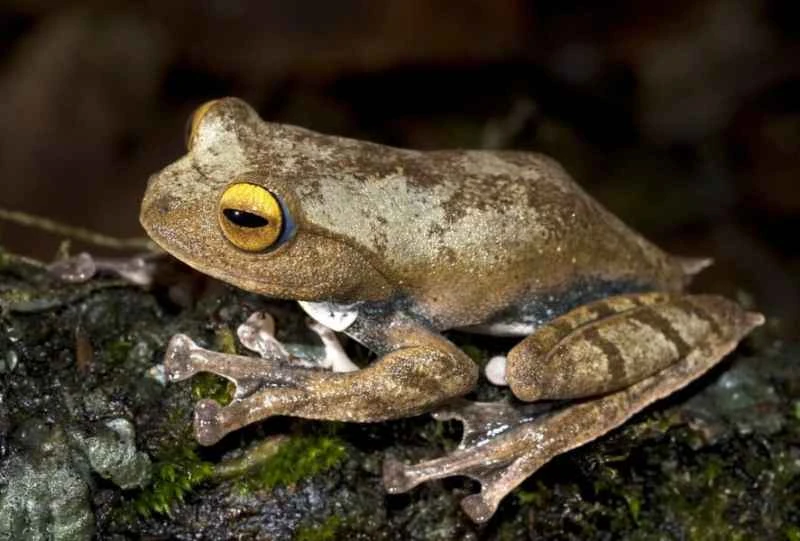
Adults have a flat and slightly wide body, with a green or olive-green back, long limbs, well-developed webbing between the toes, and suckers at the tips of the toes; tadpoles have a pair of black curved teeth around their mouths, which is an important feature that led to the naming of this species.
Detailed introduction
The vampire flying frog ( Rhacophorus vampyrus ) is a highly talked-about tree frog from Southeast Asia. It is named for its tadpoles' black, horny teeth resembling "vampire fangs" and its adults' ability to glide between the toes using the skin between their toes.
Classification and nomenclature
Chinese reference name: Vampire Flying Frog, Vampire Flying Tree Frog (common translations);
English name: Vampire Flying Frog;
Scientific name: Rhacophorus vampyrus ;
Family: Rhacophoridae → Genus: Rhacophorus
Appearance and Identification Features
Adult vampire flying frogs are typical "flying tree frogs," while the tadpole stage has a very special tooth-like structure:
Size: Adults are about 4–5 cm long, with females usually slightly larger than males;
Body shape: The body is flat and slightly wide, which is conducive to perching on branches and leaves;
Back color: Generally green or olive green, some individuals have inconspicuous markings, which help them blend into the leaves;
Abdomen: The abdomen is lighter in color, and may be pale yellow or milky white;
Limbs and webbed feet: The limbs are long, especially the hind limbs, which are extremely long. There are wide webbed membranes between the toes, which, when opened, resemble a "parachute" to help glide between trees or slow down.
Toe suckers: The toes swell to form suckers, which can firmly attach to leaves and branches, a typical characteristic of tree frogs;
Tadpole "fangs": Tadpoles have a pair of black, backward-curving horny teeth around their mouths, which look like "vampire fangs". They are mainly used to grip the walls of tree holes and pools, scrape off egg masses and organic matter, rather than actually biting blood.
Distribution range and habitat
The vampire flying frog is currently known to be mainly distributed in the mountain forests of the highlands in central and southern Vietnam .
It is commonly found in the high-altitude evergreen mountain forests of central and southern Vietnam and is an endemic species.
They are more commonly found in mountain forests at altitudes between 1,000 and 2,000 meters.
Typical habitat characteristics include:
Moist evergreen mountain forests or cloud forests, with dense canopies and high air humidity;
Water can easily accumulate in tree cavities and dead branches near mountain streams, canyons, or seepage points on slopes.
Numerous tree cavities, puddles, and small, elevated water bodies provide conditions for their unique reproductive methods.
Lifestyle
The vampire flying frog is a typical arboreal, nocturnal flying tree frog :
During the day, they mostly hide on the back of leaves, in the gaps between branches, or near tree holes in high places, remaining still and relying on camouflage to hide themselves.
They become active in the evening and at night, climbing and leaping among the tree canopy and using their webbed feet to glide short distances.
They generally rarely descend to the ground and mainly forage and reproduce in the high-altitude environments of the canopy and sub-canopy.
feeding habits
Adult vampire frogs primarily prey on small invertebrates such as insects.
Flying insects that live near the tree canopy, such as moths and small beetles;
Various small arthropods that are active on the surface of leaves at night;
By using a combination of ambush and surprise attack, it quickly latches onto its prey with its long tongue.
During the tadpole stage, they scrape and feed on egg masses and organic debris in the water accumulated in tree holes, which is very different from the lifestyle of tadpoles in ordinary ponds.
Reproduction and "tree hole nursery"
The vampire frog employs a very unique "tree hole rearing" method:
Their breeding season often coincides with the local rainy season, and the rain increases the water accumulation inside the tree cavity.
Female frogs lay their egg masses inside tree holes near the water surface; the egg masses are often attached to the hole walls.
After hatching, the tadpoles fall into a small pool of water inside the tree hole and live there, using their "vampire teeth" to attach to the wall and feed on egg masses and organic matter.
The entire larval development process is completed in a small body of water in a high tree cavity, which largely avoids predators in surface water.
This unique reproductive and tadpole-like morphology is considered a highly adaptive response to the intense selective pressures of the mountain forest environment.
Protecting the status quo and threats
The vampire flying frog was discovered relatively recently and has been assessed as one of the threatened mountain forest species (e.g., Endangered, EN category).
The main threats include:
Mountain deforestation, agricultural expansion and road construction have led to habitat fragmentation, reducing suitable high-lying tree cavities and breeding grounds;
The cultivation of cash crops such as coffee and rubber in mountainous areas has altered the structure of the original forests and hydrological conditions.
Climate change may affect humidity and rainfall patterns in cloud forests and high-altitude forests, thereby affecting the stability of water accumulation in tree cavities;
Due to their narrow distribution range and limited population size, they are particularly sensitive to environmental changes.
Protecting pristine mountain forests, limiting over-exploitation in high-altitude areas, and strengthening monitoring of the species' breeding grounds are key measures to ensure the long-term survival of the vampire frog.
Frequently Asked Questions
Q1: Does the Vampire Flying Frog really "suck blood"?
No. The word "vampire" primarily comes from the pair of black, curved, horny teeth that tadpoles have, which resemble vampire teeth.
They are mainly used to attach to the walls of tree cavities and scrape off egg masses or organic matter, not to suck blood.
Q2: Why is it called "flying frog" or "flying tree frog"?
Adults have wide webbing between their toes, which spreads out during jumps to increase the contact area with the ground, allowing them to glide short distances between trees or slow their descent.
Therefore, it is called "flying frog" or "flying tree frog".
Q3: Are vampire flying frogs easy to spot in the wild?
It's difficult. It has a narrow distribution range, mostly inhabiting the canopy and tree cavities of high-altitude mountain forests. It is nocturnal and adept at camouflage, so researchers generally only have a high chance of finding it during specific surveys.
Q4: Is the vampire frog at risk of extinction?
Due to its limited distribution area and extreme dependence on mountain forests and small water bodies in tree cavities, once the forests are cut down or the hydrological conditions change, it will become a significant threat to the ecosystem.
The population could decline rapidly, so it is listed as a threatened species and requires special attention and protection.


