Basic Information
Scientific classification
- Chinese name: Western Banjo Frog
- Scientific name: Limnodynastes dorsalis
- Order: Anura
- Family and genus: Marsh Ranaidae
Vital signs data
- Body length: Adults are usually about 5–8 cm long, with females being slightly larger than males. They are medium-sized terrestrial frogs.
- Weight: Individual weight is mostly within tens of grams, varying slightly depending on body length and nutritional status.
- Lifespan: They can survive for several years in the wild, and adults can participate in the breeding season multiple times, provided that wetlands and seasonal water bodies are stable.
Significant features
Its call sounds like the "bonk" of a banjo; it is highly terrestrial and can burrow underground to aestivate during the dry season; it is very common in Western Australian wetlands and along the edges of farmland.
Distribution and Habitat
It is mainly distributed in the winter rainy areas of southwestern and southern Australia, inhabiting seasonal and perennial wetlands, swamps, streams, and grasslands and shrublands near farmland irrigation ditches.
Appearance
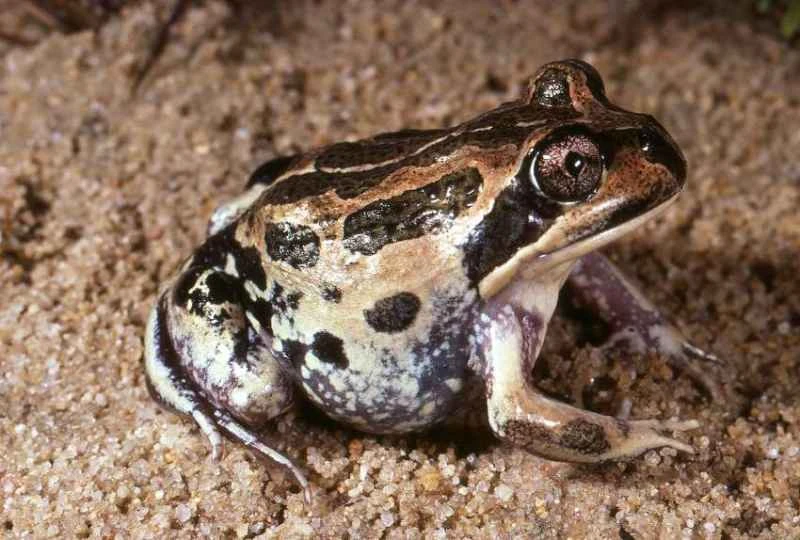
They are robust, with a brown or grayish-brown back with dark patches, and some individuals have a light-colored midline on their back; their skin is slightly rough, their limbs are strong, and their hind feet have partial webbing, which is suitable for movement in water and mud.
Detailed introduction
The Western Banjo Frog ( Limnodynastes dorsalis) is a medium-sized, native Australian frog with a distinctive call. It belongs to the genus Limnodynastes in the family Limnodynastidae. Closely related to the common Pobblebonk banjo frog in eastern Australia, it shares the same name due to its call resembling the plucking of a banjo and is a highly representative terrestrial frog species of Western Australia.
Classification and nomenclature
Chinese reference name: Western Banjo Frog (general translation);
English name: Western Banjo Frog;
Common name: Pobblebonk (onomatopoeic name, imitating its call);
Scientific name: Limnodynastes dorsalis ;
Family: Limnodynastidae → Limnodynastes .
Appearance and Identification Features
The western banjo frog has a stocky build and a distinctly "terrestrial frog" appearance.
Size: Adults are about 5–8 cm long, with females usually slightly larger than males;
Body shape: Sturdy body, broad head, short and blunt snout;
Back color: mostly brown, grayish brown or olive brown, often with irregular dark patches or cloud-like patterns;
Midline of the back: Lighter-colored longitudinal stripes or bands can be seen in the center of the back of some individuals, which is one of the common identification features of the genus Rhapis.
Abdomen: The abdomen is lighter in color, milky white or light gray, and may be accompanied by spots;
Skin texture: The skin on the back is slightly rough with small warts, but not as rough as that of a toad;
Limbs: The limbs are strong and powerful, with the hind limbs being more developed, which is advantageous for digging and jumping in mud and near water.
Toes: The hind feet have webbed toes, which is suitable for movement in shallow water and mud.
Distribution range and habitat
The western banjo frog is one of the representative frog species of southwestern Australia :
It is mainly distributed in the southern and southwestern regions of Western Australia, including the coastal plains and some inland areas;
It is more common in winter-rainy climate zones.
Typical habitats include:
Seasonal and perennial wetlands, marshes and puddles;
Streams, drainage ditches, farmland irrigation canals, and roadside puddles;
Nearby grasslands, shrublands, farmland edges, and open woodlands.
Lifestyle
The western banjo frog is a nocturnal, terrestrial frog .
During the day, they mostly hide in the soil, leaf litter, or under vegetation, and they will also burrow into moist soil to escape the heat and retain moisture.
They come out at dusk and night, foraging around waterholes, in grasslands and low-lying wetlands;
During the dry season, they can burrow underground to enter a state of "summer hibernation" and wait for rainfall to resume their activity.
vocal characteristics
The name "Banjo Frog" comes from the distinctive call of the male frog:
The call of the male frog is similar to the sound of plucking the strings of a banjo, "bonk... bonk..." or "pok... pok...".
After rain or on nights during the breeding season, when multiple male frogs sing together, their calls are very loud and rhythmic.
The calls are an important clue to identifying the presence of a group of banjo frogs.
feeding habits
Western banjo frogs feed on a variety of small invertebrates:
Insects on the ground and in grass, such as beetles, crickets, and ants;
Spiders, centipedes, and other small arthropods;
They also occasionally prey on small aquatic invertebrates that pass by the water's edge.
Reproduction and Development
The reproductive activities of the western banjo frog are closely related to rainfall and seasonal water bodies:
The breeding season mostly occurs during the local winter and months with more rainfall;
Male frogs call out at the edges of puddles, marshes, and shallow pools to attract female frogs;
Female frogs lay their eggs in shallow waters. Many swamp frogs will build foam nests to protect the embryos by wrapping the eggs in foam.
Tadpoles develop in shallow water and are highly adaptable to water quality, but they need to maintain a water environment for a certain period of time.
After metamorphosis, the young frogs migrate to live in the surrounding grasslands and moist soil.
Protecting the status quo and threats
In the IUCN Red List, the western banjo frog is currently generally assessed as Least Concern (LC) and remains relatively common in its distribution area.
Potential threats include:
Wetlands are drained, filled in, or converted into farmland and urban land.
Pesticides, fertilizers, and urban runoff pollute small water bodies;
Long-term climate change has led to changes in rainfall patterns, affecting the formation and duration of seasonal waterholes.
Protecting natural wetlands, maintaining small water bodies around farmland and cities, and reducing pollution emissions help maintain healthy populations of the western banjo frog and other swamp frog species.
Frequently Asked Questions
Q1: Why is it called "Banjo Frog"?
Because the male banjo frog's call sounds very much like the "bonk" sound made by plucking the strings of a banjo, it is aptly named the "banjo frog".
It is sometimes also called "Pobblebonk" (onomatopoeia).
Q2: Can the western banjo frog only live in water?
No. It is a typical terrestrial frog, spending most of its time in the soil, grassland, and leaf litter near water, only appearing more often near water during the breeding season or after rainfall.
Q3: Are western banjo frogs dangerous to humans?
They are generally considered harmless to humans and will not attack people unprovoked. Like other frogs, simply wash your hands after minimal contact.
Q4: How can I tell if there are banjo frogs nearby in the wild?
If you hear a continuous "bonk... bonk..." knocking sound near the wetlands of Western Australia after rain or on a night during the breeding season, it is very likely that a group of banjo frogs is singing in unison.