
Basic Information
Scientific classification
- Chinese name: Crested Tree Swallow
- Scientific name: Hemiprocne coronata, Crested Treeswift
- Classification: Climbing birds
- Family and genus: Apotheales, Apodidae, Apothecium
Vital signs data
- Body length: 21-25 cm
- Weight: No verification information available.
- Lifespan: No verification data available.
Significant features
It has a long crest of feathers on its head, which shimmers with a green sheen.
Distribution and Habitat
It is distributed in tropical regions of South and Southeast Asia, including India, Myanmar, the Indochina Peninsula, and Indonesia. In China, it is only found in Cangyuan, Jinghong, Mengyang, and Menglun in Yunnan Province. In addition, some people have seen it while sailing in the Taiwan Strait and along the Shandong coast.
They mainly inhabit relatively open areas with trees, such as forest edges, secondary forests, orchards, and parks.
Appearance
The Crested Tree Swallow is a small bird, measuring 21-25 cm in length. Its most distinctive feature is a long crest of feathers on its head, shimmering with a green sheen, making it exceptionally beautiful and unique. It has a short, rounded beak, large eyes, and a very long tail that tapers towards the tip, known as a scimitar tail. Its upperparts are bluish-grey.
Grey in color, resembling a swift, with a long tail and long, curved wings. A distinctive feature is its erect crest. Underparts are grey. The male has brown patches on the sides of its face and ear coverts. Juveniles are mostly brown, with a very small crest, often covered with white and dark brown scales.
Iris - brown; mouth - black; feet - red.
Call: A loud and harsh high-pitched cry cher-tee-too-cher-tee-too-cher-tee-too.
Detailed introduction
The Crested Treeswift, scientifically known as *Hemiprocne coronata*, has six subspecies.
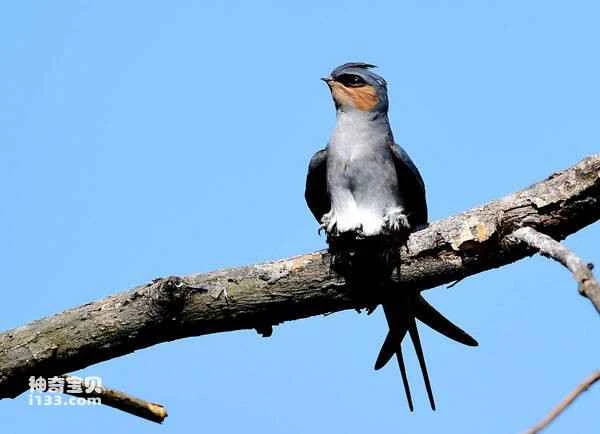
Crested tree swifts typically move in small groups, frequently circling over open areas and forests, and sometimes flying over rivers and other bodies of water. Their diet consists mainly of flying insects such as mosquitoes and moths, and they can also hunt while in flight. However, they spend significantly less time in the air than other swifts, and their hunting behavior differs. They don't constantly fly and forage; instead, they often perch on the top branches of trees, taking off to catch insects or other prey when they appear nearby. Due to their large size and long wingspan, they always spread their wings out to the sides like a sickle in the air, resembling a small airplane, sometimes flying low and sometimes taking off. They usually roost in groups at night, but sometimes they roost alone.
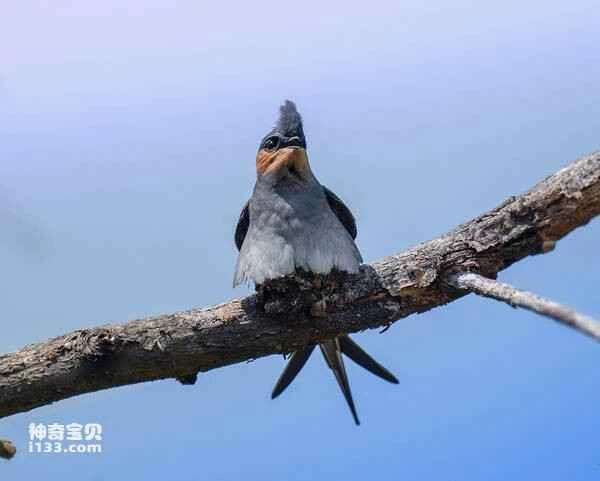
The Great Crested Tree Swift breeds from March to June, nesting in rock crevices and tree hollows. The nest is constructed of moss and tightly bound together with saliva. It is extremely small and delicate, typically only 2.5-5 cm in diameter, cup-shaped or pouch-shaped, primarily made of shredded bark, fine feathers, and saliva, forming a very tight and sturdy structure that firmly attaches to the branch. The nest is black with a few gray and off-white spots, closely resembling the color of the branch, appearing from below as a small protrusion. Only one egg is laid per clutch, pale gray or grayish-white, sometimes tinged with blue, and oblong in shape. The chick is altricial and requires careful feeding from its parents to grow.
Listed as Least Concern (LC) on the IUCN Red List of Threatened Species 2018 ver 3.1.
It is listed as a Class II protected wild animal in the "List of Key Protected Wild Animals in China".
Protect wild animals and ban the consumption of wild game.
Maintaining ecological balance is everyone's responsibility!


