Basic Information
Scientific classification
- Chinese name: Jervis Bay Tree Frog
- Scientific name: Litoria jervisiensis
- Order: Anura
- Family: Litoria jervisiensis Jervis Bay tree frog
Vital signs data
- Body length: Adults are generally about 3.5–5 cm in length, belonging to the small to medium-sized tree frogs, with males slightly smaller than females.
- Weight: Each individual weighs only a few grams, varying with size and nutritional status.
- Lifespan: It is estimated that they can live for several years in the wild and participate in breeding repeatedly in multiple breeding seasons; their lifespan may be even longer under captive conditions.
Significant features
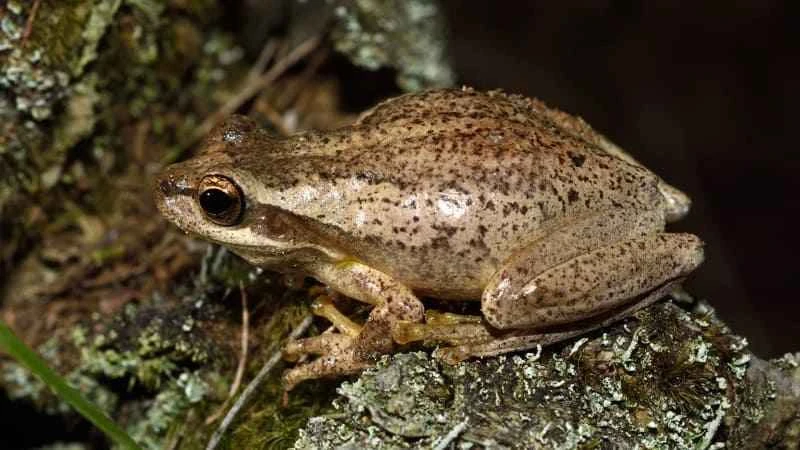
A typical small to medium-sized tree frog in the wetlands and dunes of the southern coast of New South Wales, Australia. It has a greenish-brown back, dark stripes on its sides, and orange-yellow patches on its hind legs. It mainly inhabits coastal wetland thickets and the vicinity of seasonal water bodies.
Distribution and Habitat
It is mainly distributed in Jervis Bay and surrounding areas on the south coast of New South Wales, Australia. It inhabits low-lying wetlands behind coastal dunes, seasonal ponds, shrublands and paper bark/tea tree wetlands, and its reproduction depends on shallow and seasonal water bodies.
Appearance
Small to medium in size, with an olive green or brownish-green back with dark cloud-like patterns, distinct dark stripes on the sides and light or orange-yellow spots, and orange-yellow or brownish-orange patterns commonly seen on the inner thighs; the abdomen is milky white or pale yellow with slightly rough skin, and the limbs are long with suction cups at the tips of the toes, allowing them to climb low vegetation.
Detailed introduction
The Jervis Bay Tree Frog ( Litoria jervisiensis ) is a small to medium-sized, brightly colored native Australian frog. As its name suggests, it is most typically found in Jervis Bay and its surrounding wetlands on the south coast of New South Wales, and is a tree frog species closely associated with coastal woodlands and dune wetlands.
Classification and nomenclature
Common Chinese name: Jervis Bay Tree Frog (based on a direct translation of the English name; the Chinese name is not yet fully standardized).
English name: Jervis Bay Tree Frog
Scientific name: Litoria jervisiensis
Family and genus: Tree frogs → Litoria
Appearance and Identification Features
The Jervis Bay tree frog is not large, but its markings and body shape are very distinctive:
Size: Adults are generally about 3.5–5 cm in length, with males being slightly smaller and females slightly larger;
Back color: Usually an olive green, brownish green or brownish base color, covered with dark patches and irregular cloud patterns;
Sides and stripes: There is often a distinct dark lateral stripe running from the tip of the snout through the eye and tympanic membrane, with light-colored or orange-yellow spots below the stripe or on the side of the body;
Thigh patterns: The hind legs and inner thighs often have bright orange or brownish-orange patches and stripes, which are especially noticeable when jumping;
Underside: The abdomen is milky white or pale yellow, while the throat appears slightly dark yellow or gray when the male frog croaks.
Skin texture: The skin on the back is slightly rough with small warts, and the glands on the sides are not particularly prominent;
Limbs and toes: The limbs are relatively long, the toes have a certain degree of webbing, and the ends of the fingers and toes have suction cups, which are conducive to climbing shrubs and herbaceous plants.
In summary, the Jervis Bay tree frog is a greenish-brown tree frog with dark lateral stripes and orange-yellow patches on its hind legs, which provides good camouflage in coastal wetlands and sand dune vegetation.
Distribution range and habitat
Jervis Bay tree frog is a species endemic to the south coast of New South Wales, Australia .
The typical distribution center is in Jervis Bay and its surrounding areas;
They can also be found in some similar ecological conditions in the southern coastal wetlands and forests.
It is closely associated with coastal dunes and wetland habitats:
Commonly found in low-lying wetlands, seasonally flooded depressions, and swamps behind coastal dunes;
It inhabits the edges of shrublands, tea plantations, paper bark forests, and moist eucalyptus forests;
Reproduction relies heavily on shallow water, seasonal ponds, rainwater pools in sand dune depressions, and coastal wetland waters.
Lifestyle
The Jervis Bay tree frog is a nocturnal tree frog that inhabits shrub and herbaceous vegetation .
During the day, they mostly hide in dense bushes, tall grass, or piles of fallen leaves and wood to avoid sun exposure and dehydration;
They move along the edges of wetlands and around water bodies at dusk and night, and perch on branches, grass stems or low vegetation not high above the ground.
When threatened, they will quickly jump into the water or burrow into denser vegetation to hide.
Cry
Male Jervis Bay tree frogs emit a distinctive call during the breeding season:
The calls are often described as a series of short, slightly nasal "creek... creek..." or "tik-tik-tik" syllables;
On warm, rainy, or humid nights, the sound comes from the vegetation at the edge of the pond;
When multiple male frogs call at the same time, they often form a dense and rhythmic chorus in wetlands at night.
feeding habits
Like most tree frogs, the Jervis Bay tree frog primarily feeds on small invertebrates:
Various flying insects, such as mosquitoes, midges, moths, and small dipteran insects;
Small beetles, cockroaches, and other arthropods that inhabit grass and bushes;
They also occasionally feed on smaller arachnids and other tiny invertebrates.
They typically wait patiently on vegetation or move slowly to catch nearby prey.
Reproduction and Development
The reproductive activity of the Jervis Bay tree frog is highly correlated with rainfall and seasonal water body conditions.
The breeding season typically occurs during warm, rainy periods.
Male frogs call out in shallow ponds, seasonal depressions, and vegetation at the edges of wetlands to attract female frogs;
Female frogs lay their eggs in shallow waters that are still or have slow flow. The egg masses attach to aquatic plants or floating objects, or they may sink to the bottom of shallow water.
Tadpoles develop in small bodies of water and are sensitive to changes in water quality and level. They need to complete their metamorphosis before the water dries up.
Once the froglets have completed their metamorphosis, they leave the water and begin a lifestyle dominated by vegetation along the wetland edges.
Protecting the status quo and threats
In the International Union for Conservation of Nature (IUCN) Red List, the Jervis Bay Tree Frog is usually assessed as Least Concern (LC) or near Least Concern, but is considered to be somewhat threatened in some state or local assessments.
The main potential threats include:
Coastal development, road construction, and expansion of tourism facilities have led to the shrinkage and fragmentation of dune wetlands and shrub habitats;
Wetland drainage, pollution, and invasive species (such as invasive fish) affect tadpole survival rates;
Climate change-induced changes in rainfall patterns and extreme droughts affect the formation and duration of seasonal water bodies.
Potential impacts on diseases such as fungal chytriditis.
Protecting the Jervis Bay tree frog requires maintaining coastal wetlands and dune vegetation, limiting over-development in sensitive areas, and ensuring the stability of natural hydrological processes and water quality in local water bodies.
Frequently Asked Questions
Q1: Why is the Jervis Bay Tree Frog called by this name?
Its English name, Jervis Bay Tree Frog, comes directly from the Jervis Bay region of New South Wales.
This area is considered one of the typical distribution centers of this frog, hence the name.
Q2: How can the Jervis Bay Tree Frog be more easily observed in the wild?
The best time is usually on warm, rainy nights, near coastal wetlands and seasonal ponds.
By slowly searching among the bushes and grass by the water and listening for the croaking of frogs, you can often find them on branches and grass stems not high off the ground.
Q3: Is the Jervis Bay tree frog dangerous to humans?
It is a small to medium-sized insectivorous tree frog and is generally not considered to pose a direct danger to humans.
If a short observation period is required, handle the item gently to avoid squeezing the body, and wash your hands afterward.
Q4: What is the role of the Jervis Bay tree frog in the ecosystem?
The Jervis Bay tree frog helps regulate insect populations in wetlands and scrubland by preying on large numbers of small insects and other invertebrates.
At the same time, it is also an important food source for predators such as snakes and birds, and is a link in the food web of coastal wetland ecosystems.