Basic Information
Scientific classification
- Chinese name: Triangle Spider
- Scientific name: Arkyidae; family: Arkys; genus: Arkyidae; general term for the group of spiders called Arkyidae.
- Classification: Arthropoda
- Genus and family: Arkyidae Arkys
Vital signs data
- Body length: Adult spiders of most species are about 3–8 mm in length, with females usually slightly larger than males.
- Weight: Small forest and scrub spiders, with individual bodies weighing mostly in the tens to hundreds of milligrams range.
- Life expectancy: Generally 1–2 years, depending on climate conditions and food resources.
Significant features
A general term for small spiders with a distinctly triangular or shield-shaped abdomen, which often lie in wait to ambush small insects in bushes and forest edges.
Distribution and Habitat
It is mainly distributed in shrublands, forests and wetland vegetation zones in Australia, Tasmania and surrounding areas, and can also be found in some gardens and park groves.
Appearance
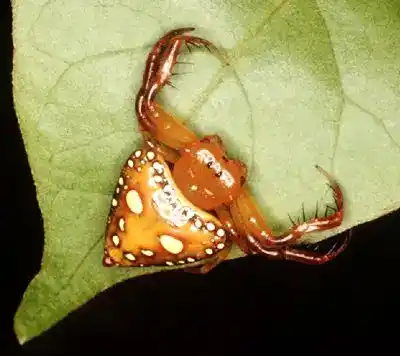
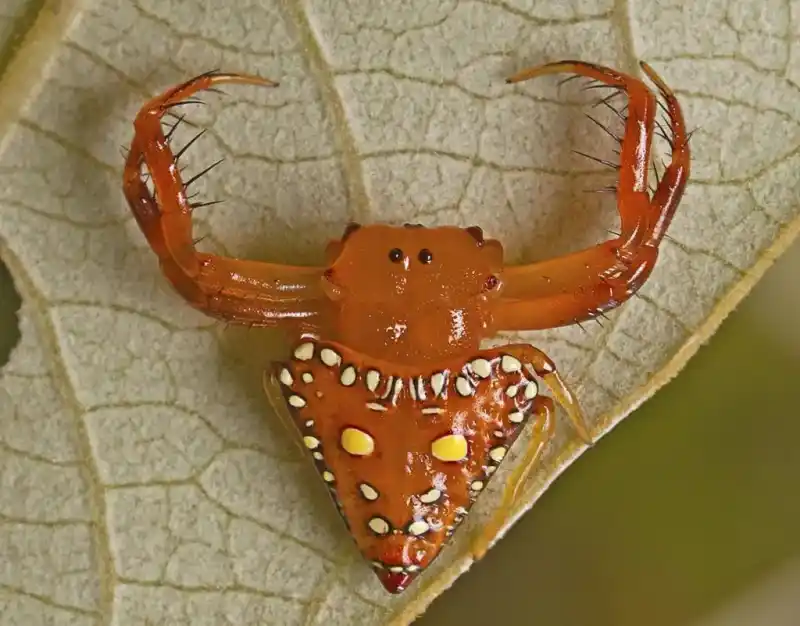
Its body color varies, ranging from brown and orange to green. Its abdomen is high and wide, triangular or shield-shaped, and its forelegs are relatively thick, making it good at camouflaging itself by lying flat on branches and leaves.
Detailed introduction
Triangular spiders are a general term for a group of spiders named for their distinctly triangular abdomens. Common representatives are species of the genus Arkys in the family Arkyidae, found in Australia and surrounding areas. These spiders mostly live in bushes and forest edges, are relatively small in size, and are adept at lying in wait to ambush their prey.
Classification Status and Naming
Common Chinese names: Triangular spider, Triangular-bellied spider (broad terminology)
English names: Triangular Spiders, Arkys Spiders
Representative genus: Arkys (such as Arkys curtulus, etc.)
Genus: Arthropoda (phylum Arthropoda) → Arachnida (class Arachnida) → Araneae (order Araneae) → Arkyidae (family Arkyidae) → Arkys (genus Arkys), etc.
Appearance and distinguishing features
The most distinctive feature of the triangular spider is its triangular or shield-shaped abdomen, giving it a unique appearance.
Size: Mostly small spiders, with adult spiders measuring about 3 to 8 millimeters in length, and females usually slightly larger than males;
Body color: The body color varies greatly, ranging from brown, orange, yellow to green. Some species have stripes of different shades, which help to disguise themselves on the leaves and branches.
Abdominal shape: The dorsal outline of the abdomen is distinctly triangular, shield-shaped, or pointed, with the sides slightly flared outwards, and there are often one or more small protrusions on the posterior margin;
Body shape: The head and chest are relatively small, the abdomen is high and wide, the forelegs are thicker, and the hind legs are slightly shorter, giving the overall impression of a "flat and tall" triangular shield;
Posture: When at rest, it often lies close to the branch or petiole, with its abdomen slightly raised, looking like a protruding leaf or a dried plant fragment.
Distribution range and habitat
Trigonella dae and related groups are mainly distributed in Australia, Tasmania and surrounding islands , and are quite common in local shrublands, forests and wetland vegetation. Some closely related groups are found in other parts of Asia and the Pacific.
Common habitats include:
Low shrubs and lower branches of the canopy;
Vegetation around forest edges, forest clearings, and small stream valleys;
The twigs above the grass, the vines, and the petioles;
They are sometimes found in gardens, woodlands, and park groves.
They prefer vegetation layers of a certain height , using the concealed positions provided by leaves and branches to ambush prey.
Lifestyle and Diet
Triangular spiders are mostly ambush hunters :
Some species weave simple small webs or support threads, but not the regular orb-like webs typical of garden spiders;
More often than not, they choose to remain still on branches or petioles, relying on camouflage and sudden bursts of speed to catch their prey;
Their main prey consists of small flying insects and other arthropods, such as aphids, small moths, small beetles, and flies.
Once prey approaches or passes by, the spider will quickly hook it with its forelegs and bite it with its venomous fangs, then drag it to a more secluded location to devour it.
Triangular spiders are usually more active at night and in the early morning, while during the day they rely more on camouflage and remain still.
Reproduction and life history
The reproductive methods of the triangular spider are similar to those of many small forest spiders:
Mature male spiders will leave their original habitat and search for the location of female spiders among the vegetation;
During courtship, the male spider will carefully approach the female, transmitting signals through its limbs and slight vibrations;
After mating, the female spider spins silk to make an egg sac on the back of a leaf or in a hidden place on a branch, and then fixes or hangs the egg sac on the plant.
After hatching, spiderlings temporarily gather near the egg sac before dispersing into the surrounding vegetation to independently find habitat and prey.
Toxicity and its impact on humans
As a small spider, the venom of the Triceratops is mainly used to subdue smaller insect prey, and there is currently no data showing that it poses a significant medical hazard to humans.
In the rare cases where a bite occurs, it usually only manifests as:
Slight stinging or discomfort at the bite site;
Mild redness or swelling in the affected area, or brief itching.
People who are particularly sensitive to arthropod toxins may experience a slightly stronger local reaction.
Simply keep the wound clean and observe it. If any abnormalities or allergic symptoms occur, consult a medical professional.
Relationship with humans and ecological role
Triangular spiders are important small predators in shrub and forest ecosystems, effectively preying on various small insects living on plants, and playing a positive role in maintaining the population balance of arthropods in the vegetation layer.
In gardens and parks, they neither weave large nets to hinder activities nor actively approach humans, and are therefore usually regarded as harmless and beneficial invisible inhabitants.
Frequently Asked Questions
Q1: Are triangular spiders common indoors?
Most triangular spiders prefer outdoor bushes and forest vegetation and rarely venture indoors.
Occasionally, plants or bouquets are brought into the house, either by chance or by accident.
Q2: Are triangular spiders dangerous to humans?
There is currently no evidence that the triangular spider is seriously toxic to humans.
Even if a bite occurs, in most cases it only results in mild, localized symptoms.
Q3: How to observe triangular spiders in the wild?
Look carefully on the branches, petioles, and inflorescences of shrubs, especially in the early morning and late afternoon when the light is softer.
It is recommended to observe or take photos only, and avoid grasping it directly with your hands.
Q4: Are triangular spiders beneficial in gardens?
Yes. They feed on a variety of small insects and are helpful in controlling some phytophagous pests.
Without disturbing human activities, the triangular spider is a natural enemy worth preserving.


