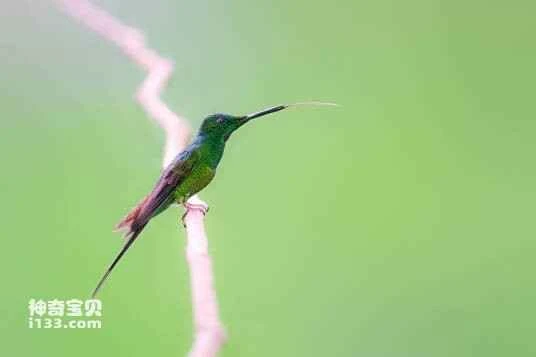
Basic Information
Scientific classification
- Chinese name: Green Fish Dog
- Scientific name: Chloroceryle americana, Green Kingfisher
- Classification: Climbing birds
- Classification and genus: Order Coraciiformes, Family Kingfisher, Genus Kingfisher
Vital signs data
- Body length: Approximately 20 centimeters
- Weight: 29-55g
- Lifespan: No verification data available.
Significant features
The most common type of kingfisher
1. *Chloroceryle americana* hachisukai: Distributed in Arizona, New Mexico, Texas, and Mexico (USA). 2. *Chloroceryle americana* septentrionalis: Distributed in Colombia, Venezuela, and Texas (USA). 3. *Chloroceryle americana* cabanisii: Distributed in Colombia, the Andes Mountains, Ecuador, and Chile. 4. *Chloroceryle americana* americana: Distributed in Venezuela, the Andes Mountains, Bolivia, and Brazil. 5. *Chloroceryle americana* mathewsii: Distributed in Argentina, Brazil, and Bolivia.
Distribution and Habitat
Green sea lions are distributed across North America (including the United States, Canada, Greenland, Bermuda, Saint Pierre and Miquelon, and the transitional zone between North and Central America within Mexico), Central America (located between North and South America, including Guatemala, Belize, Honduras, El Salvador, Nicaragua, Costa Rica, Panama, the Bahamas, Cuba, Haiti, Jamaica, Dominican Republic, Antigua and Barbuda, Saint Vincent and the Grenadines, Saint Lucia, Barbados, Grenada, Trinidad and Tobago, and other countries and regions), and South America (including Colombia, Venezuela, Guyana, Suriname, Ecuador, Peru, Bolivia, Paraguay, Brazil, Chile, Argentina, Uruguay, and the Falkland Islands).
The green kingfisher is one of the most common kingfishers. It is found in almost all freshwater and saltwater areas, especially along streams where there are trees. They are also frequently seen in ponds, evergreen forests, coastal lagoons, mangroves, wetlands, streams, and blocked waterways. Their distribution covers all of Central America, with habitats ranging from plains to 1500 meters, reaching up to 2500 meters in Costa Rica, and even 2800 meters in Mexico.
Appearance
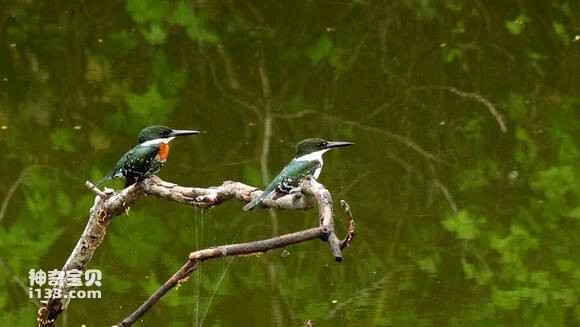
The Green Fish Dog is 20cm in length, with males weighing 29-40g and females 33-55g. Adult males have a black forehead and lores, with a deep green crown that has a bronze sheen. Wing feathers have white spots. The chin and throat are white with alternating green streaks. The belly is red with a white central section, wings are green with dark green tips on the feathers, and a green and white tail. It has a black beak, dark brown irises, and dark gray legs. Adult females have a similar crown to males, but a completely different lower body: a cream or pale yellow throat, and a golden-green upper breast. The belly is pale yellow. They are relatively large. The beak is long and laterally compressed with a rounded ridge; the nasal groove is prominent; the first primary flight feather is shorter than the second, with the second or third being the longest; the tail is longer than the beak.
Detailed introduction
The Green Kingfisher, scientifically known as *Chloroceryle americana*, has five subspecies: 1. *Chloroceryle americana hachisukai*, distributed in Arizona, New Mexico, Texas, and Mexico. 2. *Chloroceryle americana septentrionalis*, distributed in Colombia, Venezuela, and Texas. 3. *Chloroceryle americana cabanisii*, distributed in Colombia, the Andes Mountains, Ecuador, and Chile. 4. *Chloroceryle americana americana*, distributed in Venezuela, the Andes Mountains, Bolivia, and Brazil. 5. *Chloroceryle americana mathewsii*, distributed in Argentina, Brazil, and Bolivia.
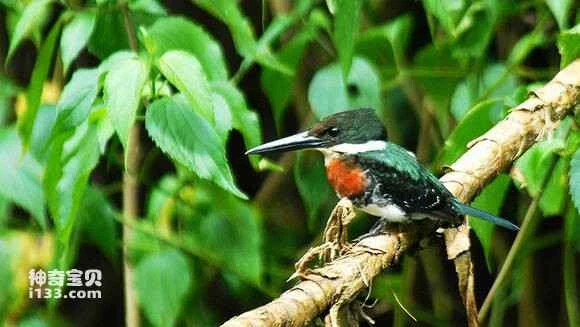
Green kingfishers typically hunt alone or in pairs. During the breeding season, serious territorial disputes can occur. They are fish-eating kingfishers with exceptional diving skills, even hovering in mid-air to lock onto their targets. They primarily live near rivers, feeding on fish. They inhabit scrubland or sparse forests, clear, slow-flowing rivers, streams, lakes, and irrigation canals. They often fly over rivers, streams, ponds, and marshes, surveying for food. Once they spot prey, they swiftly swoop down. They usually perch alone on the tops of branches, telephone poles, or rocks near water, waiting for their prey. They are commonly seen perched on low branches or rocks near the water, patiently waiting for their prey. Similar to kingfishers, they hunt by swooping down on the water's surface or diving underwater; sometimes they can even disappear completely into the water. Other times, they flap their wings and hover about 3-10 meters above the water, seemingly suspended above the surface. Upon spotting prey, they immediately plunge into the water to catch it. They place their catch on a perch and constantly manipulate it, sometimes even tossing the fish up to swallow it headfirst. Their diet consists mainly of small fish, supplemented by crustaceans and various aquatic insects and their larvae, including various shrimp, as well as ants and other small bees.
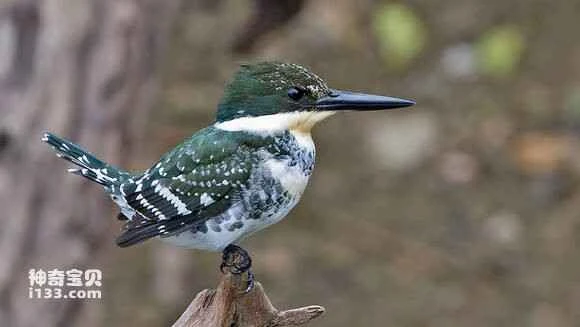
The egg-laying period for green kingfishers varies by region: in Texas, USA, it's April; in Mexico, it's March and January to May; in Costa Rica, it's April; and in Panama and Argentina, it's November to February to November. They nest on earthen cliffs, or on the banks of fields and streams, digging tunnel-like burrows with their beaks, 5 or 6 cm long and 1 meter in diameter. These burrows are generally unlined. The female lays 3 to 6 eggs directly on the ground in the nest. The eggs are pure white, glossy, with sturdy shells and slight spots. The chicks leave the nest after 27 days.
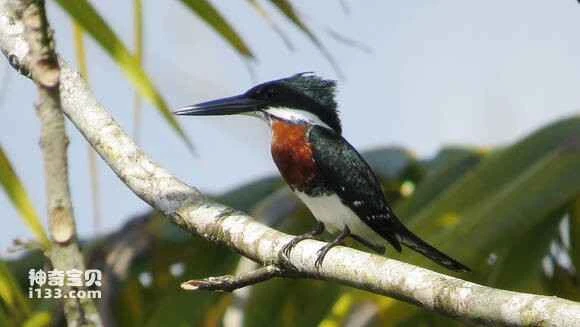
Listed in the IUCN Red List of Birds, ver 3.1: 2008.
Protect wild animals and ban the consumption of wild game.
Maintaining ecological balance is everyone's responsibility!