Basic Information
Scientific classification
- Chinese name: Blue-bellied Buddhist monk
- Scientific name: Coracias cyanogaster, Blue-bellied Roller
- Classification: Climbing birds
- Classification and Genus: Order Coraciiformes, Family Coraciiformes, Genus Coraciiformes
Vital signs data
- Body length: 28-30 cm
- Weight: 110-178g
- Lifespan: No verification data available.
Significant features
Distribution and Habitat
It is distributed in Benin, Burkina Faso, Cameroon, Central African Republic, Democratic Republic of Congo, Ivory Coast, Gambia, Ghana, Guinea, Guinea-Bissau, Mali, Niger, Nigeria, Senegal, Sierra Leone, South Sudan, Sudan and Togo.
Migratory bird: Mauritania.
Blue-bellied dracaenas are almost entirely confined to undeveloped primary forests, where the damp, open woodlands, characteristic of Guinea, allow ample sunlight. However, they are also found in a variety of other habitats, albeit less frequently. They inhabit tropical savannas, rainforests, forest belts near rainforests, plantations, grasslands, dense forests, and among clumps of palm trees along the edges of swamps and streams.
Appearance
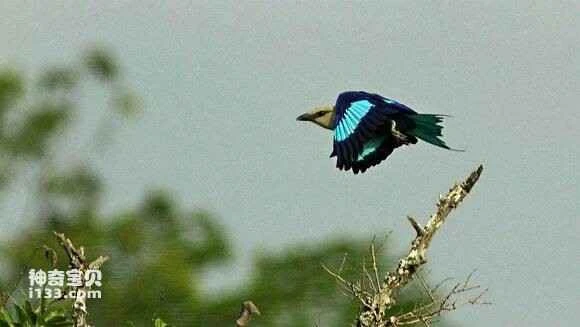
The Blue-bellied Roller (Pterocarya spp.) measures 28–30 cm in length, with females weighing 112–178 grams and males 110–150 grams. It is a medium-sized climbing bird. The lores and a small area behind the eyes are black, with a slightly brownish tip. The rest of the head, neck, throat, chin, and breast are pale yellow or greyish-white, and the face is almost white. This large area of white-grey plumage contrasts sharply with the lower half of the body. The underparts, back, rump, and tail have a brilliant deep blue hue, the tail is pale blue, and the belly, wings, and undertail coverts are dark blue. There is a 2–3 inch wide band of bright blue sheen on the primary and secondary flight feathers. The underside of the tail is blue. The beak is black, the iris is dark brown, and the legs are deep olive green. Juveniles are duller and less glossy than adults.
The beak is quite long, straight, and laterally flattened, with a slightly curved apex; the beak cleft is wide, but the width at the corners is about half the length of the apex; it has well-developed whiskers. The upper mandible has a notch near the tip, and the nostrils are exposed; the middle and inner toes are joined together to the last joint, while the middle and outer toes are joined only at the base; the number of tail feathers and flight feathers is the same as that of bee-eaters, but the tail is square or nearly wedge-shaped; the sexes are similar; juveniles resemble adults.
Detailed introduction
The scientific name of the blue-bellied mongoose is Coracias cyanogaster, and its foreign name is Blue-bellied Roller. There are no subspecies.
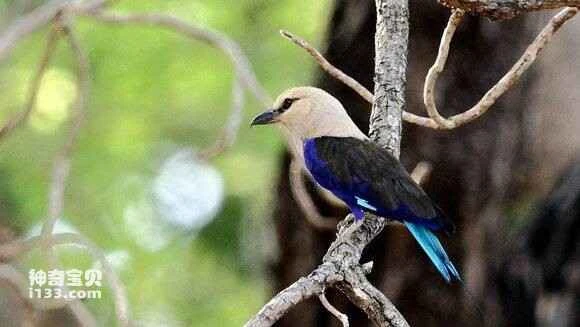
Blue-bellied Rollers live in pairs or small groups. In some areas, this species is quite solitary. In Côte d'Ivoire, they can gather in small groups of 3 to 6 individuals (up to 20 at times). They live together all day, maintaining contact with a hoarse, crying-like call. They are commonly seen perched alone or in pairs in open areas, such as on dead branches in the top of tall trees in sparse woodlands or farmland, or on power lines and poles in open areas. Their flight is irregular and erratic; occasionally they take flight to chase passing insects or swoop down to catch insects on the ground. Their flight posture is similar to that of a nightjar, strange and clumsy, circling erratically or flapping their wings. Two or three birds sometimes fly or swoop together at dusk, especially during courtship, and are sometimes attacked by flocks of small birds because their heads and beaks resemble those of birds of prey. They generally feed on the ground, sometimes swallowing prey on the spot and sometimes carrying it back to their roosting site before consuming it. Their diet consists mainly of insects, including termites, beetles, water beetles, crickets, locusts, moths, and other coleopterans, as well as lizards and frogs. Their calls are sharp, screeching sounds with a frictional quality, which become even more deafening during courtship activities.

Blue-bellied rollers are monogamous or polygamous, and they are highly territorial, fighting for territory during the mating season. This African species builds its nest in tree cavities more than 10 meters above the ground. Egg-laying occurs from April to July, and also from February to September in southern Côte d'Ivoire, Senegal, and Gambia.
Listed as Least Concern (LC) on the IUCN Red List of Threatened Species 2016 ver 3.1.
Protect wild animals and ban the consumption of wild game.
Maintaining ecological balance is everyone's responsibility!