Basic Information
Scientific classification
- Chinese name: Three-treasure bird
- Scientific name: Oriental Dollarbird, also known as the Broad-billed Roller, or Oriental Dollarbird.
- Classification: Climbing birds
- Genus and species: Order Coraciiformes, Family Coraciiformes, Genus *Tripterygium*
Vital signs data
- Body length: 24.1-29 cm
- Weight: 107-194g
- Lifespan: No verification data available.
Significant features
The name is a translation from Japanese.
Distribution and Habitat
It is distributed worldwide in Australia, Bangladesh, Bhutan, Cambodia, Brunei, India, Indonesia, Japan, North Korea, South Korea, Laos, Malaysia, Micronesia, Myanmar, Nepal, Palau, Papua New Guinea, Philippines, Russia, Singapore, Solomon Islands, Sri Lanka, Thailand, Vietnam, and East Timor.
Migratory birds are found on Christmas Island and in New Zealand.
In China, it is distributed in the Lesser Khingan Mountains of Heilongjiang Province, the Changbai Mountains of Jilin Province, Liaoning, Hebei, and Ningxia, extending south to Sichuan, Guizhou, Yunnan, Guangxi, Guangdong, Hong Kong, Macao, Hainan Island, Fujian, and Taiwan.
The three-bellied bird mainly inhabits tall trees along roadsides and river valleys in mixed coniferous and broad-leaved forests and broad-leaved forests. [4] It often inhabits alone or in pairs in mountain or plain forests, and also likes to be active in open areas at the edge of forest areas or in cultivated areas within forest areas. It is active frequently in the early morning and evening. When the weather is hot, it often inhabits trees in dense forests or in the treetops of large trees in more open areas.
Appearance
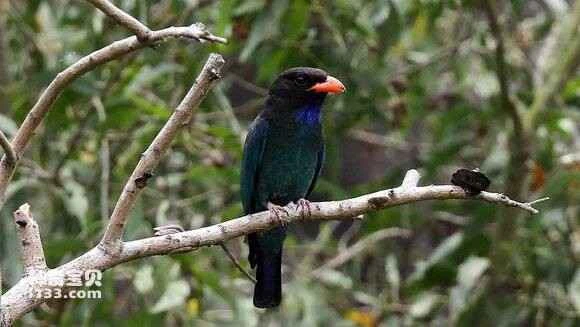
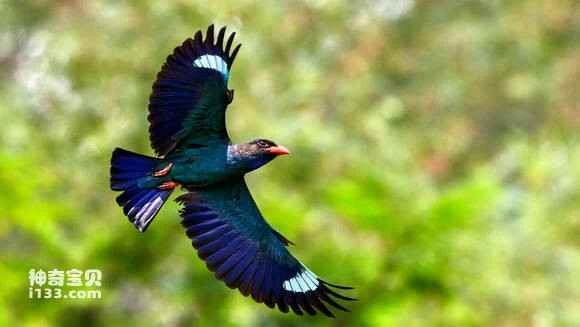
The three-bellied bird has a large and broad head with a flat top. The head and neck are blackish-brown, while the nape, upper back, shoulders, lower back, rump, and upper tail coverts are dark bronze-green. The wing coverts are similar to the back, but brighter and more blue. The primary flight feathers are blackish-brown with a broad sky-blue bar at the base; the secondary flight feathers are blackish-brown with a deep blue sheen on the outer webs; the tertiary flight feathers are blue-green at the base. The tail is black with blue markings, the same as the back at the base, and sometimes slightly tinged with dark blue-purple. The chin is black, the throat and breast are black with blue markings and cobalt blue shaft streaks, and the rest of the underparts are blue-green. The axillary feathers and underwing coverts are pale blue-green. [1]
The female bird's plumage is duller and less vibrant than the male's.
The juveniles resemble the adults, but their plumage is duller, with a greenish-brown back and no blue in their throats.
The iris is dark brown, the mouth is vermilion with a black tip on the upper beak, the feet and toes are vermilion, and the claws are black.
Size measurements: Weight ♂ 107-189 g, ♀ 108-194 g; Body length ♂ 241-290 mm, ♀ 255-290 mm; Bill length ♂ 21-31 mm, ♀ 22-30 mm; Wing length ♂ 176-197 mm, ♀ 176-197 mm; Tail length ♂ 88-113 mm, ♀ 92-111 mm; Tarsus length ♂ 16-21 mm, ♀ 16-23 mm.
(Note: ♂ male; ♀ female)
Detailed introduction
The scientific name of the Oriental Dollarbird is Eurystomus orientalis Linnaeus, and its foreign names include Broad-billed Roller and Oriental Dollarbird. Its specific habits are unknown.
The three-bellied beetle prefers to eat beetles such as green scarabs, but also grasshoppers, longhorn beetles, leaf beetles, prickly pear beetles, caddisflies, and click beetles. When foraging, it often circles back and forth in the air, catching its prey at a relatively high speed, and returns to its original branch after capturing the insect. The three-bellied beetle rarely forages on the ground. When flying or perched on a branch, it makes a rough, "kreck…kreck" call.
The three-bellied hawksbill often perch motionless on dead trees in open areas near the forest. When someone approaches, it immediately flies away, occasionally taking flight to chase passing insects or swooping down to catch insects on the ground. Its flight is similar to that of a nightjar—strange and clumsy. Sometimes it flies slowly, its long wings beating rhythmically up and down evenly; other times it soars sharply upwards or plunges sharply downwards, circling erratically or flapping its wings, constantly emitting a monotonous and harsh "cawing" sound. Two or three birds sometimes fly or swoop together at dusk, especially during courtship. Sometimes it is attacked by flocks of small birds, its head and beak making it appear like a bird of prey.
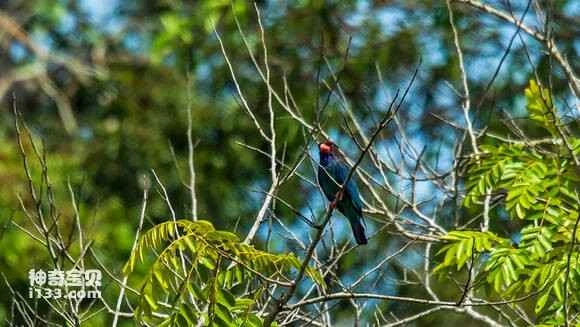
The Three-Treasured Bird is a resident bird in Yunnan and Hainan Island, and a summer visitor in other regions. It migrates to its breeding grounds in April and May and leaves in September and October.
The Three-Toothed Macaw is oviparous, with a breeding season from May to August. It nests in natural burrows in tall ash and poplar trees at the edges of mixed coniferous and broadleaf forests, and also utilizes abandoned woodpecker burrows. The burrows are often lined with wood shavings and moss, and sometimes with dry twigs and leaves. They breed once a year, laying 3-4 eggs per clutch. The eggs are white, smooth, and without spots. They are oval in shape, measuring 32-37 × 26.5-30 mm, with an average of 34.9 × 27.9 mm, and weighing 12-17 grams, with an average of 13.9 grams. Both parents take turns incubating the eggs; the chicks are altricial.
The global population size of the Three-Treasured Bird has not been quantified, but the species has been frequently reported in its distribution area. Population estimates in various countries and regions are as follows: 100-10,000 adult pairs and 50-1,000 migratory birds in China, less than 1,000 migratory birds in Taiwan; 100-10,000 adult pairs and 50-10,000 migratory birds in South Korea; less than 100,000 adult pairs and less than 1,000 migratory birds in Japan; and 100-10,000 adult pairs and 50-1,000 migratory birds in Russia.
In 806 AD (the first year of the Yuanhe era of the Tang Dynasty), the Japanese high monk Kōbō Daishi, also known as Kūkai, returned to Japan from China. At Kongōbō-ji Temple on Mount Kōya, he wrote a seven-character quatrain entitled "Idle Forest," a famous poem about the Three Jewels (Buddha, Dharma, Sangha) and the bird. The poem reads: "Alone I sit in the thatched cottage at dawn in the idle forest, I hear the sound of the Three Jewels from a bird. The bird has a voice, and I have a heart; voice and heart, clouds and water, are all clear." A poem can also be found in the ancient Japanese book "Shōreishū Buqueshō": "A lonely moon shines on the desolate corridor forest at dawn, a gentle breeze carries the Three Jewels, and a spirit bird sings. It cries out the true nature of the constant position, and the sounds of the ten realms are all clear." In modern Japan, during the Meiji Restoration, Fujisawa Tsuneyuki, a Confucian scholar from the Takamatsu Domain, wrote: "A waning moon and broken clouds mark the approaching dawn, in the Zen hall, I hear the singing of a bird. Human gains and losses are like dreams, all are clear in the sound of the Three Jewels."It is listed in the "List of Terrestrial Wild Animals of Beneficial or Important Economic and Scientific Research Value under State Protection" (Item 277) issued by the State Forestry Administration on August 1, 2000.
Listed in the China Species Red List, assessed as Least Concern (LC).
It is not currently listed in the Convention on International Trade in Endangered Species of Wild Fauna and Flora (CITES).
Listed as Least Concern (LC) in the IUCN Red List of Threatened Species 2016 ver 3.1.
Protect wild animals and ban the consumption of wild game.
Maintaining ecological balance is everyone's responsibility!