
Basic Information
Scientific classification
- Chinese name: Little Star-headed Woodpecker
- Scientific name: Dendrocopos kizuki, Yungipicus kizuki, Japanese pygmy woodpecker
- Classification: Climbing birds
- Family and genus: Order Piliformes, Family Pilidae, Genus *Pygmy woodpecker*
Vital signs data
- Body length: 12-16 cm
- Weight: 20-22g
- Lifespan: No verification data available.
Significant features
Distribution and Habitat
The Little Star-headed Woodpecker is distributed within China in southeastern Heilongjiang, Changbai Mountain in Jilin, eastern and southern Liaoning, Dongling in Hebei, and Dexian in Shandong. Outside of China, it is found in the Russian Far East, Ussuri River Basin, Sakhalin Island, Korea, Japan, and the Ryukyu Islands.
The Little Star-headed Woodpecker mainly inhabits mountain coniferous forests, mixed coniferous and broad-leaved forests, and broad-leaved forests. In Changbai Mountain, it can even be found in birch forests at an altitude of 1,700 meters. In early spring and autumn, it often forages in forest edges and secondary forests.
Appearance
The male Little Star-headed Woodpecker has a pale greyish-brown forehead and crown, brownish-gray cheeks, ear coverts, and sides of the neck, sometimes with brownish-white tips. The supercilium is white, extending backward to the nape and connecting with the white patches on the sides of the neck. The forehead stripe is white, the nape and nape are lead-black, with a fine vermilion stripe on each side of the nape immediately following the white supercilium. The back, shoulders, and inner wing feathers are blackish-brown with white horizontal bars or markings, especially the white horizontal bars on the middle of the back. The lower back has denser white patches, and the rump to the upper tail coverts are black. The tail is also black, with white horizontal bars on the outer tail feathers. The wings are a black and white mixture. The lesser wing coverts are blackish-brown, while the median and greater wing coverts are only white in the center, the rest being blackish-brown. The flight feathers are black, except for the inner tips of the primaries, which are all mixed with white patches, especially the larger white patches on the tertiaries. The whiskers, throat, and upper breast are white, the rest of the underparts are greyish-white with blackish-brown longitudinal stripes. The axillaries and underwing coverts are white, mixed with greyish-black spots. The female is similar to the male, but lacks the small red longitudinal stripes on both sides of the nape. The iris is red, the bill is lead-grey, and the legs are black.
Size measurements: Weight ♂ 20-22 g, ♀ 20-22 g; Body length ♂ 142-162 mm, ♀ 120-152 mm; Bill length ♂ 13-17 mm, ♀ 15-18 mm; Wing length ♂ 89-94 mm, ♀ 82-94 mm; Tail length ♂ 56-72 mm, ♀ 52-64 mm; Tarsus length ♂ 14-17 mm, ♀ 14-16 mm.
Detailed introduction
The Little Star-headed Woodpecker, scientifically known as Dendrocopos kizuki or Yungipicus kizuki, and also called Japanese pygmy woodpecker, has four subspecies.
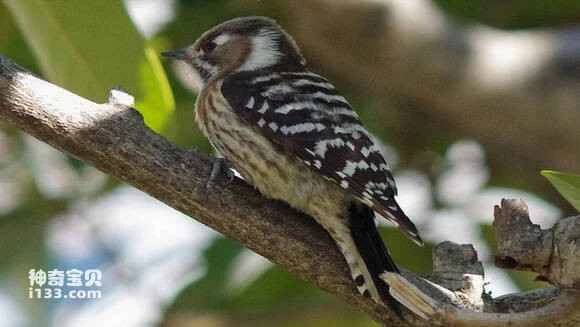
The Little Star-headed Woodpecker is a resident bird, usually solitary except during the breeding season, though family groups of 3-5 individuals can be seen during the later breeding season. Its usual call is low and monotonous, resembling a "zhā-i". Its other calls are noisy, including sharp "khit" or "khit-khit-khit" sounds, continuous "kzz-kzz" sounds, and tapping noises. In flight, it flaps its wings extensively. It frequently flies from one tree to another in search of food, generally moving from the upper part of one tree to the lower part, then climbing upwards to forage. Its diet consists mainly of various insects and larvae, including leaf beetles, longhorn beetles, small beetles, pear beetles, and Coleoptera, and occasionally also eats plant fruits and seeds.
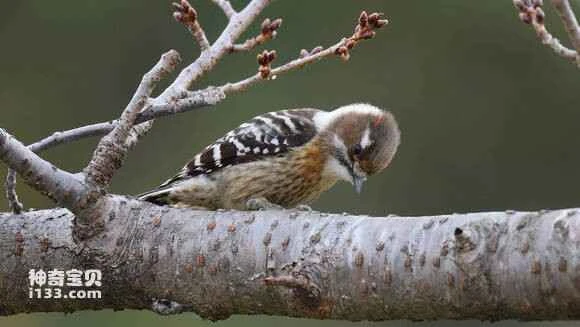
The breeding season for the Little Star-headed Woodpecker is from April to June. By late March, they are already paired and exhibit courtship behavior, frequently chasing each other in the canopy while calling. They nest in broad-leaved trees such as poplar and ash with decaying heartwood. They begin building nest burrows in late April, a process jointly undertaken by both parents. The nest burrows are typically 3-11 meters above the ground, with an entrance diameter of 3.5-4.5 cm, an inner diameter of 7-8 cm, and a depth of 14-16 cm. The nest is empty of any lining, sometimes containing only a few wood shavings. Egg laying begins in early May, with one brood per year, typically containing 4-7 eggs, usually 5. The eggs are white, smooth, and spotless, measuring 19 mm × 15 mm. Both parents take turns incubating the eggs. The chicks are altricial and are fed by both parents.
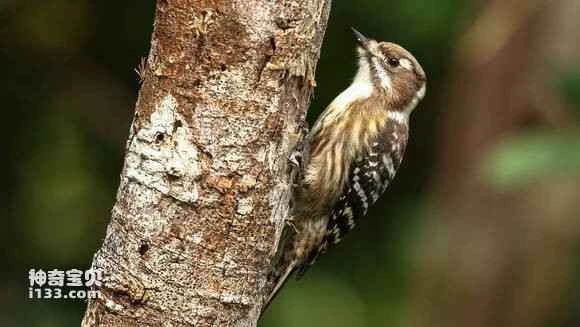
It is listed in the "List of Terrestrial Wild Animals of Beneficial or Important Economic and Scientific Research Value under State Protection" issued by the State Forestry Administration of China on August 1, 2000.
Listed as Least Concern (LC) on the IUCN Red List of Threatened Species 2012 ver 3.1.
Protect wild animals and ban the consumption of wild game.
Maintaining ecological balance is everyone's responsibility!


