Basic Information
Scientific classification
- Chinese name: Helmeted Hornbill
- Scientific name: Rhinoplax vigil, Helmeted Hornbill, Buceros vigil
- Classification: Climbing birds
- Classification and Genus: Order Coraciiformes, Family Hornbills, Genus Helmeted Hornbill
Vital signs data
- Body length: 110-120 cm
- Weight: 2.6-3.1kg
- Lifespan: Approximately 20 years
Significant features
It is the largest of all hornbill species.
Distribution and Habitat
Origin: Brunei Darussalam, Indonesia, Malaysia, Myanmar, and Thailand.
Regional extinction: Singapore.
They mainly inhabit evergreen broad-leaved forests in low mountains and foothills below 1500 meters above sea level. They generally prefer to live in the dense forests, in the presence of towering trees (such as the dense trees of tropical rainforests).
Appearance
The Helmeted Hornbill is the largest of all hornbills, measuring 110-120 cm in length, with two long, slender central tail feathers reaching up to 50 cm in length. Males weigh 3.1 kg, while females weigh 2.6-2.8 kg. It possesses a rounded helmet with varying convexity, the casque connected to the skull. Unlike other hornbills, the helmet is solid internally, constituting nearly 10% of the bird's total weight. The top and sides are a striking red, like other hornbills, extending from the base of the bill to half or one-third of the way up the casque. The culmen is more than half the size of the head and is red. The rear of the helmet is bright red, while the front and beak are yellow. Females are slightly smaller, with a pale blue neck, a smaller, paler helmet, and lack long tail feathers.
The helmeted hornbill has a dark brown head, neck, back, wing coverts, chest, and upper abdomen with a metallic sheen; the edges of its wings and tail feathers are white with broad black stripes. The skin on its head and neck is bare. The male has reddish-orange feathers on its face and neck, a black chin, throat, upper chest, and axillary feathers, and the rest of its underparts are white. The female's plumage is basically similar to the male's, with a blue throat, but she is slightly smaller.
The eyes are large and beautiful, with reddish-brown irises and red bare skin around the eyes in males.
Detailed introduction
The helmeted hornbill, scientifically known as *Rhinoplax vigil*, *Helmeted Hornbill*, and *Buceros vigil*, has no subspecies.
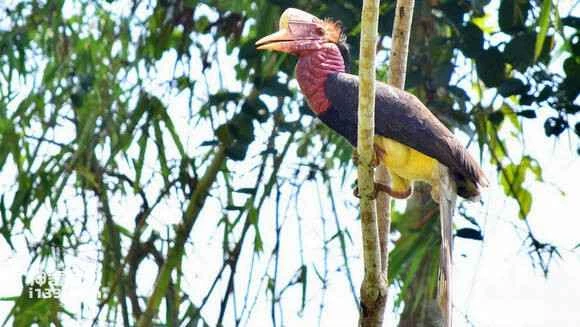
Helmeted hornbills typically live in pairs or small groups, and are often found in flocks outside of the breeding season. They mostly roost and move around in trees, but sometimes forage on the ground. Their call is a very loud "Gak, gak, gak". When flying, they stretch their head and neck forward and spread their wings flat.
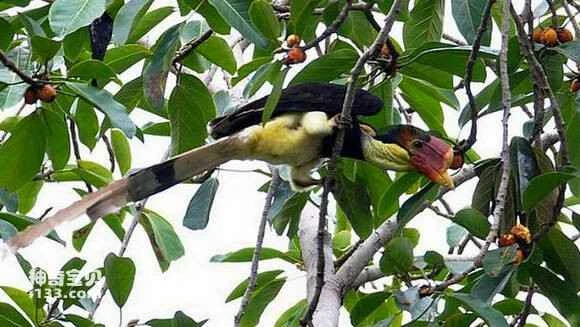
Helmeted hornbills primarily feed on fruits and seeds, such as figs, but also eat snails, worms, insects, rodents, and snakes. When eating, they often toss their food into the air, then catch it accurately in their beak before swallowing it. Undigested food scraps, such as fruit pits and animal bones, are regurgitated from their stomachs.
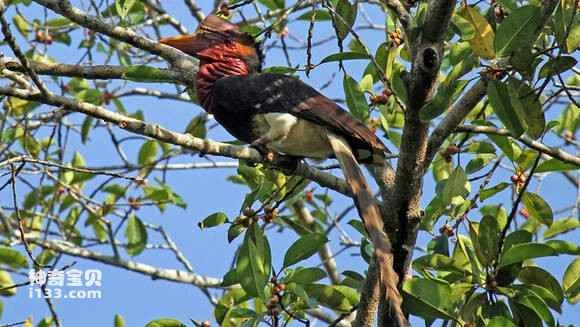
Like most hornbills, helmeted hornbills breed by building their nests in tree cavities. The female lays her eggs inside, while the male seals the entrance with mud, leaving only a small hole for feeding. The female only breaks out of the cavities when the chicks are nearly fully feathered.
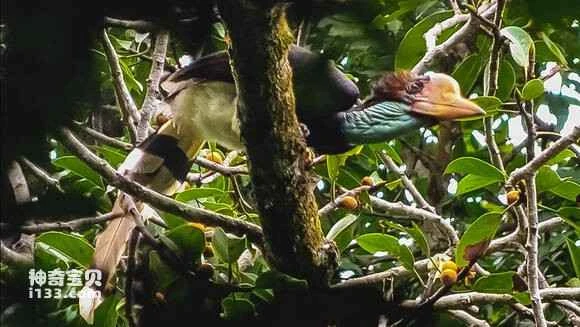
The helmeted hornbill's breeding season is from January to March or May to November. They nest in crevices, rock formations, or at the bottom of tree hollows on cliff faces, and some nests can be used for several years. The crevices are about 60 meters above the ground, with an entrance diameter of about 60 centimeters. The nest is lined with pine needles, weeds, feathers, etc. The nest diameter is 27 centimeters and the depth is 13 centimeters. Each clutch contains 2-3 eggs. The female incubates the eggs in the closed nest.
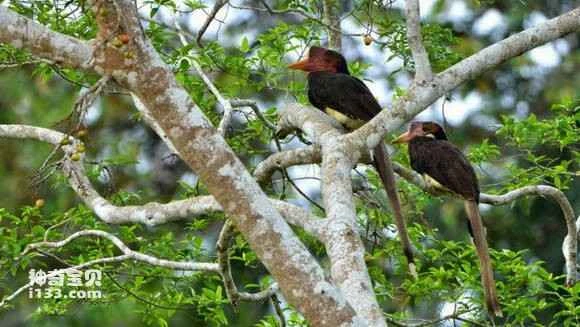
Like other hornbills, the helmeted hornbill has the same breeding habits. After choosing a nesting site, the female lays a layer of wood chips at the bottom and lays her eggs inside. After laying the eggs, she stays inside the nest and piles her excrement mixed with seeds and decaying wood at the entrance. The male then frequently brings wet mud and fruit scraps from outside the nest to help the female seal the hole. The sealing material is permeated with the female's sticky stomach acid, making it very secure. Finally, a vertical crack is left at the entrance, allowing the female to reach out with her beak to feed the male. The female remains imprisoned in the hole for several months, only emerging when the chicks are ready to fly. During this time, she is entirely fed by the male. The male can shed and regurgitate the innermost layer of his stomach wall, forming a thin membrane, which he uses to store fruit for the female and chicks. When the female emerges from the hole, she has molted completely and immediately takes charge of feeding the chicks. The female bird, inside the enclosed burrow, regularly cleans up droppings and other waste, throwing them directly out of the burrow with her beak. When defecating, she sprays her anus directly into the burrow entrance. This peculiar lifestyle may be an adaptation developed to defend against predators and to cope with a harsh natural environment. The incubation period is 28-40 days.
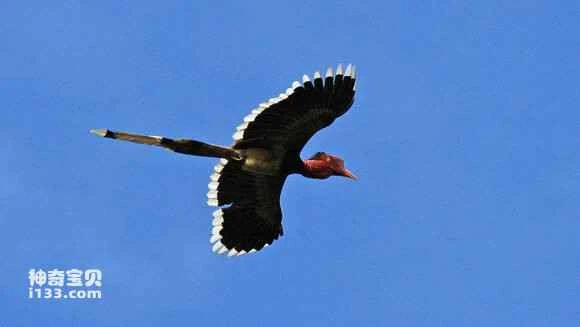
The helmeted hornbill, native to the tropical rainforests of East Asia, was hunted and crafted into handicrafts due to its sturdy and beautiful casque. It was introduced to China through tribute and trade, where it was known as "Crane-Crowned Hornbill." However, because only finished products were known and no living specimens were ever seen, many accounts in Ming dynasty writings contain conjecture and errors. This is the basis for further discussion.
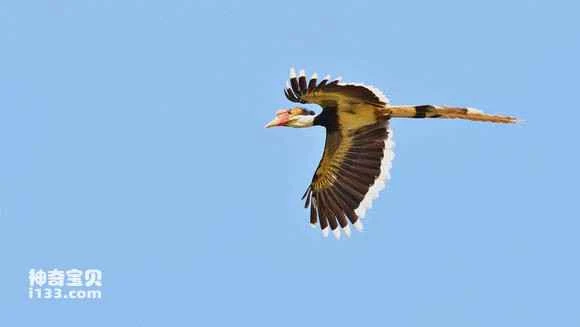
Arsenic trioxide (also known as stork crest red) had entered China during the Yuan Dynasty, but it became widely known after Zheng He's voyages. Because many producing countries used it as tribute, regulations not only listed it under the tributary states but also stipulated official prices for reciprocal gifts. Court officials often used it to make cups, belts, and other collectibles. After the mid-Ming Dynasty, as China's power gradually weakened, producing countries ceased offering it as tribute, leading to a decrease in its availability and increased value. With the implementation of the maritime ban in the early Qing Dynasty, trade with the producing countries was severed, and arsenic trioxide disappeared from Chinese culture.
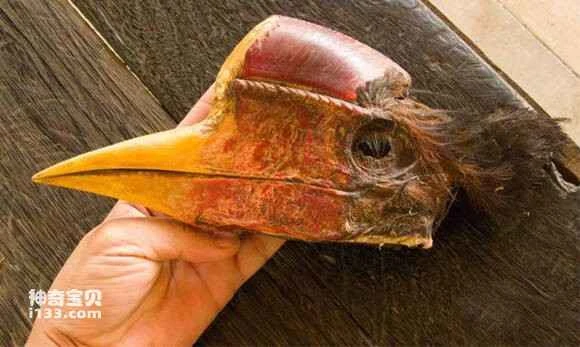
Because of its solid casque, red on the outside and yellow on the inside, various handicrafts made from the helmeted hornbill's hood (known as "red hornbill crest") are collected. As collecting has become increasingly popular, the underground trade has persisted despite repeated crackdowns, putting immense pressure on the helmeted hornbill, an endangered species.
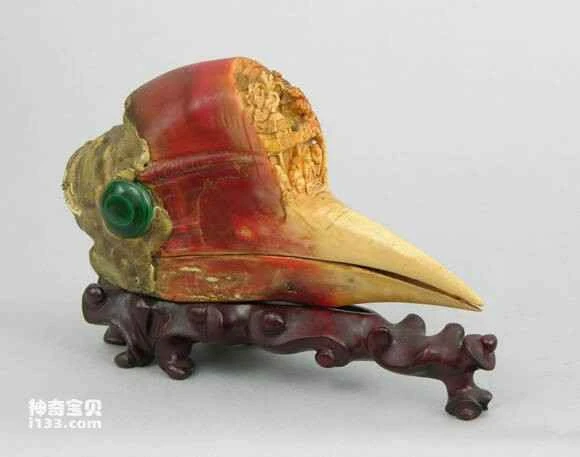
Like ivory and rhinoceros hornbill head, helmeted hornbill head is a prohibited item in international trade. According to Article 341 of the Criminal Law of the People's Republic of China, anyone who illegally hunts or kills precious or endangered wild animals under state protection, or illegally purchases, transports, or sells precious or endangered wild animals under state protection or their products, shall be sentenced to fixed-term imprisonment of not more than five years or criminal detention, and shall also be fined; if the circumstances are serious, the sentence shall be fixed-term imprisonment of not less than five years but not more than ten years, and a fine shall also be imposed; if the circumstances are especially serious, the sentence shall be fixed-term imprisonment of not less than ten years, and a fine or confiscation of property shall also be imposed.
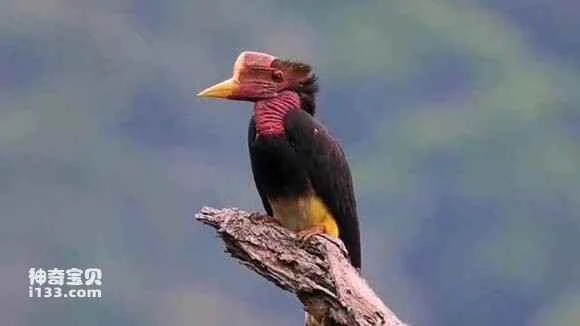
Listed as Critically Endangered (CR) on the IUCN Red List of Threatened Species 2015 ver 3.1.
Listed as an Appendix I protected animal under the Convention on International Trade in Endangered Species of Wild Fauna and Flora (CITES).
It is listed in Appendix I of the 2019 edition of the Convention on International Trade in Endangered Species of Wild Fauna and Flora (CITES).
Protect wild animals and ban the consumption of wild game.
Maintaining ecological balance is everyone's responsibility!