Basic Information
Scientific classification
- Chinese name: Great Crested Hornbill
- Scientific name: Anorrhinus galeritus, Bushy-crested hornbill
- Classification: Climbing birds
- Genus and species: Coraciiformes, Hornbillidae, Lesser Helmeted Hornbill
Vital signs data
- Body length: Approximately 74 cm
- Weight: No verification information available.
- Lifespan: No verification data available.
Significant features
Distribution and Habitat
The Great Hornbill is distributed in the Indochina Peninsula and southeastern coastal areas of China (including Myanmar, Vietnam, Laos, Cambodia, Thailand, Hong Kong, and Hainan Island), as well as the Pacific Islands (including Taiwan, the Dongsha Islands, Xisha Islands, Zhongsha Islands, Nansha Islands, the Philippines, Brunei, Malaysia, Singapore, Sumatra and Java in Indonesia, and Papua New Guinea).
The Great Hornbill has been recorded in southern Xishuangbanna, in southern Yunnan, China, and has also been found in southeastern Tibet.
Appearance
The Great Crested Hornbill is a small (74 cm) brown hornbill. It has blue bare skin around the eyes, a dark yellow bill, and a small casque. The primary flight feathers are tipped with white, which is very visible in flight; the outer tail feathers are also tipped with white. The male has a nearly white throat and brown underparts. Iris – reddish-brown; bill – dark yellow; legs – black.
Detailed introduction
The scientific name of the crested hornbill is *Anorrhinus galeritus*, and its specific habits are unknown.
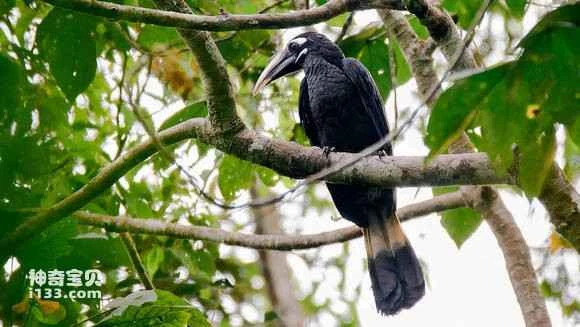
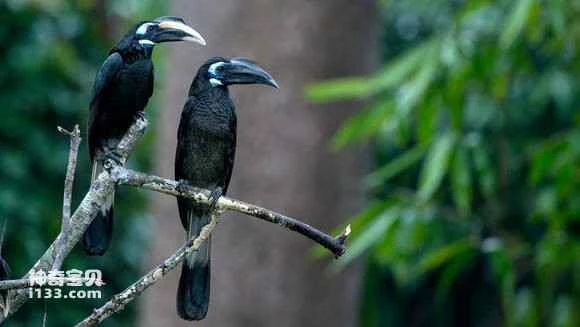
The population size of the Great Hornbill is unknown, but due to habitat loss, it is speculated that the population is small and declining.
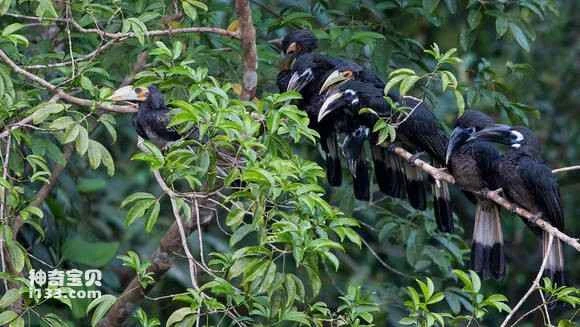
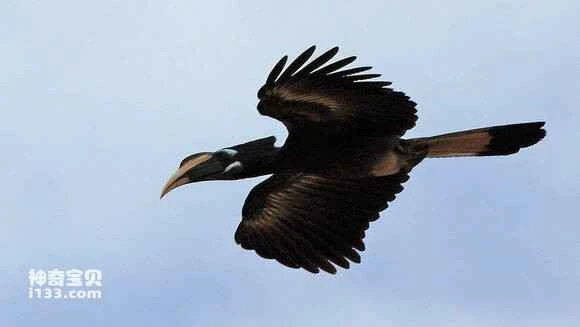
Listed as a Class II National Key Protected Wild Animal, CITES Appendix II.
Protect wild animals and ban the consumption of wild game.
Maintaining ecological balance is everyone's responsibility!