Basic Information
Scientific classification
- Chinese name: Philippine Hornbill
- Scientific name: Brown Hornbill, *Buceros hydrocorax*, *Rufous hornbill*
- Classification: Climbing birds
- Classification and Genus: Order Coraciiformes, Family Hornbillidae, Genus Hornbill
Vital signs data
- Body length: No verification information available.
- Weight: No verification information available.
- Lifespan: Approximately 35 years
Significant features
It is a species endemic to the Philippines
Distribution and Habitat
The Philippine hornbill is distributed across the Pacific islands (including Taiwan, the Dongsha Islands, Xisha Islands, Zhongsha Islands, and Nansha Islands of China, as well as the Philippines, Brunei, Malaysia, Singapore, Sumatra and Java in Indonesia, and Papua New Guinea). It is endemic to the Philippines, mainly concentrated on Luzon Island.
The Philippine hornbill inhabits tropical forests.
Appearance
The Philippine hornbill is mostly covered in black feathers, but its neck and head are brown. It has an extremely wide beak with a crescent-shaped helmet-like structure above the upper mandible, making it look as thick as a rhinoceros horn.
Besides its brown neck, most Philippine hornbills also have brown legs and tails, though the edges are lighter and whitish. Like other hornbills, the Philippine hornbill has an extremely long tail, almost a third of its body length, which provides it with more lift during flight. The brown hornbill also has bicolored eyes, usually green or blue.
Detailed introduction
The Philippine hornbill, scientifically known as *Buceros hydrocorax*, is a bird belonging to the genus *Buceros* in the family Bucerosidae.
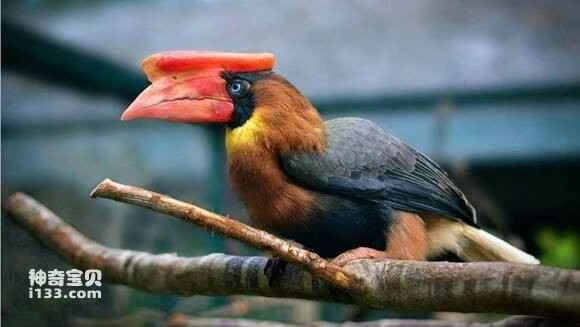
Although the Philippine hornbill is called the brown hornbill, most of its color is black, with only a distinct brown patch on its chest and neck, bordering its cheeks. The border is tinged with a light yellow, which contrasts sharply with the black feathers on its head, hence the name brown hornbill.
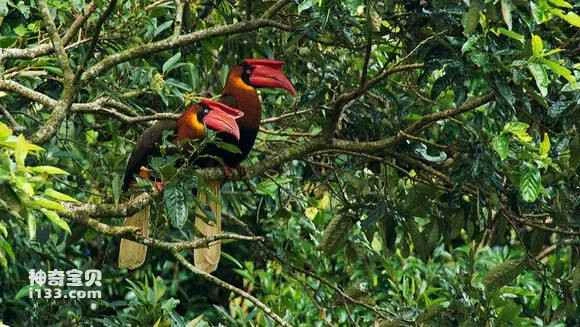
The greatest threats to the Philippine hornbill are poaching and habitat loss.
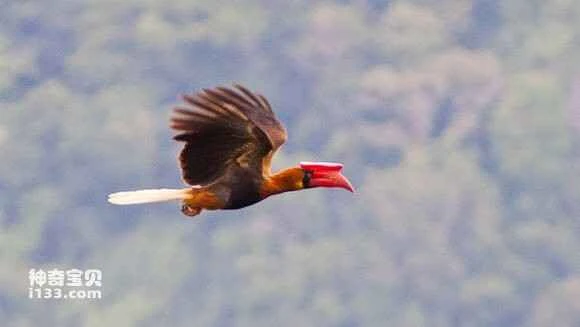
It is listed as Near Threatened (NT) on the IUCN Red List.
Protect wild animals and ban the consumption of wild game.
Maintaining ecological balance is everyone's responsibility!