
Basic Information
Scientific classification
- Chinese name: Ishima quetzal
- Scientific name: Priotelus roseigaster, Temnotrogon roseigaster, Hispaniolan Trogon
- Classification: Climbing birds
- Family and genus: Trogonales, Trogonidae, Trogonus idiomus
Vital signs data
- Body length: 27-30 cm
- Weight: No verification information available.
- Lifespan: No verification data available.
Significant features
Distribution and Habitat
It is distributed in the Dominican Republic, Haiti, and Hispaniola.
Inhabiting tropical rainforests, this bird requires numerous old, dead trees to build its nest in dry pine forests. It is found on mountain peaks ranging from 500 to 3000 meters in altitude, though it is rarely seen at lower elevations. It lives solitary lives and rests near streams during the day. Despite its extremely fast flight speed, this bird is naturally lazy, usually perching in bushes or high branches, chirping softly.
Appearance
The Ishima Trogon is 27-30 cm in length, with a black head, dark gray neck, metallic bright green upperparts, gray breast, bright red belly, gray-black wings with contrasting white stripes, and a dark blue tail. It has an orange-yellow beak and amber iris.
Detailed introduction
The Ishima trogon (scientific name: Priotelus roseigaster, Temnotrogon roseigaster) is a small climbing bird.
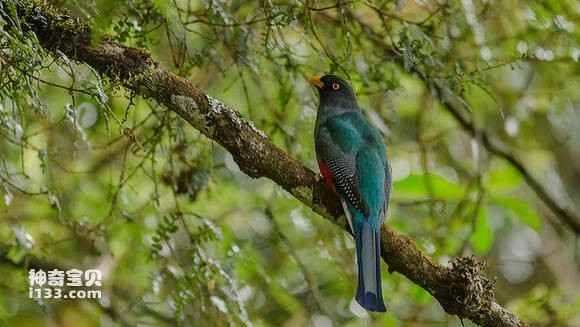
The Ishima trogon is usually found singly or in pairs, mostly in the middle and upper parts of trees, but also frequently on the ground. When flying through the forest, it often follows a undulating, wave-like pattern, very quickly, but not over very long distances. It is timid and solitary, preferring quiet environments, and is not very vocal, often resting in shady places. It is an omnivorous bird, feeding on seeds, fruits, and insects. It hunts both in the air and on the ground, primarily feeding on various insects such as locusts, mantises, moths, butterflies, and bees, as well as their larvae. It sometimes also eats small invertebrates such as snails, and the fruits, berries, and seeds of plants.
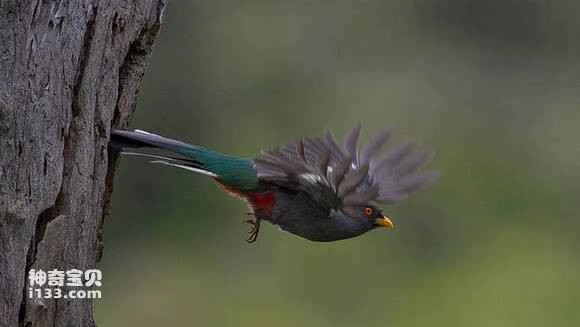
The breeding season for the Ishima Trogon is from March to May. They nest in natural tree cavities or dig holes in remaining tree trunks. Each clutch contains 2-4 eggs, which are pale brown and round in shape. Incubation lasts 17-19 days, with both male and female taking turns incubating. The chicks are altricial.
The Ishima trogon is considered a near-threatened species due to its small distribution range and declining numbers caused by the degradation and fragmentation of the forests it inhabits. However, its range is not yet severely dispersed, or is confined to only a few locations. For these reasons, it is classified as a near-threatened species.
Listed as Near Threatened (NT) on the IUCN Red List of Threatened Species 2012 ver 3.1.
Protect wild animals and ban the consumption of wild game.
Maintaining ecological balance is everyone's responsibility!


