Basic Information
Scientific classification
- Chinese name: Cuban quetzal
- Scientific name: Priotelus temnurus, Cuban Trogon
- Classification: Climbing birds
- Family and genus: Trogonales, Trogonidae, Trogonella pumilum
Vital signs data
- Body length: 24-46 cm
- Weight: No verification information available.
- Lifespan: No verification data available.
Significant features
Cuba's national bird
Distribution and Habitat
As a species of bird endemic to Cuba, the Cuban trogon is widely distributed in the country's forest regions.
The Cuban trogon inhabits tropical rainforest environments, lives solitary lives, and rests near streams during the day. Although it flies extremely fast, this bird is lazy by nature and usually perches in bushes or high branches, chirping. The local Cuban indigenous people named it guatiní based on its call.
Appearance
Cuban trogons are 24–46 cm long with a wingspan of about 25–35 cm. Their heads and necks are dark blue, their eyes are bright red, their upper beak is black and their lower beak is red with serrated horny flesh inside, their backs are dark green with a slight metallic sheen, their chests are white, their bellies are red, their feet are black, their wings are interspersed with black and white stripes, and their tail feathers are crescent-shaped. Females are slightly smaller than males, and the most obvious difference is that the red on the female's belly is slightly paler.
Detailed introduction
The Cuban trogon (scientific name: *Priotelus temnurus*) is a small climbing bird. There are two subspecies: the nominate subspecies and the Pine Island subspecies.
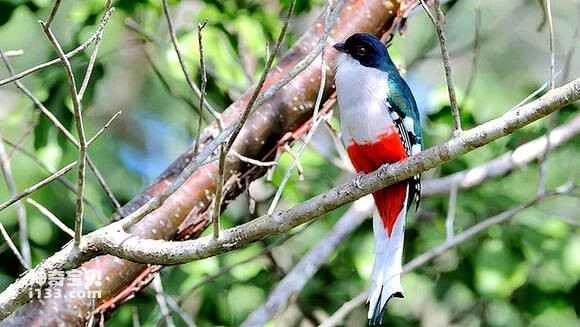
Cuban trogons are omnivorous birds, feeding on seeds, fruits, insects, and more.
Cuban trogons mate and breed between March and June each year, with one male and one female. The couple builds their nest in tree cavities. The female lays 3 to 4 eggs at a time, and the incubation period is about 14 to 21 days. Both parents raise the chicks together. The chicks' feathers gradually develop after one month of hatching, and they can live independently at two months old. Newborn chicks retain a pair of primitive claws in their wings, which disappear in adulthood.
Almost all birds in the Trogonidae family are like the temperamental "Zhang Fei Bird" in Lu Xun's writings, who couldn't be kept in a cage overnight. They cannot be confined to a cage, otherwise they will soon become irritable and depressed to death. The Cuban Trogon is no exception. This unruly character aptly reflects the Cuban people's love of freedom, which is why it was chosen as the country's national bird.
Due to habitat destruction caused by deforestation, the population of Cuban trogons is declining and they are now listed on the IUCN Red List of Threatened Species.
Protect wild animals and ban the consumption of wild game.
Maintaining ecological balance is everyone's responsibility!