
Basic Information
Scientific classification
- Chinese name: Blue-and-white three-treasure bird
- Scientific name: Oriental Broad-billed Roller, Purple Roller (Eurystomus azureus)
- Classification: Climbing birds
- Genus and species: Order Coraciiformes, Family Coraciiformes, Genus *Tripterygium*
Vital signs data
- Body length: Approximately 30 centimeters
- Weight: No verification information available.
- Lifespan: No verification data available.
Significant features
With its bright plumage, it is a valuable caged ornamental bird.
Distribution and Habitat
It is distributed in the area from the eastern waters of Mindanao through the Makassar Strait to the east of Bali and Lombok, and west of Papua New Guinea, including the islands of Sulawesi, Nusa Tenggara, Southwest Islands, Moluccas, and East Timor in Indonesia.
They usually inhabit alone or in pairs in mountain or plain forests, and also like to be active in open areas on the edge of forest areas or in cultivated areas within forest areas. They are more active in the early morning and evening. When the weather is hot, they often perch on trees in dense forests or on the treetops of large trees in more open areas.
Appearance
A medium-sized (30 cm) dark-colored castanea. It has a broad red bill (black in juveniles). This bird has magnificent plumage, with bright shoulders that are slightly bluish. The overall color is dark blue-grey, but the throat is a bright blue. In flight, there are symmetrical bright blue circular patches in the center of each wing.
Detailed introduction
The scientific name of the Purple Roller is Eurystomus azureus, and its specific habits are unknown.
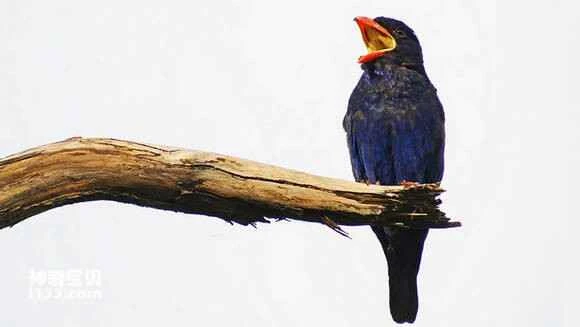
The Blue-crowned Night Beetle prefers to eat beetles such as green scarabs, as well as locusts, longhorn beetles, and click beetles. It flies slowly, its long wings beating rhythmically up and down. When foraging, it often circles back and forth in the air at a relatively fast speed, returning to its original branch after catching an insect. It can also be found in eastern my country.

The Blue-crowned Treasurebird breeds from March to May, once a year. They generally do not build nests, laying their eggs in natural burrows. These burrows are usually quite high and often have a foul odor. Each clutch contains 3-4 eggs, which are white and glossy. The chicks are altricial after hatching. They support their bodies by their tarsi completely flat on the ground. They sit upright with their heads held high.
Protect wild animals and ban the consumption of wild game.
Maintaining ecological balance is everyone's responsibility!


