Basic Information
Scientific classification
- Chinese name: Megalodon
- Scientific name: Megalodon, Megalodon
- Order: Carnivora
- Family and Genus: Megalodon
Vital signs data
- Body length: 15-25m
- Weight: 60-103 tons
- Lifespan: 88-100 years
Significant features
The most distinctive feature of the Megalodon was its enormous teeth. Fossilized teeth have been found to be up to 15 centimeters long, hence the name "mega-tooth." It was the largest and most powerful apex marine predator, with a bite force considered the strongest among all animals, both ancient and modern.
Distribution and Habitat
It has a very wide distribution, found in most parts of Europe, Africa, North America and South America, as well as Taiwan, Puerto Rico, Cuba, Jamaica, the Canary Islands, Australia, New Zealand, Japan, Malta, the Grenadines and India; its main geographical range is between 178.32°E and 122.35°W, and between 55.28°N and 43.99°S.
Appearance
Its body is torpedo-shaped, with a conical nose, huge pectoral and dorsal fins, and a powerful crescent-shaped tail.
Megalodon teeth are similar to those of the great white shark, but larger and thicker. The largest Megalodon tooth ever discovered reached 18 centimeters in length and weighed nearly 450 grams. The smooth enamel surface has longitudinal striations, and the tooth edges have numerous regular serrations, approximately 50 per 2.5 centimeters. The symmetrical teeth are deeply rooted in the jaw and have two roots. Unlike the tooth surface, the roots are quite rough.
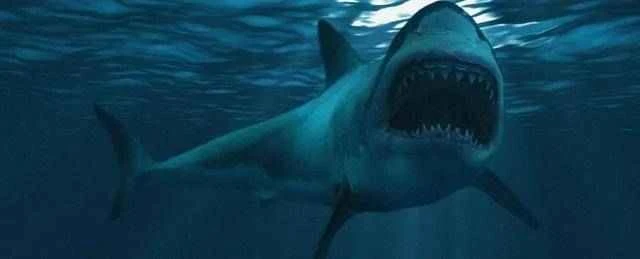
The megalodon's jaw structure is typical of sharks, with 270-280 teeth of four different types arranged in five horizontal rows within a pair of jawbones over 2 meters wide. They possessed an incredibly powerful bite; their lower jaw could crush a small car.
The megalodon's vertebral cortex was about the size of a teacup, ranging from 5 to 23 centimeters in diameter. The vertebrae consisted of two cartilaginous canals that enclosed the notochord and its sheath (the precursor to the vertebral column).
Detailed introduction
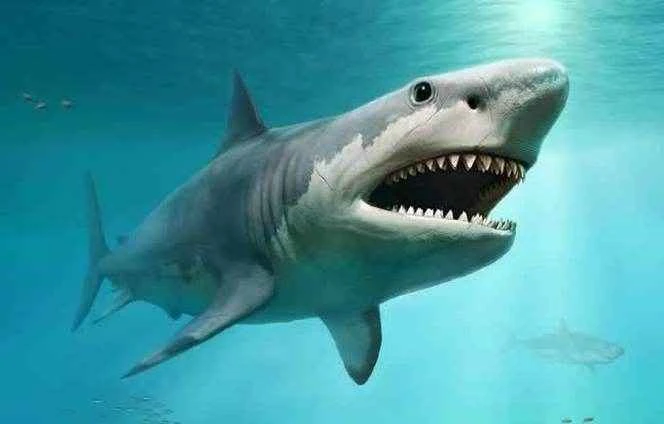
The Megalodon (scientific name: *Carcharocles megalodon*, *Otodus megalodon* ), also known as the giant toothed shark , is an extinct prehistoric shark and fish , one of the most fearsome aquatic carnivores to ever roam the Earth's oceans. Mature adults averaged at least 50 feet ( 15 meters) in length , with some reaching up to 82 feet (25 meters ), averaging 16-18 meters in size ( males averaged 16 meters , females were larger, averaging 18 meters ) . The heaviest Megalodon weighed 103 tons, with an average weight of 60-70 tons ( males averaged 60 tons, females 70 tons ) . Megalodon possessed the strongest bite force of any animal in history, with a bite force of 28-36 tons, surpassing even the Pliosaurus funkei (a member of the Pliosaurus suborder). With a bite force of 15 tons, it could easily bite through the bones of a whale, possibly making it one of the most powerful bite-bearing creatures ever discovered on Earth. Belonging to the cartilaginous fish family, it lacks an exoskeleton, so what remains are primarily its teeth. Its body is torpedo-shaped, with a conical snout, massive pectoral and dorsal fins, and a powerful crescent-shaped tail. According to a study forthcoming in the journal *Historical Biology*, the Megalodon not only gave birth to the world's largest shark pups, but it also achieved this size through a practice called oophagy — the shark embryos would eat their unborn siblings.
The Otodontidae family, to which Megalodon belongs, traces its origins back to the Cretaceous period (approximately 145 million to 66 million years ago). The earliest known Megalodon fossils appear in the Late Oligocene (approximately 28 million years ago). Throughout the Miocene, based on fossil records from the Middle Miocene (approximately 15.9 million years ago), Megalodon was primarily distributed in the western Atlantic, Mediterranean, and Caribbean Seas of the Northern Hemisphere, with only a few fossil records in Australia in the Southern Hemisphere. By the Late Miocene, its distribution had expanded to its maximum extent, encompassing the central eastern Pacific, western Atlantic, eastern Atlantic, Mediterranean, Indian Ocean, and Caribbean Sea, as well as parts of the Americas (from California to Chile, and Florida to Argentina), Europe, southern Africa, New Zealand, and Japan. However, with the global cooling of the Pliocene marking the beginning of the Ice Age, Megalodon populations gradually declined, culminating in extinction at the end of the Pliocene (approximately 2.6 million years ago).
The fossil record of Megalodon teeth shows that the number of serrations in its teeth gradually increased during its evolution. Simultaneously, the crowns became wider, the shape more triangular, and the lateral cusps gradually disappeared. This evolution in tooth morphology may reflect a shift in Megalodon's predatory strategy from biting to cutting. This shift may be related to a change in prey selection, from primarily fish to primarily whales. It continuously renewed its teeth, providing scientists with a wealth of Megalodon tooth fossils. However, over the long course of time, most of their skeletal remains have been destroyed. Therefore, little has been known about their reproductive methods and individual growth patterns.
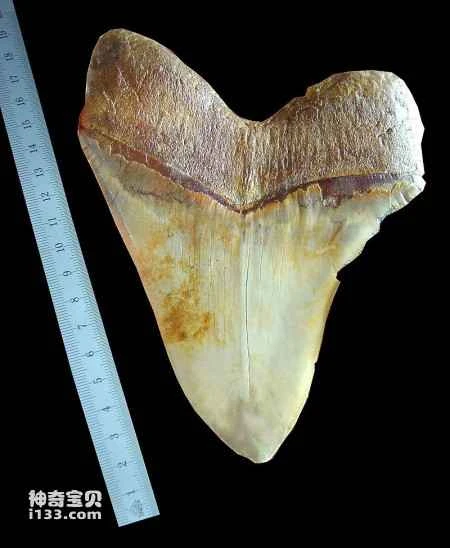
Megalodon is an organism inferred from fossilized teeth and some vertebrae. Like other modern sharks, its skeleton was cartilaginous rather than bony, resulting in a lack of fossil record of its skeleton. However, Megalodon possessed over a hundred large, hard enamel teeth that were remarkably well-preserved. These teeth were similar to those of the great white shark and were approximately 21 centimeters long (hipside length). Megalodon had over 250 teeth, each up to 20 centimeters long. These teeth had sharp, serrated edges.
Megalodon teeth have been excavated and used since ancient times. Due to their large size and serrated blades, they have become precious artifacts in pre-Columbian cultures in the Americas and have been processed into projectile tips, knives, jewelry, and funerary accessories.
Unlike most fish, sharks lack a swim bladder. They maintain buoyancy through two main methods: first, by utilizing the large amount of oil in their enormous liver (which can be up to one-third of their body size), and second, by maneuvering their pectoral fins. "Sharks do not have air inside their bodies, therefore they will not 'explode'."
Researchers from Chicago and New Jersey have pointed out that megalodon juveniles, like modern lamniform sharks, likely fed on unhatched eggs in the womb to grow. This would certainly have led to a decrease in shark numbers, but those that survived this deadly sibling competition were enormous — larger than an adult human. By using CT scans (a process that uses multiple X- rays to reconstruct 3D structures) on fossilized vertebrae housed at the Royal Institute of Natural Sciences in Brussels, Belgium, the team was able to calculate the approximate length of the megalodon at birth — revising it to be approximately 6.6 feet ( 2 meters). The study also determined that the shark grew at an average rate of 6.3 inches ( 16 centimeters) per year during the first half of its life, and growth curve models suggest that this shark had a lifespan of 88-100 years.
Morphological characteristics
The megalodon is the largest known fish, with mature adults reaching 50 feet ( 15 meters) in length and sometimes as long as 82 feet (25 meters ) ; their weight ranges from 60 to 70 tons, with females being longer and heavier than males. Resembling a great white shark, it had a torpedo-shaped body, a conical snout, massive pectoral and dorsal fins, and a powerful crescent-shaped tail.
Megalodon teeth are similar to those of the great white shark, but larger and thicker. The largest Megalodon tooth ever discovered reached 18 centimeters in length and weighed nearly 450 grams. The smooth enamel surface has longitudinal striations, and the tooth edges have numerous regular serrations, approximately 50 per 2.5 centimeters. The symmetrical teeth are deeply rooted in the jaw and have two roots. Unlike the tooth surface, the roots are quite rough.
The megalodon's jaw structure is typical of sharks, with 270-280 teeth of four different types arranged in five horizontal rows within a pair of jawbones over 2 meters wide. They possessed a powerful bite; their lower jaw could crush a small car.
The megalodon's vertebral cortex was about the size of a teacup, ranging from 5 to 23 centimeters in diameter. The vertebrae consisted of two cartilaginous canals that enclosed the notochord and its sheath (the precursor to the vertebral column).
Distribution range
Megalodon has a very wide distribution, found in most parts of Europe, Africa, North America and South America, as well as Puerto Rico, Cuba, Jamaica, the Canary Islands, Australia, New Zealand, Japan, Malta, the Grenadines and India; its main geographical range is between 178.32 °E and 122.35 °W, and between 55.28 °N and 43.99 °S.
Lifestyle
Foraging behavior
Megalodon was a carnivorous shark and the largest marine predator in history. A calcium isotope study of extinct and extant cartilaginous fish and rays showed that Megalodon had a higher nutritional level in the food chain than the great white shark of the same era. As an opportunistic predator, Megalodon primarily preyed on fish, baleen whales ( Balaenoptera ), toothed whales (ancestors of modern sperm whales Physeter macrocephalus , dolphins Delphinidae , and killer whales Orcinus orca ), sirenians (such as dugong dugon and manatee Trichechu ), and seals ( Phocoidae ).
Megalodon employed a strategy of attacking prey from above, below, or behind, using its rapid swimming ability to hunt over short distances. Deep cracks on fossilized prey suggest that their attack methods varied depending on the prey. When facing medium-sized dolphins and similarly sized fish, attacks focused on crushing bones and causing devastating damage to vital organs. However, when hunting enormous whales, Megalodon appears to have attempted to tear and bite off their flippers, incapacitating the prey before feeding; after inflicting one or more fatal bites, they would wait for the prey to die before tearing it apart and consuming it.
competitive behavior
Megalodon lived in highly competitive environments, and its apex position in the marine food chain likely had a significant impact on the structure of marine ecosystems. The fossil record shows a correlation between the appearance and diversification of Megalodon and the emergence of cetaceans and other marine mammals. Juvenile Megalodons tended to inhabit areas rich in small cetaceans, while adult Megalodons preferred areas rich in large cetaceans. This preference likely developed in the Early Oligocene, possibly because juvenile Megalodons were more vulnerable to attacks from other large predatory sharks, such as the hammerhead shark ( Sphyrna mokarran ). In areas where the ranges of great white sharks and Megalodons overlapped, such as in Pliocene California, the two would occupy the area at different times of the year, rather than coexisting simultaneously.
Body temperature regulation
Megalodon is believed to regulate its body temperature in a manner similar to that of the modern great white shark, making it not entirely cold-blooded like most fish. Like the great white, Megalodon generated heat through the contraction of its swimming muscles, raising the temperature of parts of its body above the surrounding water. This adaptation, known as zonal endothermy, is a characteristic of warm-blooded animals. This adaptation likely allowed Megalodon to swim and hunt in colder waters, enabling it to hunt prey alone in these environments.
Growth and Reproduction
Reproduction methods
Regarding the reproductive methods of the Megalodon, there are currently two main theories: viviparous and ovoviviparous. One theory suggests that the Megalodon was viviparous, with the pups receiving nutrition from the mother via the umbilical cord and growing and developing until maturity inside her body. The other theory posits that the Megalodon was ovoviviparous, meaning the eggs hatch inside the mother, but the pups are not connected to the mother via the umbilical cord; instead, they obtain nutrition by consuming the yolk sac. Megalodon typically chooses specific locations to lay their eggs and give birth to the pups. These locations are usually also the pups' habitat and hunting grounds, which helps them grow successfully and avoid other, more powerful predators.
Growth characteristics
Newborn megalodon juveniles are about 3.5 meters long, and their growth rate is approximately twice that of extant great white sharks. A 2010 study showed that megalodon somatic cell growth slows or stops around age 25 , indicating that sexual maturity in this species is extremely delayed. Based on the growth rings on the megalodon vertebrae, a mature megalodon reaching 15 meters in length could live to be 88-100 years old.
Extinction history
The extinction began in the late Miocene (approximately 5 million years ago). Global cooling and the onset of an ice age disrupted ecosystems, leading to a decline in the population of megalodon sharks, which preferred warmer waters . Tectonic movements caused the Panama Canal to rise, connecting South and North America, but this also severed the connection between the Pacific and Atlantic Oceans, resulting in significant changes to deep-sea currents. Consequently, the Earth's climate underwent major changes. Global cooling and glaciation caused sea levels to drop, reducing foreshore habitats and destroying megalodon brooding grounds.
Meanwhile, changes in ocean currents led to food scarcity. Megalodon primarily fed on whales, but the cooling polar waters made them unsuitable for survival, allowing whales to escape Megalodon predation . This, coupled with a significant decline in whale populations, resulted in food shortages and Megalodon's eventual extinction. As a top predator, Megalodon struggled to obtain sufficient food. Furthermore, the evolution of whales led to the emergence of various fast-moving, large carnivorous species, creating direct competition with Megalodon. In particular, the emergence of intelligent, team-oriented killer whales over 2 million years ago likely placed immense pressure on Megalodon's survival. Other explanations suggest that any disruption to the food chain would eliminate predators with high metabolic demands. Megalodon went extinct approximately 2.6 million years ago, ending its 14 million- year reign on Earth .
Astronomers speculate that a supernova event that occurred in Piton 2.6 million years ago may be related to the extinction of the megalodon. This event occurred at the boundary between the Pliocene and Pleistocene epochs and was a mass extinction event of a megafauna, with an estimated 36% of species ( genera ) going extinct.
Megalodon is not uncommon; it is found all over the world. So, have any Megalodon fossils been discovered in China? To date, Megalodon tooth fossils have only been found in Taiwan: in strata dating back approximately 6 million years in Kaohsiung, scientists have repeatedly discovered Megalodon tooth fossils, some exceeding 10 centimeters in size.
The deepest megalodon tooth: In June 2022 , a fossilized tooth of the extinct megalodon was collected from the seabed of the Pacific Ocean at a depth of 3,089 meters. (Guinness World Records)