Basic Information
Scientific classification
- Chinese name: Australian Cattle Dog
- Scientific name: Cattle Dog, Australian Queensland Heeler, Blue Heeler, Australian Cattle Dog, Queensland Heel Dog
- Classification: Rodentia
- Classification: ACD (Cattle Dog, Blue Heller, Red Heller, Queensland Heller)
Vital signs data
- Body length: 43-51cm
- Weight: 16-20kg
- Lifespan: 15-29 years
Significant features
A strong physique, versatile work abilities, an alert and resourceful nature, and a love and loyalty to their work. Character traits include alertness, resourcefulness, courage, and honesty; they are wary of strangers but absolutely loyal to family members.
Distribution and Habitat
Originating in Australia, this breed is well-adapted to the harsh, undeveloped environment of the Australian outback, where they are primarily used for herding cattle over long distances. Australia's vast areas, characterized by subtropical desert and tropical savanna climates, along with the flat, open, and arid terrain of the central plains, provide ideal living and working conditions for the Australian Cattle Dog. They are invaluable assistants to farmers, controlling cattle with precision and efficiency, thus playing a vital role in Australian livestock farming.
Appearance
It is a strong, versatile, and well-proportioned working dog, whose main physical characteristics include:
Size: Male dogs stand between 46 and 51 cm tall, while female dogs stand between 43 and 48 cm tall. Weight ranges from 16 to 20 kg.
Head: The head is sturdy, balanced in proportion to the body, and well-proportioned. The cheek muscles are well-developed, and the lower jaw is strong, deep, and well-defined, and relatively wide. The ears are slightly arched, and the eyes are oval, medium-sized, and convey an alert and intelligent expression.
Ears: Medium-sized, broad at the base, erect, and pointed at the tip.
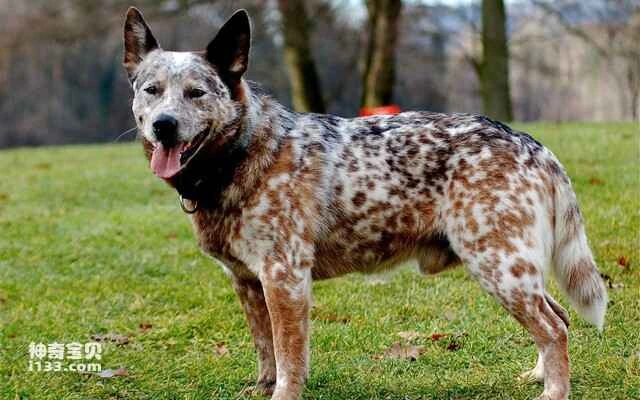
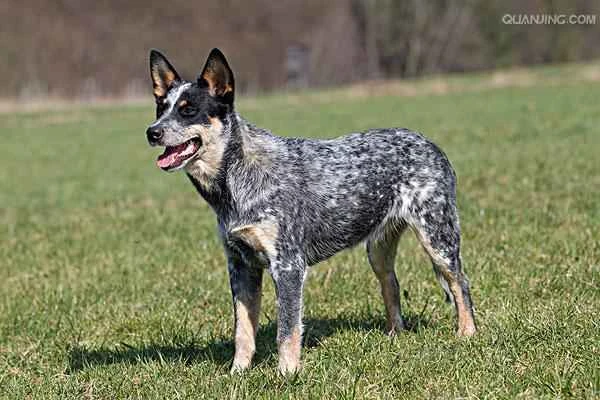
Coat: The coat is smooth, double-coated, with a short, dense undercoat and a tight, straight outer coat that lies flat against the body and provides rain protection. The hair on the underside of the body and down to the back of the legs is slightly longer. Coat colors include mottled blue, blue spots, and red spots, with black, blue, or brown markings on the head.
Tail: The tail is set slightly low, extending down from the sloping rump to the hock. When at rest, the tail hangs straight down with a slight curve; when moving or excited, the tail protrudes in a beautiful brush shape.
Characteristic weight: 15-22 kg (33-49 lbs)
Height: Males 46-51 cm (18-20 inches)
Females 43–48 cm (17–19 inches)
Fur: Short double coat; Colors: Blue, blue spots, blue stripes, red spots, red stripes
Detailed introduction
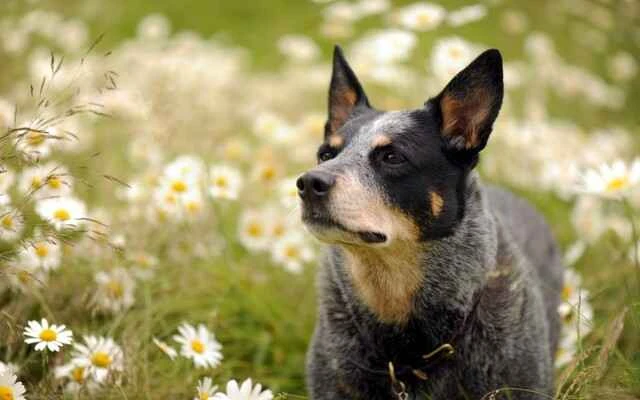
The Australian Cattle Dog, also known as the Queensland Heeler , Blue Heeler , or simply Cattle Dog, is a breed originating in Australia. It was specifically bred to herd cattle over long distances. The Australian Cattle Dog holds the record for the longest-lived dog in the world at 29 years.
Australian Cattle Dogs are energetic, have great stamina, are versatile, intelligent, and highly independent. They respond well to structured, fun, and challenging training. In the Australian outback, they are primarily used for herding cattle over long distances and must be adapted to the harsh, wilderness environment to control the herds with the most precise and effortless methods.
Historical Origins
The origins of the Australian Cattle Dog are complex. There is an endangered blue-legged dog breed in England that herded sheep and cattle onto ships by biting the fore and hind legs of livestock. While the origins of the Australian Cattle Dog are debated, it bears a striking resemblance to this short-tailed breed.
In the 19th century, an Australian pioneer named Thomas Smithao needed to develop a breed similar to the Australian Cattle Dog, one that was strong and capable of overcoming the difficulties of herding cattle. He imported blue-spotted Highland Sheepdogs from England and crossbred them with selected dingoes known for their stealthy, scavenging abilities, thus creating this breed. This breed is very similar to the modern Australian Cattle Dog. This dog is highly alert and therefore requires intensive training from a young age.
The breed is descended from crossbreeding of several different ancestors, including the dingo, Highland Collie, Dalmatian, Australian Colby, and Old English Sheepdog. The most important of these is the dingo, which was further developed by the brothers Jack and Harry Bagst in Sydney in the 1880s , eventually forming the modern Australian Cattle Dog and Australian Tailless Cattle Dog. The Bagst brothers successfully shaped the breed's characteristics through extensive selective breeding and culling. The Australian Cattle Dog is known as the " Red Heeler" or " Blue Heeler" due to its coat color and herding instincts. The nickname " Queensland Heeler " may also originate from a popular pamphlet published in Victoria. The Australian Cattle Dog holds the record for the longest canine lifespan at 29 years. With an average lifespan of 14 years, it demonstrates a significantly longer lifespan compared to the average of 12.7 years for other purebred dogs and 12 years for mixed-breed dogs. Many Australian Cattle Dogs remain active into their 12- to 14- year-old selves, and some even maintain good vision, hearing, and dental health until their death.
Body shape characteristics
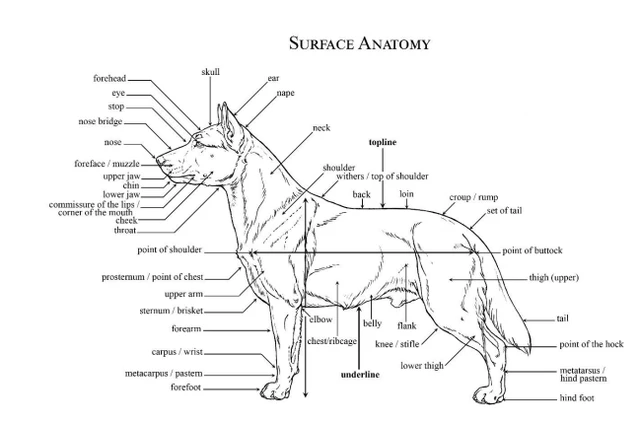
The Australian Cattle Dog is a robust, muscular, compact, versatile, and well-proportioned working dog. It is characterized by its sturdiness, power, symmetry, and muscular build, exhibiting agility, strength, and tenacity.
Height: Male dogs: 46-51 cm, Female dogs: 43-48 cm.
Weight: 16-20kg .
physical characteristics
head
The head is strong and balanced in proportion to the body, with a well-proportioned structure. It possesses a broad skull, with well-developed cheek muscles extending from the flat area between the eyes to a distinct forehead. The jaw is strong, deep, and very well-defined. The ears are slightly arched, proportionate to the rest of the body, and balanced. The cheek muscles are abundant but neither coarse nor overly prominent. The jaw is strong, thick, and well-developed. The foreface is broad, blending appropriately below the eyes. The muzzle tapers gradually, is of medium length, and is thick and strong. The lips are tense and clean. The muzzle is of moderate length, deep, and strong, with a black nose that matches the body color. The neck and shoulders are strong and powerful.
Teeth: The teeth are healthy and strong, regularly arranged, with a scissor bite. The lower incisors close behind the upper incisors and neither protrude inward nor outward.
Eyes: Oval in shape, medium in size, neither protruding nor sunken, conveying alertness and intelligence. A wary and curious gaze is its defining characteristic. The color is deep, a dark brown.
Ears: Both ears are of medium size, with smaller ears being preferred over larger ones. They are widely spaced at the base, muscular, erect, and moderately pointed ( neither spoon-shaped nor racket-shaped ) . When in use, the base of the ears expands, moving downwards and outwards; when alert, both ears are erect. There is appropriate feathering on the inner side.
Forequarters: Broad shoulders, slightly sloping; strong and angular upper arm bones; forelimbs are thick, rounded bones that extend to the feet. From the front, the legs are straight , but the palms and forearm bones form a certain angle.
Hindquarters: The hindquarters are broad, strong, and muscular. The croup is long and sloping. The legs are long, well-developed, with proper flexion at the stifle joints and strong hock joints. Viewed from behind, the hock joints and feet are in a straight line.
Chest: Deep, muscular, and of moderate width. Loin: Broad, strong, and muscular with deep loin dimples. Feet: Round, with short, strong, arched, and compact toes. Pads are hard and thick, and claws are short and strong.
Tail: The tail is set slightly low, descending from the sloping rump outline, extending approximately to the hock. When at rest, the tail hangs straight down with a slight curve. During movement or excitement, the tail is raised, forming a beautiful brush shape.
Coat color: Mottled blue, blue spots, red spots, with black, blue, or brown markings on the head. The coat is smooth and double-coated. The undercoat is short and dense, while the outer coat is tight, all hairs are straight, harsh, and lie flat on the body, providing rain protection. The hair on the underside of the body and down to the back of the legs is slightly longer.
Gait: The expression should be alert and sharp, and a sound physique is of utmost importance. Movement should be appropriate, free, docile, and sustained. The shoulders and muzzle should move in coordination with the hind legs. Quick movement and explosive power are essential qualities of this dog. Shrugging, carrying heavy loads, loose or overly straight shoulders, bowed elbows or hocks, loose paws, and stiff, straight stifle joints are all considered serious faults.
Lifestyle
The Australian Cattle Dog's alertness, intelligence, guarding ability, courage, honesty, and absolute loyalty make it an ideal working dog. Its loyalty and protective instincts are invaluable to ranchers, cattle, and property. It is adaptable to various climates. Australian Cattle Dogs reach sexual maturity at 12 months. They go into heat twice a year, in February and August, and typically give birth to three to five puppies per litter.
Features and Uses
The Australian Cattle Dog's alertness, intelligence, guarding ability, courage, honesty, and absolute loyalty make it an ideal working dog. This breed is known for its strong guarding instincts and powerful bite, making it unsuitable as a family pet.
Feeding methods
Shower
Known for their "wash and wear " nature, Australian Cattle Dogs are excellent at removing accumulated dandruff. Bathing doesn't need to be too frequent; once every two weeks in summer and once a month in winter is generally sufficient. Be careful, as overly frequent bathing can damage the protective oily layer on their coat. They require relatively little grooming. Use lukewarm water when bathing, avoiding the eyes, and remember to thoroughly dry their fur afterwards. These dogs only shed during the annual shedding season, with unneutered females potentially shedding twice a year. This characteristic makes Australian Cattle Dogs relatively easy-to-care-for pets.
Special shampoo for fur
If regular shampoo isn't effective at removing dandruff, you'll need to choose a specialized anti-dandruff shampoo containing various special ingredients. Never use human anti-dandruff shampoo to bathe your dog, as this can cause further irritation.
When an Australian Cattle Dog has severe dandruff, it's best to avoid using shampoos containing flea-killing ingredients, as these products often make the skin even drier.
Hair care spray
If your Australian Cattle Dog lives in a dry environment, it may develop a lot of dandruff. You can buy some oily coat conditioner from a pet store. Spraying it on its fur can effectively prevent excessive evaporation of moisture from its coat.
Moisturizing oil
Products typically used for baby skincare can also moisturize the fur of Australian Cattle Dogs.
Combing
Regularly brushing your Australian Cattle Dog removes accumulated dandruff and dead hair, and helps distribute the natural oils secreted by its skin evenly across every inch of its skin. With frequent brushing, many dandruff problems can be naturally resolved.
When choosing a comb, pay attention to whether the teeth are too hard. You can test it on the back of your hand. If it hurts, your dog will likely feel the same way. In fact, the combs that people use to comb their hair are very suitable for dogs. You can also choose a special pet grooming comb.
Add fish oil
One reason for increased dandruff might be insufficient oil in the Australian Cattle Dog's diet. Adding a suitable amount of pet-specific fish oil to their food is a good idea, as it can help restore the skin's normal metabolic function. Just half a teaspoon or a teaspoon of fish oil daily can produce noticeable improvements.
Change dog food
Some lower-quality dog food cannot meet the nutritional needs of Australian Cattle Dogs, which can lead to poor coat health. Many dogs' dandruff problems naturally heal after switching to a more professional dog food.
Common health problems
Injuries are more common than illnesses in cattle dogs.
Australian Cattle Dogs are associated with congenital, hereditary deafness due to carrying a recessive allele that causes white coat and skin. This deafness association may be caused by the combined effects of multiple genes. In one Australian study, approximately 10.8% of Australian Cattle Dogs exhibited deafness in one or both ears.
Progressive retinal atrophy is also a common disease affecting Australian Cattle Dogs. The most common form of this disease is progressive rod-cone degeneration ( PRCD ), which causes the degeneration of rod and cone cells in the dog's later years, eventually leading to blindness. PRCD is an autosomal recessive genetic trait, and dogs may carry the gene for the disease without showing symptoms.
While hip dysplasia is uncommon in Australian Cattle Dogs, its incidence is high enough that breeders and owners should conduct specialized radiographic screenings for potential pelvic problems. In addition, Australian Cattle Dogs may suffer from other genetic diseases, such as hereditary poliomyelitis, a rare condition caused by a genetic biochemical defect; diagnosed dogs typically develop the disease within the first year of life and rapidly become paralyzed.
According to a survey of 69 surviving dogs, the most common health problems recorded by their owners included musculoskeletal problems (such as vertebral arthritis, elbow dysplasia, and arthritis), reproductive problems (such as pyometra, infertility, and pseudopregnancy), and blindness. [38] A 30-year study conducted by veterinary colleges in the United States and Canada found that the most common diagnostic problems in Australian Cattle Dogs included fractures, lameness, and anterior cruciate ligament injuries.
The breed standard states that, even as a companion or show dog, the dog should maintain good muscularity, with a symmetrical and balanced appearance, and no part should be excessively exaggerated. The breed should not appear too slender or too bulky, as this would limit its agility and stamina required as a working dog.
size
In terms of size, female Australian Cattle Dogs stand approximately 43–48 cm ( 17–19 inches ) tall at the shoulder, while males stand approximately 46–51 cm ( 18–20 inches ). The dog's body length should be slightly greater than its shoulder height, and the length from the breastbone to the hip should be greater than its shoulder height, in a ratio of approximately 10 to 9 .
coat and color
A puppy with red fur that hasn't grown yet
As the puppy grows, the red hairs will stand out from its white coat.
Australian Cattle Dogs have two widely accepted coat colors: red and blue. Chocolate and cream are considered breed faults. Blue dogs may be solid blue, have blue spots or markings, with brown on the legs and chest, and may have white markings on the head and one or two black patches or "masks." Red dogs have evenly distributed red markings, a brown (red) "mask" on the head, and sometimes this coloration on the body as well.
Red and blue dogs are born white (unless they have solid body or facial markings), and red or black hairs begin to appear as they age, starting around four weeks old. The distinctive coloration of adult dogs is formed by an even distribution of black or red hairs against a predominantly white coat. This color distribution is not a patchy pattern (which can cause related health problems), but rather due to the presence of speckled genes. The speckled pattern refers to the color appearing in white areas, but the overall effect depends on other genes that alter the size, shape, and density of the speckled pattern.
The Australian Cattle Dog's appearance also includes some solid or near-solid patches. In red and blue dogs, the most common are a "mask" marking on the eyes, a white tip on the tail, solid spots at the base of the tail, and sometimes solid spots on the body, although this is not desirable for show dogs. Blue dogs may have brown markings on the middle of the legs, chest, and throat, as well as on the muzzle and eyebrows. Both color variations may have a white star-shaped spot on the forehead called the "Bentley Mark ," believed to be a descendant of a dog named Tom Bentley, characterized by a white spot on the forehead and a black tail streak. Common color errors include black hair in red dogs and excessive brown on the face and body of blue dogs, known as "spreading brown." Australian Cattle Dogs have a double coat; the outer guard coat is short and straight, providing protection against harsh weather, while the undercoat is short, fine, and dense.
The head of the cattle dog is alert.
A cattle dog with a left "single mask" and a "Bentley mark" (on the top of its head) is displaying the breed's typical alert expression.
"Mask" markings refer to specific spots that appear around the eyes of Australian Cattle Dogs. These spots are black on blue-coated dogs and red on red-coated dogs. Depending on whether the spots appear on one or both eyes, these markings are called "single mask" (or "half mask") and "double mask" (or "full mask"), respectively. Dogs with no markings on their faces are called "pure-faced." According to the Australian Cattle Dog breed standard, all mask patterns are acceptable. In judging a dog's appearance, even and symmetrical mask markings are generally preferred over uneven markings.
Tail
According to the breed standards of the Australian, American, and Canadian Kennel Clubs, the Australian Cattle Dog has a naturally long tail, typically with a solid-colored spot at the base and a white tip. The tail should hang naturally, conforming to the slope of the back, slightly curved when at rest, and raised when excited. Furthermore, the tail should have a good brush cover, indicating good health.
In the United States, tail docking is sometimes performed on working dogs, but in all Australian states and territories, tail docking is generally illegal except in exceptional circumstances.
The Australian Cattle Dog and the Australian Tailless Cattle Dog share the same bloodline and early history. In the 1930s , the Queensland breed standard described both long-tailed and short-tailed types of cattle dogs. These two types were shown in different show categories. By 1963 , the Australian National Kennel Council had clearly distinguished between the two types in its breed standard.
temperament
In terms of temperament, Australian Cattle Dogs, like many working dogs, exhibit high energy and intelligence, and possess a degree of independence. According to Stanley Cullen's book *Dog Intelligence*, Australian Cattle Dogs rank among the top ten in obedience training intelligence. Therefore, this breed requires ample exercise, human companionship, and work to maintain its physical and mental health. Outside of working environments, Australian Cattle Dogs should participate in exercise, skill learning, or other activities to fully develop and utilize their physical and intellectual abilities.
In a family setting, the Australian Cattle Dog is a loving and playful pet. However, it is wary of unfamiliar people and exhibits natural caution in new environments. This makes it an excellent watchdog with proper training. Furthermore, while friendly towards well-behaved children, it may shoo away children who run or scream. By weaning, puppies should have learned to enjoy human interaction and to be rewarded for responding to commands. Australian Cattle Dogs develop a deep bond with their owners, a strong attachment that makes them protective and unlikely to stray far from them; they react quickly to their owner's emotions and may defend them without waiting for commands. Therefore, without proper training and management from puppyhood, their protective and biting tendencies can become uncontrollable and pose a risk as adults.
Australian Cattle Dogs are typically silent while working, but will bark when alert or needing attention; this barking can sometimes be due to boredom or frustration, especially in dogs raised in noisy environments. Furthermore, while they respond well to familiar dogs, in multi-dog environments, Australian Cattle Dogs may need to establish a social hierarchy, which can sometimes trigger aggressive behavior, indicating they are not well-suited to pack life with other dogs.
FCI Certification Standards
Overall Appearance: The overall appearance is that of a strong, compact, and well-proportioned working dog, capable and willing to complete the tasks assigned to it, no matter how challenging. Its physique, strength, balance, and solid muscle condition must give the impression of exceptional agility, power, and stamina. Any tendency towards being stocky or thin is a serious fault. Important Proportions: The straight length from the point of the sternum to the hip is greater than the height at the shoulder, with a ratio of 10 : 9 .
Behavior / Temperament: The loyalty and protective instincts of the cattle dog make it a self-appointed guardian of herders, herds, and property. While naturally suspicious of strangers, it must obey commands, especially in the show ring. Any temperament or structural characteristics inconsistent with a working dog must be considered a serious fault. As its name suggests, the dog's primary function is controlling and moving cattle in both open and confined areas—its unparalleled ability.
Its constant vigilance, exceptional intelligence, alertness, courage, and trustworthiness, along with its absolute loyalty to its duties, make it an ideal working dog.
Head: The head must be strong, balanced with the rest of the dog, and conform to its overall structure.
Skull region:
Skull: The broad skull curves slightly between the ears.
Stop: The skull is slightly flattened, but the stop is distinct.
Facial area:
Nose: Black.
Muzzle: Broad and full below the eyes, gradually tapering to form a medium-length, deep, and powerful muzzle; the skull and muzzle are on a parallel plane.
Lips: Tight and clean.
Jaw / Teeth: The lower jaw is strong, deep, and well-developed. Teeth should be healthy, strong, and evenly spaced, with a scissor bite, the lower incisors close behind and just touching the upper incisors. Healthy, strong teeth are crucial because dogs need to herd or bite difficult cattle.
Cheeks: Muscular, neither coarse nor prominent.
Eyes: The eyes should be oval, medium-sized, neither protruding nor sunken, and must convey alertness and intelligence. The eye color should be dark brown. They should emit a warning or suspicious glint when a stranger approaches.
Ears: Ears should be medium-sized, preferably small rather than large, broad at the base, muscular, erect, and moderately pointed, neither spoon-shaped nor bat-shaped. The ears are set wide apart on the skull, tilt outwards, are sensitive to use, and will stand erect when alert; the leather should be thick, and the inside of the ear should be covered with abundant hair.
Neck: The neck is very strong, muscular, of medium length, and integrated with the body; it has no throat.
Body:
Backline: Horizontal.
Back: Strong.
Loin: Broad, strong, and muscular. Dogs have strong physiques and deep loins.
Hips: Quite long and sloping.
Chest: Deep, muscular, and of medium width. Ribs are flexible, extend well backward, and are not barrel-shaped.
Tail: The tail is set moderately low, following the sloping contour of the rump, and its length extends approximately to the hock. At rest, it should hang with a very slight curve. When moving or excited, the tail may be carried high, but under no circumstances should any part of the tail extend beyond the vertical line passing through the base. The tail should be like a brush.
limbs
Forequarters:
Overall appearance: The forelimb bones are strong and rounded, extending to the feet, and should be straight and parallel when viewed from the front.
Shoulders: Shoulders are strong, sloping, and muscular, forming a good angle with the upper arm, and the acromion should not be too close together. Although the shoulders are muscular and well-boned, excessive load on the shoulders and a heavy front can hinder proper movement and limit work capacity.
Metacarpals (metacarpals) : Viewed from the side, the metacarpals should be flexible and at a slight angle to the forearm.
Forefoot: The foot should be round, with short, strong, arched, and closely spaced toes. The pads should be hard and deep, and the toenails must be short and strong.
Hindquarters:
Overall appearance: The hindquarters are broad, strong, and muscular. Viewed from the rear, the hind legs are straight and parallel from the hock to the foot, neither too close together nor too wide.
Thighs: Long, wide, and well-developed.
Knee joint: Good turning ability.
Hock: Strong and well-positioned.
Hindfoot: The foot should be round, with short, strong, arched, and closely spaced toes. The pads should be hard and deep, and the toenails must be short and strong.
Gait / Movement: Movements should be realistic, free, supple, and tireless, with shoulder and forelimb movement synchronized with powerful thrust from the hindquarters. The ability to move quickly and suddenly is essential. Soundness is paramount. When trotting, the feet tend to be closer together on the ground as speed increases, but when the dog stops, it should stand firmly on its feet.
Coat: The coat is smooth, with a double coat. The undercoat is short and dense. The outer coat is dense, with each hair straight, harsh, and even, thus providing rain protection. The coat is longer on the lower body and behind the legs, forming a slight croup near the thighs. The hair on the head (including the inside of the ears), legs, and front of the feet is shorter. The hair on the neck is longer and thicker. A coat that is too long or too short is considered a fault. The average length of the body hair should be 2.5 to 4 cm.
color:
Blue variegation: The color should be blue, blue variegated, or blue speckled, with or without other markings. Permissible markings on the head are black, blue, or tan, preferably evenly distributed. The midsection of the forelegs is tan, extending to the chest and front of the throat, with the jaw being tan; the hindquarters, inner sides of the hind legs, and inner thighs are tan, extending from the front and stifle joint down to the outer side of the hind legs, from the hock to the toes. A tan undercoat is permissible on the body, as long as it does not show through the blue outer coat. Black markings on the body are undesirable.
Red spots: The entire body should be covered in uniform red spots, including the undercoat (neither white nor creamy white). Dark red markings on the head are acceptable, but not desirable. Uniform markings on the head are desirable. Red markings on the body are permissible but not ideal.
Size and weight:
Shoulder height: Males: 46 to 51 cm.
Female: 43 to 48 cm.
Defects: Any behavior that deviates from the above points should be considered a defect, and the severity of the defect should be proportional to its degree and its impact on the dog's health and welfare as well as its ability to perform conventional work.
Critical defects
• Shoulders are loaded, relaxed, or straightened.
• Weakness in the elbows, hips, or feet.
• Keep your knees straight.
• Cow leg or bow leg.
• The movements appear stiff
The drawbacks of disqualification:
• Dogs that are either overly aggressive or excessively shy.
• Any dog that clearly exhibits physical or behavioral abnormalities.
Notice:
• Male animals should have two distinct, normal testes that are fully descended into the scrotum.
• Breeding should only be carried out using functionally and clinically healthy dogs with typical breed structure.
The latest revisions are shown in bold.