
Basic Information
Scientific classification
- Chinese name: Red-necked Grebe
- Scientific name: Podocipes grisegena, Red-necked Grebe
- Classification: Waterfowl
- Genus and family: Grebe, order Grebe, family Grebe, genus Grebe
Vital signs data
- Body length: 48-56 cm
- Weight: about 1kg
- Lifespan: No verification data available.
Significant features
Summer plumage features a black crown and short crest, greyish-white cheeks and throat, and chestnut-red foreneck, sides of neck, and upper breast.
Distribution and Habitat
The Red-necked Grebe is distributed in Europe, the far north coast of Africa, southwestern Asia, eastern Siberia, and western and northern North America.
Native distribution: Afghanistan, Albania, Armenia, Austria, Azerbaijan, Belarus, Belgium, Bosnia and Herzegovina, Bulgaria, Canada, China, Croatia, Czech Republic, Denmark, Estonia, Finland, France, Georgia, Germany, Greece, Hungary, India, Iran, Ireland, Italy, Japan, Kazakhstan, North Korea, South Korea, Kyrgyzstan, Uzbekistan, Latvia, Lithuania, Macedonia, former Yugoslavia, Moldova, Montenegro, Netherlands, Norway, Pakistan, Poland, Romania, Saint Pierre and Miquelon, Serbia, Slovakia, Slovenia, Spain, Sweden, Switzerland, Tajikistan, Turkey, Turkmenistan, Ukraine, United Arab Emirates, United Kingdom, United States.
Migratory birds are distributed in Algeria, the Bahamas, Bermuda, Cyprus, Egypt, the Faroe Islands, Greenland, Iceland, Israel, Lebanon, Luxembourg, Portugal, Saudi Arabia, Svalbard and Jan Mayen, Syria, and Tunisia.
Distribution in China: In summer, it is found in Heilongjiang (Harbin, Suihua, Tailai, Qiqihar, Jiamusi), and migrates through Jilin, Liaoning and even Hebei. Sometimes it migrates to Fujian (central part, Fuzhou) and Guangdong (Pearl River Estuary).
The Red-necked Grebe primarily inhabits various bodies of water in low mountains, hills, and plains. During the breeding season, it inhabits inland freshwater lakes, marshes, and large ponds, particularly those rich in aquatic plants and emergent vegetation such as reeds and sedges. It is also found in calm river bends. Outside the breeding season, it mostly inhabits coastal areas and estuaries.
Appearance
The Red-necked Grebe has a black crown in its summer plumage, with elongated and slightly protruding feathers on both sides of the crown forming a short black crest; grayish-white cheeks and throat, chestnut-red foreneck and upper breast, and grayish-brown hindneck and upper body; white wing coverts and outer wing coverts, with the remaining wing coverts being grayish-brown; grayish-brown primary flight feathers with black spots, white secondary flight feathers, and black tail feathers; white lower breast and belly with indistinct pale gray markings; and white flanks with dark brown tips.
In winter plumage, the forehead and crown are black, the nape and upperparts are dark brown with grayish-brown feather edges, the area below and behind the eye is pale grayish-brown, and the rest of the sides of the head, chin, and upper throat are white; the foreneck and sides of the neck are brown with grayish-white feather tips, and the rest of the underparts are white, with dark brown spots on the sides of the breast and flanks; the wing coverts, lesser wing coverts, and secondary flight feathers are white, forming a broad white border on the front and back of the wing.
The iris is dark brown, the beak is black with a yellow base, the tarsus is black with a slight yellowish-green tinge on the inner side.
Size measurements: Weight: ♂ 1003-1006 g; Body length: ♂ 517-568 mm, ♀ 485 mm; Bill length: ♂ 46-47 mm, ♀ 48 mm; Wing length: ♂ 185-187 mm, ♀ 180 mm; Tail length: ♂ 46-49 mm, ♀ 43 mm; Tarsus length: ♂ 58-64 mm, ♀ 59 mm. (Note: ♂ male; ♀ female)
Detailed introduction
The Red-necked Grebe (scientific name: *Podiceps grisegena*) has two subspecies worldwide: the nominate subspecies *P. g. grisegena* (Boddaert, 1783) and the northern subspecies *P. g. holboellii* (Reinhardt, 1854). In China, only the northern subspecies is found, breeding in Heilongjiang Province and wintering in Hebei, Fujian, and Guangdong. During migration, it passes through Jilin and Liaoning Provinces. Some sources also suggest that the nominate subspecies breeds in the Tekes River region of China, but this has not been confirmed.
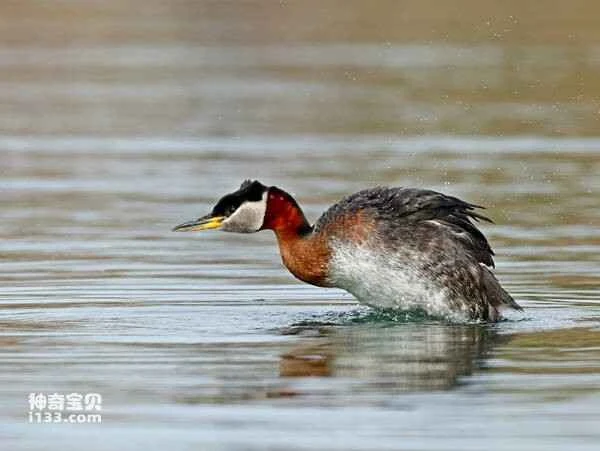
Red-necked grebes are usually found alone or in pairs on the water's surface during the day, occasionally forming small groups, especially during migration. They are excellent swimmers and divers, and dislike flying. Even when suddenly faced with danger, they usually escape by diving or swimming into nearby vegetation. They are wary and extremely cautious, mostly staying away from the shore. They move more easily on land than the Great Crested Grebe, but generally do not venture onto land. During the breeding season, they become aggressive to defend their territory, using underwater attacks to drive away intruders when they are threatened.
The Red-necked Grebe's diet mainly consists of various fish, frogs, tadpoles, insects and their larvae, crustaceans, mollusks, and other small aquatic invertebrates and vertebrates, as well as some aquatic plants. They primarily forage by diving, and while in flight, they can catch low-flying insects. Red-necked Grebes typically catch and swallow small prey underwater, bringing larger prey to the surface to enjoy. They usually grasp their prey with their beaks and shake their heads to swallow it. Outside the breeding season, they are completely silent. When nesting, they are quite noisy, emitting a mournful "uooh, uooh, uooh…" sound, ending with a harsh, hoarse cry; they also make a harsh, cherk call.

The Red-necked Grebe migrates in spring (March-April) and autumn (late September-early October). It is a summer visitor in Heilongjiang Province, China, and a winter visitor in the south. They often migrate in pairs or small groups along rivers and coastlines. In North America and Northeast Asia, they winter in China, Japan, and the southern United States.
The breeding season for the Red-necked Grebe is generally from May to July, mid-April to May in Europe, and mid-May to June in North America. During the breeding season, they often make frequent, continuous "kek-kek-kek" calls or weeping "khkh-khaaa-kkhakbaa-kha" calls. During courtship, the male and female first swim together, flapping their wings, then raise their forebody, stand face-to-face in the water, their beaks touching, and their crests erect, before swimming away to one side. Around April, the Red-necked Grebe begins migrating to their breeding grounds, where they begin nesting. They usually breed in solitary pairs, about 50 meters apart. They nest in freshwater lakes and ponds rich in reeds, cattails, and other aquatic plants. The nest is a floating nest, made of dead aquatic plants, and is usually placed among aquatic vegetation.

Each clutch contains 4-5 eggs, though some clutches may contain as few as 3, or as many as 6 or even 8. The eggs are initially bluish-green, gradually turning rusty-brown as they incubate; they measure 47.8-53.5 mm × 33.5-36.8 mm, with an average of 51.5 mm × 35.77 mm. Incubation begins immediately after the first egg is laid, lasting 20-23 days. The chicks are precocial. After hatching, the chicks climb onto their parents' backs and stay for about 10 days. Around two weeks later, the chicks are able to move around and dive, and they can fly after 7-9 weeks. The chicks are then fed by their parents for about 54 days until their plumage is almost fully developed.
The Red-necked Grebe is extremely rare in China, found only in Harbin, the Liaodong Peninsula, Hebei, and Fujian. According to the Asian Midwinter Waterbird Surveys conducted by the International Waterfowl Research Bureau in 1990 and 1992, there were 1,156 individuals in China in 1990 and 574 in 1992; the number in other parts of East Asia was 575 in 1990. Outside of East Asia, only 77 individuals were observed in West Asia and 143 in South Asia in 1992, indicating a very limited population. In 2006, Wetlands International estimated the global population of the Red-necked Grebe to be between 190,000 and 290,000. In 2009, population estimates in some countries were as follows: approximately 10,000–100,000 pairs of adult birds and 1,000–10,000 individuals of the Red-necked Grebe migrated to China, with approximately 50–1,000 wintering there; fewer than 100 pairs of adult birds and fewer than 50 individuals migrated to Japan, with approximately 1,000–10,000 wintering there; and 10,000–100,000 pairs of adult birds and 1,000–10,000 individuals migrated to Russia.
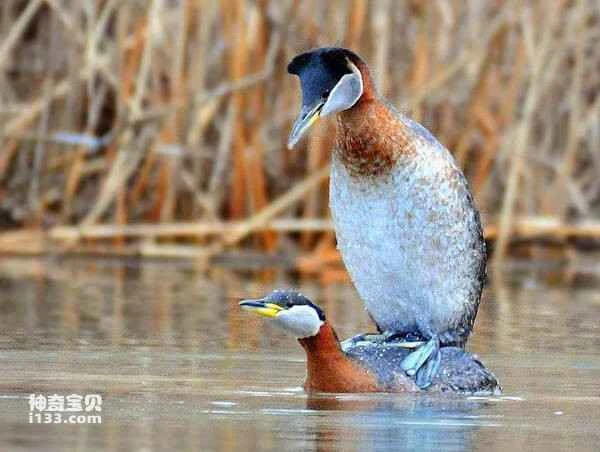
In North America, the Red-necked Grebe is threatened by ecopolluted organisms such as PCBs and pesticides, which cause egg sterility and thinning of eggshells, leading to a decreased reproductive success rate. Threats to the species also include lake alteration and degradation, disturbance from human activities (especially recreational activities), and habitat loss (due to agricultural and road development). It may also be threatened by oil spills, although the impact of such spills is relatively small. To conserve the Red-necked Grebe, it is necessary to survey its population size in its breeding areas and monitor its reproductive numbers. It is also necessary to reduce the encroachment on its habitat by water traffic and its disturbance to the population. Identifying and protecting key locations outside its breeding grounds and investigating its wintering behavior and non-breeding season activities will also contribute to the conservation of the Red-necked Grebe.
It has been included in China's "National Class II Key Protected Wild Animals List" (1988).
It has been listed as an endangered species by the Wisconsin Department of Natural Resources.
It is listed as Least Concern (LC) in the IUCN Red List of Threatened Species 2018 ver 3.1.
It is listed as a Class II protected wild animal in China's "National Key Protected Wild Animals List" (2021).
Protect wild animals and ban the consumption of wild game.
Maintaining ecological balance is everyone's responsibility!


