
Basic Information
Scientific classification
- Chinese name: Great Golden-backed Woodpecker
- Scientific name: Chrysocolaptes guttacristatus, Greater flameback
- Classification: Climbing birds
- Genus and family: Order Vulpecula, Family Pilidae, Genus *Goldenback Woodpecker*
Vital signs data
- Body length: 31-35 cm
- Weight: 232-240g
- Lifespan: No verification data available.
Significant features
Distribution and Habitat
The Great Golden-backed Woodpecker is found in Bohol, Leyte, Samar, Billyland, Pannaon, Mindanao, Basilan, and Samar in the Philippines.
The Great Golden-backed Woodpecker prefers relatively open woodlands and forest edges. It mainly inhabits evergreen broad-leaved forests and mixed forests in low mountains and plains below 1500 meters in altitude, and also appears in forest edges and sparse forests.
Appearance
The Great Golden-backed Woodpecker is about 31 cm in length. Its crown and crest are deep red, its nape is white; its back, shoulders, and wings (except for the primary flight feathers and outer coverts, which are dark brown with white spots) are entirely olive; its rump is deep red; its upper tail coverts and tail are black. It has a white eyebrow stripe and a broad black stripe behind the eye extending to the side of its neck. Its cheeks, chin, and throat are white with five narrow black horizontal bars; the rest of its underparts are dark white, with each feather edged in black (wider on the chest and narrowest on the abdomen). Its iris is reddish-yellow; its bill is slate-grey; its tarsi and toes are pale greenish-brown.
The female's entire head and crest are black with white spots, otherwise she is the same as the male. Juveniles have heads similar in color to the female. In males, red quickly appears on the crown, gradually extending to the crest.
Size measurements: male weight 232-240 grams, body length 310-354 mm, bill length 53 mm, wing length 178-180 mm, tail length 104-110 mm, tarsus length 31-33 mm.
Detailed introduction
The Greater Flameback Woodpecker, scientifically known as *Chrysocolaptes guttacristatus*, has three subspecies.
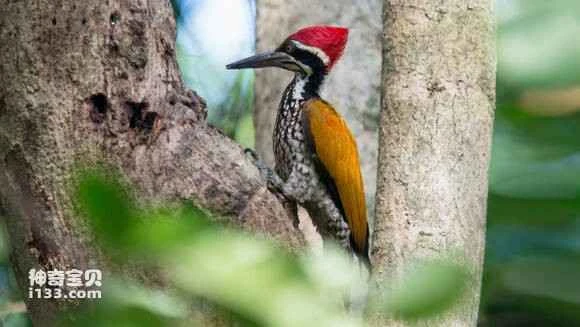
The Great Golden-backed Woodpecker is usually solitary or in pairs. It forages and moves throughout the entire tree. It frequently flies from tree to tree, calling as it flies. Sometimes it also forages for ants and insects on the ground. It often calls while climbing tree trunks to forage. Its call is harsh and shrill. When found in pairs, the sound of its chiseling is sometimes very loud. Its call is loud, piercing, and has a shrill, explosive quality, resembling the cry of a very loud cicada.
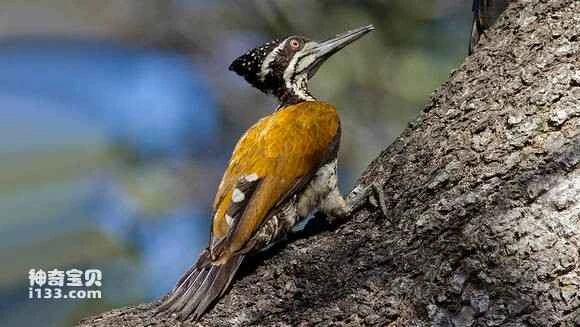
The Great Golden-backed Woodpecker primarily feeds on various insects, but also eats worms and other small invertebrates. In autumn and winter, it also consumes a variety of plant fruits and seeds.
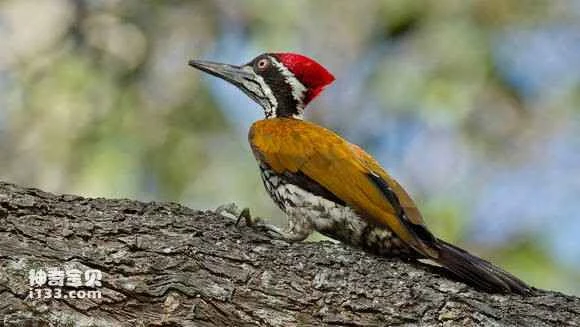
The Great Golden-backed Woodpecker breeds from March to May. They nest in evergreen broad-leaved forests, as well as in sparse forests mixed with bamboo, and even in dead trees along farmland edges. The heartwood of the nesting trees is usually decayed, making them easy to pry open. The nest hole has a relatively large opening, usually 7-8 cm wide, and is 15-40 cm deep, with the entrance typically 1.5-6 meters above the ground. Each clutch contains 4-5 eggs, occasionally up to 6, or as few as 3 or 2. The eggs are white and measure 26-33 × 20-24 mm.
Listed as Least Concern (LC) in the IUCN Red List of Threatened Species 2016 ver 3.1.
It is listed in the "List of Terrestrial Wild Animals of Beneficial or Important Economic and Scientific Research Value under State Protection" issued by the State Forestry Administration of China on August 1, 2000.
Protect wild animals and ban the consumption of wild game.
Maintaining ecological balance is everyone's responsibility!


