Basic Information
Scientific classification
- Chinese name: Pygmy Cormorant
- Scientific name: Osprey
- Classification: Wading birds
- Family and genus: Pygmy cormorant
Vital signs data
- Body length: 45-50 cm
- Weight: 340 grams
- Lifespan: 3-10 years
Significant features
It is the smallest of all cormorants. The pygmy cormorant is one-third smaller than the common cormorant. It has a strong and long beak with grooves on both sides of the upper beak and a hook at the tip. It has a gular pouch at the base of the lower beak. Its nostrils are small and completely closed in adults. Its lores are bare. It has a slender neck, a round and stiff tail, and its feet are located at the rear of its body. Its tarsi are short and featherless. Its toes are flat, with the hind toe being long and webbed.
Distribution and Habitat
It flies low over coastal areas, lakes, ponds, deltas, and estuaries. It prefers to live in freshwater lakes and brackish waters with fairly rich vegetation, shrubs, and reeds.
Appearance
The pygmy cormorant has a strong, long beak with grooves on both sides of the upper beak and a hook at the tip, suitable for catching fish; a gag at the base of the lower beak; small nostrils that are completely hidden in adults; bare lores; a slender neck; moderately long wings, lacking the fifth secondary flight feather; a round, stiff tail with 12-14 tail feathers; feet located at the rear of the body; short, featherless tarsi; flat toes, with the hind toe being long and webbed.
Detailed introduction
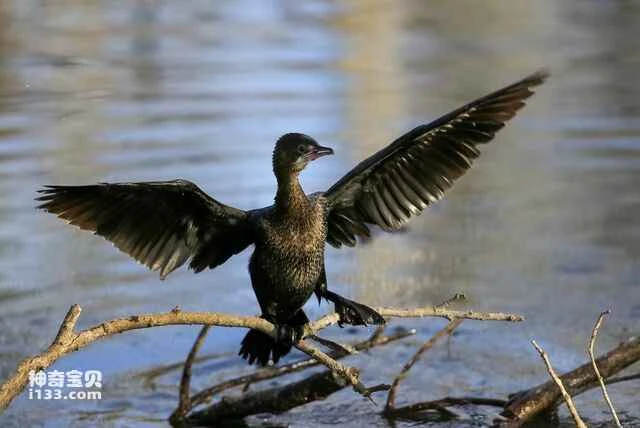
The pygmy cormorant (scientific name: *Microcarbo pygmeus * ) is a seabird belonging to the genus *Microcarbo* in the family Cormorantidae. It is the smallest of all cormorants. This species is partially migratory and is rare in Western Europe.
The pygmy cormorant has a strong, long beak with grooves on both sides of the upper mandible and a hook at the tip, suitable for catching fish; a gular pouch at the base of the lower mandible; small nostrils that are completely hidden in adults; bare lores; a slender neck; and wings of moderate length. It prefers to fly low over coastal areas, lakes, ponds, deltas, and estuaries. It thrives in freshwater lakes and brackish waters with relatively abundant vegetation, shrubs, and reeds. Its diet consists mainly of fish and crustaceans.
External features
The pygmy cormorant is the smallest of all cormorants. It is about one-third smaller than the common cormorant , with a body length of approximately 45-50 cm , a wingspan of 80-90 cm , and a weight of about 340 grams. Its plumage is a metallic dark brown, with a brown head, a slightly curved beak, and a rather short nozzle. It has a long tail. During the breeding season, it develops red spots on its head and neck, a characteristic that distinguishes it from other European cormorants. Males and females are similar in appearance.
The pygmy cormorant has a strong, long beak with grooves on both sides of the upper beak and a hook at the tip, suitable for catching fish; a gag at the base of the lower beak; small nostrils that are completely closed in adults; bare lores; a slender neck; moderately long wings, lacking the fifth secondary flight feather; a round, stiff tail with 12-14 tail feathers ; feet located at the rear of the body; short, featherless tarsi; flat toes, with the hind toe being long and webbed.
Growth and Reproduction
Pygmy cormorants build their nests on rocky banks or steep ledges near water, using twigs, dry grass, and fallen feathers. The nests are shallow cup-shaped and vary in size. The breeding season is between April and June . Each clutch contains 4 to 6 eggs. The chicks hatch after about 28 days of incubation. Both parents participate in raising the chicks. They feed them by storing fish in their large esophagus. When feeding, the parents open their beaks, and the chicks insert their beaks into the parents' throats to peck at the partially digested fish. When providing water, the parents spray fresh water from their beaks into the chicks' mouths. The chicks are altricial.
Lifestyle
The pygmy cormorant is an inhabitant of humid regions and prefers a moderate climate. It likes to fly low over coastal areas, lakes, ponds, deltas, and estuaries. It thrives in freshwater lakes and brackish waters with fairly abundant vegetation, including thickets, shrubs, and reeds.
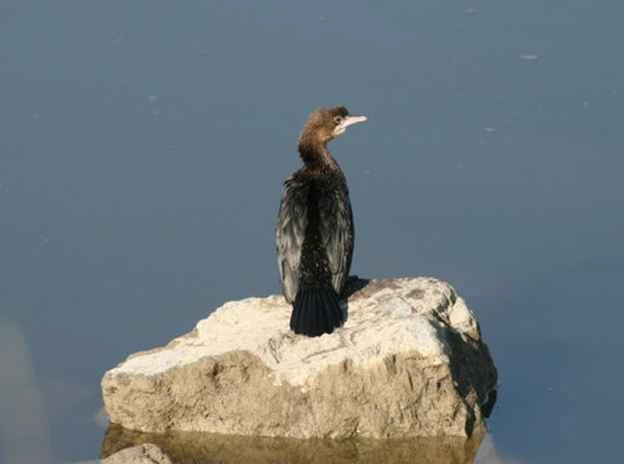
The pygmy cormorant is a strong flier, flying in a straight line with its legs and head extended, much like a duck. Except during migration, it typically stays close to the water; when on land, its body is almost perpendicular to the ground, supported by its stiff tail feathers. It is an excellent swimmer and diver. They often form a semi-circle in the water to hunt fish. They also frequently fly low, skimming the water's surface. When flying, their neck and legs are extended. Their main diet consists of fish and crustaceans. When hunting, they submerge their heads in the water to track prey. Their wings have evolved to aid in propulsion, thus they use both webbed feet and wings. After catching prey, they must surface to swallow. After diving, their feathers become soaked, and they must spread their wings to dry in the sun before flying.
Distribution range
The specific distribution range of the pygmy cormorant extends from eastern Italy in southeastern Europe to Kazakhstan, Tajikistan, Turkmenistan and Uzbekistan in Central Asia. Therefore, Xinjiang, which is also in Central Asia, can be considered as part of the distribution range of this species. The Eurasian continent and northern Africa (including the whole of Europe, Africa north of the Tropic of Cancer, the Arabian Peninsula and Asia north of the Himalayas-Hengduan Mountains-Minshan Mountains-Qinling Mountains-Huaihe River) have traces of it in the Danube River basin, the Adriatic, the coast of the Black Sea, the Caspian Sea and the delta of the Arabian peninsula. The largest distribution of the pygmy cormorant is in the Balkan countries of southeastern Europe such as Albania, Greece, Bulgaria, and Romania, as well as in the West Asian countries such as Turkey, Cyprus, Iran, Iraq, Azerbaijan, Israel and Syria. In Romania, according to the research of ornithologist Robert Ritter von Dombrowski[5] in the late 19th century, it is mainly distributed in the Danube Delta, followed by the water bodies of Constanta County and the wetlands of Montenia.