Basic Information
Scientific classification
- Chinese name: Black-bellied Pelican
- Scientific name: Snakebird
- Classification: Wading birds
- Genus and species: Black-bellied Snake Pelican
Vital signs data
- Body length: 850–900 mm
- Weight: Approximately 2.6 kg
- Lifespan: 9-16 years
Significant features
It is monogamous, and its belly feathers are blackish-brown, hence its name. Its unique appearance, resembling a snake but not quite, especially its long, S-shaped neck, has earned it the nickname "snake bird." This bird is entirely black, with a small head and a long, slender neck. It is adept at diving and uses its beak as a spear to catch fish.
Distribution and Habitat
Habitats located in trees or bamboo groves, near aquatic environments and large communities. These aquatic environments typically include deep estuaries, lakes, ponds, streams, rivers, or swamps. The water in these environments only needs to be deep enough for diving and swimming.
Appearance
Its unique appearance, resembling a snake but not quite, is characterized by its dark brown belly feathers, hence its name; a slender neck; and a small, narrow head. The head and neck are brown, with a white line extending from the chin to the sides of the neck; the feathers on other parts of the body are darker, with white filamentous feathers on the shoulders edged in black; the iris is brown, the beak is yellowish-brown, the upper jaw line is black, and the legs are gray.
The black-bellied pelican ranges in length from 850 to 900 mm. It possesses a long, straight beak, a long neck, a long tail (202–240 mm), and webbed feet. Its wingspan is 116–128 cm. The wingspan is typically 331–357 mm. Adult males are usually slightly larger than females. Its feathers are semi-hydrophobic, aiding in swimming. Curves also exist in the 7th, 8th, and 9th vertebrae, allowing for a sudden, striking motion of the neck to catch fish.
Detailed introduction
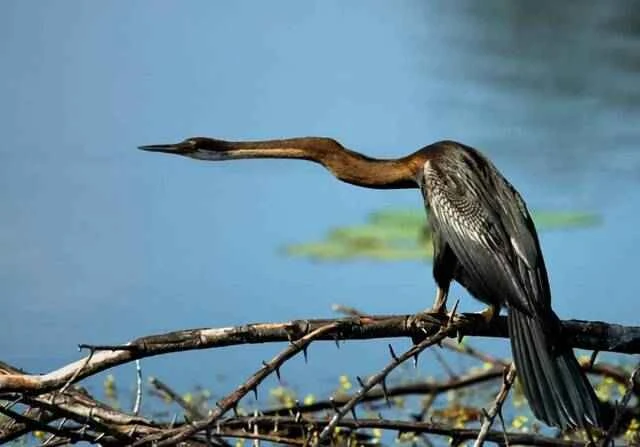
The Black-bellied Snake Pelican (scientific name: * Anhinga melanogaster * , also known as the Darter ) is a bird belonging to the family Pelecanidae in the order Pelecaniformes. It is also called the Snake Bird. It is relatively large, approximately 850–900 mm in length ; its belly feathers are blackish-brown, hence its name; it has a slender neck; and a small, narrow head. The head and neck are brown, with a white line extending from the chin to the sides of the neck; the feathers on other parts of the body are darker, with white filamentous feathers on the shoulders edged in black; the iris is brown, the bill is yellowish-brown, the upper jaw line is black, and the legs are grey.
The Black-bellied Pelican is distributed in India, Southeast Asia, the Philippines, Sulawesi, and the Sunda Islands. It inhabits clean sections of lakes and large rivers. A tropical inland waterbird, it is an adept diver, using its beak as a spear for fish. When swimming, almost its entire body is submerged, except for its head and neck, undulating from side to side like a snake. For most birds, wet wings mean certain death, but for the Black-bellied Pelican, wet wings add weight, helping them to dive better. They have even evolved powerful webbed feet for better underwater survival. It uses its serrated beak to stab fish and carry them ashore. During the breeding season, the male performs courtship displays, spreading its long tail feathers into a fan shape and pointing them forward. It emits a piercing scream during courtship.
Morphological characteristics
The Black-bellied Snake Pelican is a long-necked bird that, despite its snake-like appearance, is a true bird, similar in size and shape to cormorants. On average, the Black-bellied Snake Pelican is between 850 and 900 mm in length. It possesses a long, straight beak, a long neck, a long tail ( 202–240 mm ), and webbed feet. Its wingspan is 116–128 cm , and the wing length is generally 331–357 mm . Adult males are typically slightly larger than females. Its feathers are semi-water-permeable, aiding in swimming.
There are also bends in the 7th , 8th , and 9th vertebrae, which allows their necks to suddenly shoot out to catch fish. In northeastern India, locals domesticate these birds for fishing. Darts players are named for this behavior. Adult males and females are similar in color; however, juveniles have different colors. The crest and nape are brown, and the back of the head is black. Their beaks are long and yellow with serrated edges. The underside of the neck is white; there is also a white stripe on the sides of the head. The back and long tail are black. The tail consists of 12 feathers. However, their wings have black feathers and white feathers. The legs are black; the feet have four toes and are webbed. Black-bellied pelicans molt and may lose so many feathers that they may be unable to fly for several days. During this time, they usually look "wrinkled".
The crest and nape of the young bird are a lighter brown. The underside of the neck is white, but there are no white stripes on the sides of the neck. The white wing feathers are more yellowish-white in the juvenile stage.
Habitat
Black-bellied pelicans typically inhabit wooded or bamboo groves, near aquatic environments and large communities. These aquatic environments often include deep estuaries, lakes, ponds, streams, rivers, or swamps. The water in these environments only needs to be deep enough for diving and swimming.
Lifestyle Habits and Behaviors
Black-bellied pelicans spend most of their time resting or swimming. Because their feathers are not completely waterproof, they absorb moisture and have low buoyancy, allowing them to swim and dive more quickly. They typically swim with their wings spread, paddling with their webbed feet. After swimming, they sit on tree branches to sunbathe, spreading their wings to preen and dry. They are quite clumsy on or near the ground.
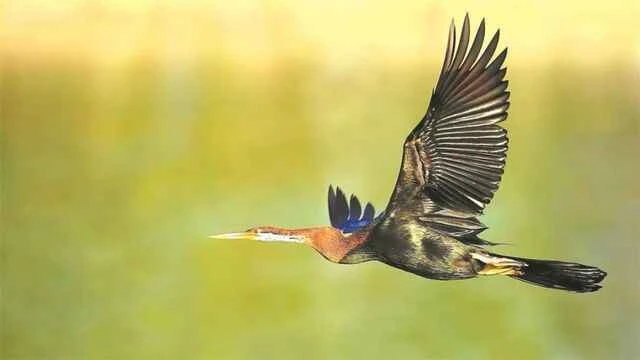
The black-bellied pelican can sit on the water's surface or swim actively. When swimming, only its head and neck are above water, while the rest of its body is submerged. They may suddenly leap from the water or from tree branches. In flight, the black-bellied pelican is very similar to a cormorant. They are powerful fliers, capable of soaring great distances without flapping their wings.
Cry
Black-bellied pelicans primarily communicate through calls. Their distinctive call is a hoarse croaking sound, like " kah-kah-kah ," accompanied by hissing and clicking sounds. The black-bellied pelican's call is similar to that of a cormorant, but slightly lower. During breeding, pairs call to each other and communicate through displays of wing flapping. When approached or startled by humans, they typically stretch their necks and flap their wings, which may be a warning to others nearby.
feeding habits
Black-bellied pelicans may capture prey in one of several ways. They may dive into the water from their roost or from the surface, slowly tracking or chasing the fish. Some wait for the fish to surface or swim across the water. At this point, they will attempt to thrust their necks out, piercing the fish with their spears. This sudden movement is possible because their necks are bent at the 7th to 9th vertebrae. Once their prey is pierced, the black-bellied pelican will surface, toss the fish into the air, and swallow it headfirst. Alternatively, they may swallow the whole fish underwater instead of piercing it with their spears. Afterward, they usually leave the water and dry their fins.
The black-bellied pelican typically eats fish, but has been found to consume small amounts of insects, aquatic reptiles (turtles, snakes) and amphibians (frogs, salamanders), shrimp, rodents, mollusks, sponges, and various plant grasses and seeds. However, the presence of these plant materials in their stomachs is likely accidental.
Distribution range
Native to the Indian subcontinent; distributed in tropical and subtropical regions of Africa, Asia, and Oceania, extending west to Pakistan and north to the India - Nepal border; mainly found in island nations such as India, Laos, Myanmar, Cambodia, Sri Lanka, Singapore, Thailand, Malaysia, the Philippines, and Indonesia.
Reproduction methods
The black-bellied pelican is monogamous and typically breeds in groups during mating season. Males attract and greet mates by flapping their wings. They build nests on branches near water, using twigs to construct the nests, which are about 40-50 cm in diameter and lined with leaves. The nests are usually located on trees hanging over the water and can be reused year after year. If threatened, both males and females will defend the nest and their young by jumping, hissing, and biting. The pairs communicate through calls and wing-flapping displays.
The Black-bellied Pelican is known to be highly prolific. After successful mating, the female will lay 5-8 eggs approximately 40 days later . Incubation takes 25-30 days . The eggs typically hatch asynchronously. These eggs are oval-shaped and covered with a greenish-white coating (which may turn brown during incubation). Underneath this coating, the egg is a pale greenish-blue. The chicks leave the nest and become independent around 50 days old. Sexual maturity occurs around 2 years of age. After hatching, the chicks are cared for by both parents. The incubation period is relatively short in the first few weeks . After hatching, the male Black-bellied Pelican increases its hunting activity, feeding the chicks regurgitated food up to 6-9 times a day. In the wild, the average lifespan is 9 years . In captivity, the longest known lifespan is 16 years.
The black-bellied pelican was listed as Near Threatened on the IUCN Red List of Threatened Species in 2016. In 2023 , it will also be included in China's List of Key Protected Terrestrial Wild Animals of Yunnan Province.