Basic Information
Scientific classification
- Chinese name: Indian Pond Heron
- scientific name:
- Classification: Wading birds
- Family and genus: Indian pond heron
Vital signs data
- Body length: Approximately 460 mm
- Weight: Approximately 253 grams
- life:
Significant features
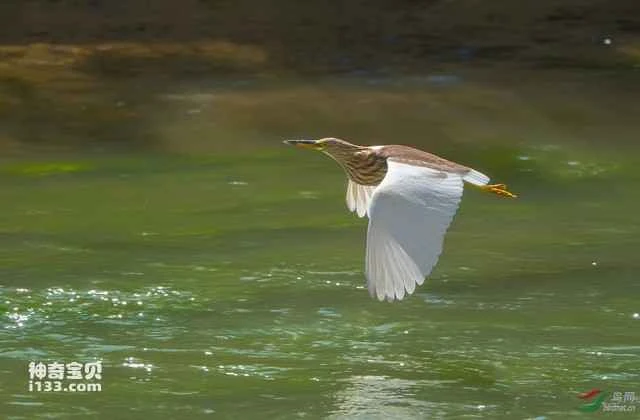
Medium-sized wading birds, typically hunchbacked, with subtle markings of olive and brown shimmering across their bodies in flight, and bright white wings. They have a stout, short neck and a short, thick, pale yellow or brown beak. Their legs are red. In summer, adults develop long, ornate feathers on their necks. Their flight is striking, especially when their white wings make them stand out. The Indian Pond Heron is an excellent camouflage bird, often allowing people to approach before quickly taking flight, leading local folklore to believe that the bird is nearsighted or has eye problems.
Distribution and Habitat
Their habitat is almost always near bodies of water, lakes, rivers, mangroves, and wetlands. They typically inhabit marshy wetlands or waters with floating vegetation such as water hyacinth. However, this species is increasingly appearing near settlements and foraging near public garbage dumps, which can lead to food poisoning and intestinal blockage in birds.
Distribution: Resident birds: Bangladesh, Bhutan, India, Iran, Myanmar, Nepal, Pakistan and Sri Lanka, Persian Gulf, Andaman and Nicobar Islands;
Breeding location: Maldives;
Non-breeding areas: Oman and the United Arab Emirates;
Wandering (non-breeding grounds): Seychelles and Yemen;
Wandering: Thailand
Appearance
It measures approximately 46 cm in length and has a wingspan of 75-90 cm. A medium-sized wading bird, its appearance completely changes during the breeding season. Normally, the head, neck, breast, and a large portion of the abdomen have white with brownish-grey vertical stripes. The lower abdomen to the tail is white, with the plumage and back almost the same color as the stripes, but slightly darker; the primary and secondary flight feathers are light brown. During the mating season, the yellow legs turn salmon-colored, and the plumage undergoes a complete transformation: the back becomes dark brown, the nape, cap, and parts of the cheeks turn light grey, and the neck changes from grey to yellow. The most significant change is in the beak; normally, the lower jaw is yellow, the upper jaw is grey, both parts turn yellow, and the tip is black. Finally, during the breeding season, a tuft of white down appears on the back of the neck.
The beak is strong, and the feathers on the head, neck, and upper chest are elongated. The plumage changes significantly during the breeding season, with the crest extending into a spear shape. It has a rounded tail with 12 tail feathers. The tarsi are robust, almost as long as the middle toe (including the claw). The feet and toes are slender, with the tibiae partially bare. Three toes are in front and one behind on each foot, and the claw of the middle toe has a comb-like edge. Males and females are the same color. The body shape is spindle-shaped, with loose plumage and filamentous down feathers.
Detailed introduction
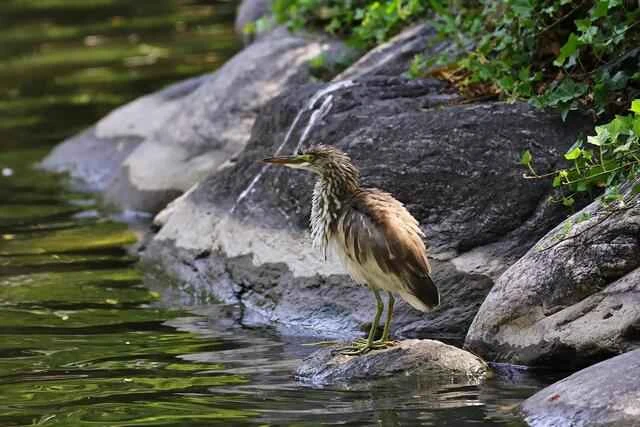
The Indian Pond Heron (scientific name: *Ardeola grayii *) is a medium-sized wading bird, a small heron belonging to the family Ardeidae in the order Pelecaniformes. Originating in the Old World, it breeds in southern Iran and extends eastward to the Indian subcontinent, Myanmar, and Sri Lanka. They are widespread and common, but easily overlooked when they are quietly hunting at the edge of small ponds or roosting near human settlements. They are very conspicuous when in flight, their bright white wings contrasting sharply with the camouflage of olive and brown stripes on their bodies. Their camouflage is so excellent that they can be approached at close range before they take flight, a behavior that has led to folk names and the belief that these birds are nearsighted or blind.
Distribution: Resident birds: Bangladesh, Bhutan, India, Iran, Myanmar, Nepal, Pakistan and Sri Lanka, Persian Gulf, Andaman and Nicobar Islands;
Breeding location: Maldives;
Non-breeding areas: Oman and the United Arab Emirates;
Wandering (non-breeding grounds): Seychelles and Yemen;
Wandering: Thailand
The Indian Pond Heron weighs approximately 253 grams, has a body length of about 460 mm, a wingspan of about 207.4 mm, a wingspan of 750-900 mm, a bill length of about 72.4 mm, a bill width of about 9.3 mm, a bill thickness of about 12.1 mm, a tarsus length of about 57.3 mm, and a tail length of about 74 mm. The Indian Pond Heron is stocky with red legs and a hunched back, making it quite distinctive among herons. It has a short, stout neck, a short, thick, pale yellow or brown bill, and a yellowish-brown back. In flight, its wings appear entirely white, and its body is dark brown. Its body is adorned with subtle markings of contrasting olive and brown hues. It has bright white wings, and in summer, adults develop long, ornate feathers on their necks. The beak is strong, and the feathers on the head, neck, and upper chest are elongated. The plumage changes significantly during the breeding season, with the crest extending into a spear shape. It has a rounded tail with 12 tail feathers. The tarsus is robust, almost as long as the middle toe ( including the claw ) . The feet and toes are slender, with the tibiae partially bare. Three toes are in front and one behind on each foot, and the claw of the middle toe has a comb-like edge. Males and females are the same color. The body shape is spindle-shaped, with loose plumage and filamentous down feathers. Adults have long feathers on their necks.
When they take flight, their colors shift from muted to striking white wings, making them very prominent. They are very similar to the monsoon heron (Ardeola ralloides) , but with a darker back. Further east of their range, they are superseded by the pond heron (Ardeola bacchus) .
Its appearance changes completely during the breeding season. Normally, the head, neck, chest, and a large portion of the abdomen have white with brownish-grey vertical stripes. The lower abdomen to the tail is white, with the plumage and back almost the same color as the stripes, but slightly darker; the primary and secondary flight feathers are light brown. During the mating season, the yellow legs turn salmon-colored, and the plumage undergoes a complete transformation: the back becomes dark brown, the nape, cap, and parts of the cheeks turn light grey, and the neck changes from grey to yellow. The most significant change is in the beak; normally the lower jaw is yellow, the upper jaw is grey, both parts turn yellow, and the tip is black. Finally, during the breeding season, a tuft of white down appears on the back of the neck. A reddish variation in plumage has been documented. Populations found in the Maldives have been suggested as a new species, but this has not been widely accepted. It forms a superspecies with the closely related Pond Heron, Javanese Pond Heron, and Madagascar Pond Heron.
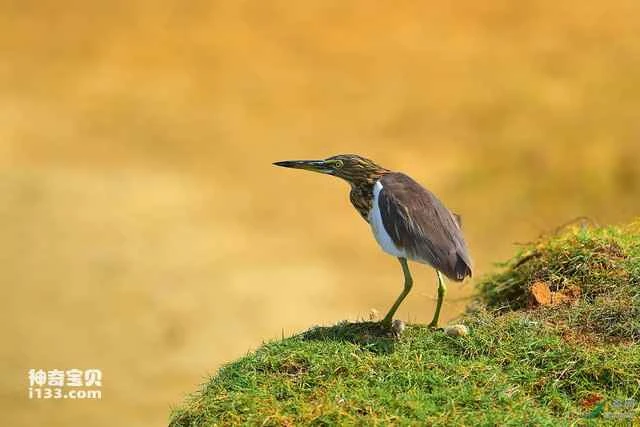
This bird was first described in 1832 by Colonel W.H. Sykes and named after John Edward Gray. Chromosome karyotype studies have shown that the Pond Heron has 68 chromosomes (2N) .
Behavior and Ecology: Diurnal or twilight active. Often gregarious, usually in small groups, perched on the edges of ponds and open waters or in shallow water, sometimes solitary, staying with other herons. Generally silent, but may emit a harsh call when startled or approaching the nest. They can be observed hunting on water lilies. This species typically maintains a very hierarchical position, taking flight suddenly as if only noticing a person or animal disturbing it at the last moment. They snatch food swiftly with their beaks. The contrasting white wings flash in view at takeoff, and they usually arch their necks to make them appear shorter. Very common in India, they usually forage alone, but during the dry season, when small wetlands have high prey density, they sometimes forage in considerable numbers at close range. They are semi-gregarious during breeding. They are sometimes found foraging on garbage heaps. During the dry season, they sometimes forage on moist lawns or even dry grass. When foraging, they allow close approach, only taking flight when too close. They sometimes form collective habitats in the trees along boulevards in busy urban areas.
Food and Foraging: Indian Pond Herons forage in marshy wetlands. During the dry season, they forage on watered lawns and even in dry grasslands, sometimes forming communal habitats and frequently appearing in trees along busy city streets. They typically forage at the edges of ponds, but also make extensive use of floating vegetation such as water hyacinths to access deeper waters. They sometimes swim on the surface or catch fish from the air, landing in deeper waters. They have also been observed flying and catching fish leaping out of the water. Sometimes, they fly low over the water, driving frogs and fish to the shore before landing to hunt. There are also records of them picking up breadcrumbs and dropping them onto the water to lure fish.
These birds' main diet includes crustaceans, aquatic insects, fish, tadpoles, and sometimes leeches (Herpobdelloides sp.) . Outside of wetlands, these herons also eat insects (including crickets, dragonflies, and bees), fish ( Barilius was identified as an important food source in a study in Chandigarh), and amphibians.
Breeding: Indian Pond Herons are usually silent, but will threaten their nests with harsh, hoarse calls when other birds approach. They display bright red legs during the breeding season, which begins with the arrival of the monsoon. They nest in small colonies, often mixed with other wading birds, typically on platforms in mangroves or bushes near lakes and ponds. Most nests are built in tall trees about 9 to 10 meters high. The male gathers nesting materials while the female builds the nest. The pair can use the same nest year after year. The breeding season begins in May and lasts until September , but in southern India and Sri Lanka, it may extend from November to February of the following year. Each clutch contains 3 to 5 eggs. Both parents incubate the eggs, which hatch in batches over 18 to 24 days. Both parents feed the chicks. Fish are their primary food source. Undisturbed nest sites may be reused year after year.
Factors contributing to mortality: They have few natural predators, but injured birds may be preyed upon by birds of prey. An arbovirus that causes Balagodu disease, as well as trematodes and several other parasites, have been recorded in these birds. Antibodies against Japanese encephalitis and West Nile virus have been detected in pond herons and cattle egrets in southern India. Heavy metals acquired from foraging in polluted waters may be particularly concentrated in their tail feathers.
Cultural Significance: In Sri Lanka, this bird is called *kana koka* , which translates to "half-blind heron" in Sinhalese. The Hindustani phrase " bagla bhagat " is used to describe a "wolf in sheep's clothing" or a hypocrite, resembling a meditating saint, and appears in a Marathi proverb. The rice paddy bird also appears as a character in *Hitopadsha*, in one story where it wounds itself to save the king. Anglo - Indian naturalist writers noted the bird's striking color variations. Philip Stuart Robinson described the bird as "all grey when sitting and all white when flying." It is said that in ancient India, many people ate this bird.
At the height of the feather trade, feathers were collected from "paddy field birds" and exported to Britain.