Basic Information
Scientific classification
- Chinese name: White-faced egret
- Scientific name: White-faced Heron
- Classification: Wading birds
- Genus and species: White-faced Heron
Vital signs data
- Body length: 60-70 cm
- Weight: 550g
- Lifespan: 10 years
Significant features
The white-faced heron gets its name from its overall bluish-grey plumage, with a white forehead and cheeks. During the breeding season, the area between its beak and eyes is greyish-black, but at other times it is pale olive-yellow. The white-faced heron has a long, pointed, straight bill, large, long wings, and slender legs and toes. Its tibia is partially bare, with three toes in front and one behind on each foot, and the middle toe has a comb-like edge on its claw. Males and females are similar in plumage, consisting primarily of three colors: pale, blue, and grey. The forehead, crest, chin, and upper throat are white, while the crest color is variable, sometimes extending white down the neck. The iris can be grey, green, dark yellow, or laurel-colored, with variations depending on the individual.
Distribution and Habitat
They can be found alone or in groups in various wetlands, including estuaries, intertidal zones, mangroves, coastlines, inland grasslands, and marshes. They prey on fish, frogs, shrimp, and mollusks.
Origin: Australia, Christmas Island, Fiji, Indonesia, New Caledonia, New Zealand, Norfolk Island, Papua New Guinea, East Timor.
Wandering: China, Cocos (Kelling) Islands, Solomon Islands.
Appearance
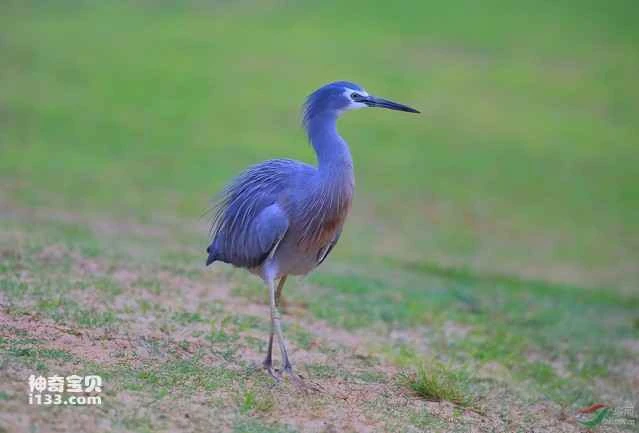
Slightly larger than the Great Egret but smaller than the Grey Heron, a bluish-grey heron. The forehead, eye area, face, and chin are white; the entire crown, neck, and back are bluish-grey; the foreneck and upper chest are brown; the abdomen is grey; and the wings are also grey, with slightly darker tips on the primary flight feathers. The iris is yellow to lead-grey; the beak is black; and the legs and toes are yellow with a slight green tinge.
Detailed introduction
The white-faced egret (scientific name: Egretta novaehollandiae ), also known as the white-faced heron, is a common bird in most parts of Australia and Oceania, including New Guinea, the islands of the Torres Strait, Indonesia, New Zealand, and the rest of Australia except for the driest regions.
It is a medium-sized heron, pale with a bluish-grey hue, yellow legs, and white facial markings. It can be found almost anywhere near shallow water, whether fresh or saltwater, and while it will immediately spread its long, slow-flapping wings and leave the scene when disturbed, it will boldly attack fishponds in the suburbs.
Historically, it was thought to be closely related to the genus *Ardea* , but for a time it was classified in its own genus—* Notophoyx *—due to the lack of plumage typical of that genus. In his commentary on the heron family, American ornithologist Walter J. Bock placed the White-faced Heron in *Ardea* , considering it related to the White-necked Heron and synonymous with it as *Notophoyx* . Similarly, Swedish naturalist Kai Kurli - Lindel considered the species a dwarf member of the genus *Ardea* . Robert B. Payne and Christopher J. Risley classified the White-faced Heron in the genus *Egretta* because its skeletal anatomy is more like that of herons than herons. They point out that Bock did not provide a reason for classifying the species in *Ardea* and considers its closest relative to the Little Blue Heron (*Egretta caerulea*) due to similarities in plumage and skull. Frederick Sheldon confirmed in a 1987 study using DNA-DNA hybridization technology that the white-faced egret is a member of the heron family.
The Ngarling Jerry people of Lower Murray, South Australia, call it krawli .
Adult white-faced herons are medium-sized within their family, mostly pale bluish-grey. The forehead, crown, chin, and upper throat are white. The crown pattern is variable, sometimes extending the white to the neck; this variation allows for individual identification. The iris can be grey, green, dark yellow, or cinnamon. The area between the eye and beak (eye stripe) is black. The beak is black, usually pale grey at the base. During the breeding season, pinkish-brown or bronze breeding plumage appears on the foreneck and chest, while bluish-grey feathers appear on the back. Adults typically weigh 550 g ( 1.21 lbs) and range in height from 60 to 70 cm ( 24–28 inches ). Immature birds are pale grey except for the white throat, and often have red on the lower body. Chicks are typically covered in grey down.
The White-faced Heron is distributed across most of Australasia, including New Guinea, the islands of the Torres Strait, Indonesia, New Caledonia, New Zealand, sub-Antarctic islands, and throughout Australia except for the driest regions. The species now inhabits Christmas Island, but there are no recorded breeding records. It is also common on Lombok, Flores, and Sumbawa, and has been seen as a vagrant in China, the Cocos Islands, and the Solomon Islands. It mostly visits the Northern Territory during the winter. It was self-introduced to New Zealand in the late 1940s . It is the only heron species recorded breeding in Tasmania.
The white-faced egret is a migratory species found in freshwater areas, marshes, farm dams, tidal flats and saltwater wetlands, farm dams, pastures, grasslands, crop fields, coastlines, salt marshes, intertidal mudflats, harbors, beaches, golf courses, orchards, or garden fishponds. It is protected in Australia under the National Parks and Wildlife Act 1974 .
Behavior: It typically perches on fence posts, trees, telephone poles, and rooftops. Its flight is slow and involves undulating movements.
Vocalizations: The most common vocalization is a hoarse, low croak or cooing sound, graak or graaw , usually made during flight, interaction, or when encountering aggression. Another vocalization, gow, gow, gow, is typically made when returning to the nest. High-pitched calls such as wrank, oooooooooh , or aaarrrgh are used as alarm calls.
Breeding: In some areas, nesting can occur almost any time of year, with spring in the Southern Hemisphere being the most common time for breeding, especially during periods of abundant rainfall. Breeding primarily takes place in southern Australia, with the most frequent breeding season from August to December . At other times, the bird disperses to much farther locations. It inhabits altitudes ranging from sea level to over 1000 meters. Both sexes share the responsibilities of nest building, incubation, and chick care. They typically nest alone, sometimes forming small, dispersed groups, and occasionally larger breeding flocks. Both sexes participate in nest building and incubation. Nests are usually chosen in trees around freshwater or saltwater marshes. The nest is a rough, shallow bowl made of twigs, built in large, leafy trees, 5-12 meters above the ground, or sometimes in the forks of bushes. Nests can be reused for several years. The nesting material is constructed of soft sticks, lined with twigs and grass. Each clutch contains 2-7 pale blue eggs, commonly 3-5 . The average size is 48.5 × 35 mm. Incubation lasts 24-26 days. During the breeding season, the birds grow feathers on their necks, heads, and backs (breeding plumes). The parents guard the chicks for 3-4 weeks, and the chicks grow flight feathers and leave the nest after 40 days. They continue to be fed by the adults for at least a few more weeks. White-faced egret chicks often stay with the adults until the start of the next breeding season, and they typically only breed one brood per year.
Typical predators of fledgling birds include kookaburras, Australian bellbirds, eagles, and owls.
Although the white-faced heron is not migratory, it does exhibit seasonal activity in its local area, sometimes making long-distance flights. In New Zealand, white-faced herons typically migrate inland during the winter, while in Australia they tend to migrate inland to flooded wetlands during the breeding season, and also to coastal areas outside the breeding season.
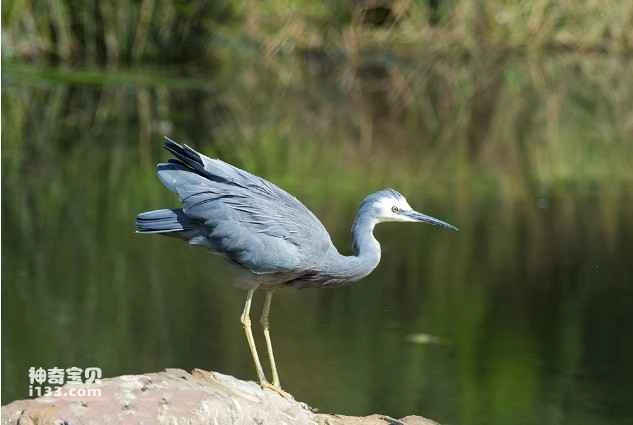
The white-faced heron is an elegant bird in flight, slowly flapping its deep blue wings. Compared to most herons, they fly more frequently with their necks outstretched. Although usually solitary, white-faced herons occasionally form loose small groups while foraging to protect their widely spaced foraging grounds, and when roosting, many gather together.
This species primarily hunts during the day, but has been reported to hunt at night as well. It is an opportunistic species, feeding on a variety of prey, typically foraging in shallow water or on dry land. It will also chase prey, using its feet to slap and stir the water's surface to disturb and startle potential prey. It often stands on the water's edge or in shallow water, swiftly snatching food with its beak. They eat mostly small aquatic organisms, with a diverse diet including fish, frogs, small reptiles, earthworms, insects, snails, crustaceans such as shrimp and crabs, and also some plant matter. It uses a variety of techniques to find food, including standing still to wait for prey to move (often using a unique rhythmic neck movement, both in water and on land), moving slowly in shallow water, flapping its wings, paddling with its feet, or even spreading its wings to chase prey. White-faced egrets usually forage alone or in small groups. They are typically territorial during the breeding season, but may forage in flocks outside the breeding season, especially after rain or flooding.