Basic Information
Scientific classification
- Chinese name: Spotted Heron
- Scientific name: White-necked Black Heron
- Classification: Wading birds
- Taxonomy and genus: White-necked Black Heron, Spotted Heron
Vital signs data
- Body length: 43-55 cm
- Weight: 247-280 grams
- life:
Significant features
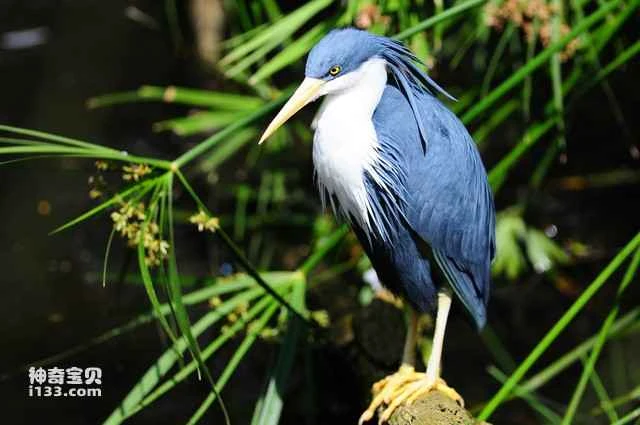
The lower half of the face and upper chest are white, while the rest of the body is a metallic blue-black. During the breeding season, there are white, needle-like plumes under the neck. The iris is orange-yellow, and the beak and legs are bright yellow.
Distribution and Habitat
They are often found in swamps, wet grasslands and mangroves near the coast, feeding on insects, small invertebrates, fish and amphibians.
Appearance
A medium-sized wading bird, 43-55 cm in length and weighing 247-280 g. Similar in size and shape to the Great Egret, but with a bluish-black crown and crest; white cheeks to neck, white plumes on the chest, bluish-black back and underparts, and a yellow bill. Morphology: Forehead, crown, and crest bluish-black; cheeks, chin, throat, and neck white; wings slate-black; back, shoulders, rump, and tail bluish-black; underparts bluish-black or slate-black; during the breeding season, the crest on the crown is longer, with long, dark lanceolate plumes on the apex, and long lanceolate plumes also hanging from the lower part of the foreneck down to the chest. Iris pale yellow or white; lores and periorbital bare skin blue; bill yellow; tarsi and toes yellow or orange.
The beak is long and pointed, the wings are large and long, the legs and toes are slender, the tibia is partially bare, the feet have three toes in front and one toe behind, and the claw of the middle toe has a comb-like edge. Males and females are the same color. The body shape is spindle-shaped, the body feathers are loose, with filamentous plumes, ornamental feathers on the chest, some have crest feathers on the head, and the legs are covered with feathers.
Detailed introduction
The White-necked Black Heron (scientific name: *Egretta picata *) is distributed in Sulawesi, Papua New Guinea, East Timor, coastal and sub-coastal areas of the northern monsoon region of Australia, and the Wallace Region. In China, it is only occasionally seen in Pingtung and Kaohsiung in Taiwan, and parts of Nantong in Jiangsu Province.
The Great Egret is a medium-sized wading bird, measuring 43-55 cm in length and weighing 247-280 grams. Its head and body size are similar to the Little Egret, but its crown is bluish-black with a crest; cheeks to neck are white, with white plumes on the chest; back and underparts are bluish-black; bill is yellow. Morphology: Forehead, crown, and crest are bluish-black; cheeks, chin, throat, and neck are white; wings are slate-black; back, shoulders, rump, and tail are bluish-black; underparts are bluish-black or slate-black. During the breeding season, the crest on the crown is longer, with long, dark lanceolate plumes on the chin and also long lanceolate plumes hanging from the lower part of the foreneck down to the chest. Iris is pale yellow or white; lores and periorbital bare skin are bluish-blue; bill is yellow; tarsi and toes are yellow or orange.
The beak is long and pointed, the wings are large and long, the legs and toes are slender, the tibia is partially bare, the feet have three toes in front and one toe behind, and the claw of the middle toe has a comb-like edge. Males and females are the same color. The body shape is spindle-shaped, the body feathers are loose, with filamentous plumes, ornamental feathers on the chest, some have crest feathers on the head, and the legs are covered with feathers.
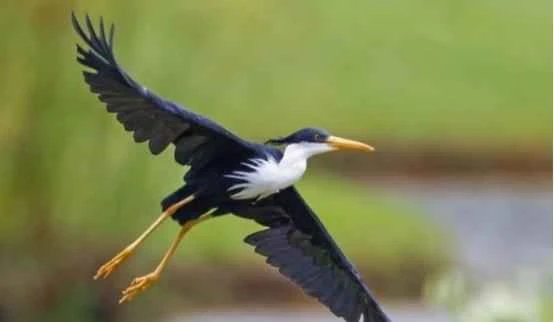
They are gregarious, often appearing in small groups of 3-5 or more than 10 individuals in shallow water near the water's edge. At night, they gather in large flocks of dozens or hundreds at their roosts, while during the day they disperse into smaller groups. They often stand on one leg in the water, with the other leg tucked under their belly, their head tucked into their back in a hunched posture, remaining motionless for extended periods. When walking, their gait is light and steady, appearing unhurried. In flight, their head is tucked back to their shoulders, their neck bent downwards into a pouch shape, their legs stretched straight back, protruding far behind their tails, and their wings flap slowly as they fly. Every morning at dawn, they fly in flocks from their roosts to their foraging grounds, sometimes as far as tens of miles. In the evening, they gather again to rest in paddy fields and on small trees on hillsides near their roosts, forming large flocks before entering forests and bamboo groves together. At night, they roost in groups atop tall trees in small patches of dense forest, and also frequently roost near houses or in garden groves and bamboo groves. They are relatively bold and unafraid of humans.
When hunting, the heron is unique. Its hunting strategy is completely different from other heron species. It does not wait for long periods of time, preferring to run in fast-flowing rivers with its legs nearly submerged, and spear fish with its long, sharp beak. It also eats crustaceans, amphibians, small mollusks, fish, but mostly aquatic insects and their larvae.
This is a small heron, measuring 43-55 cm in length, with dark slate-colored wings, body, and crested head, and a white throat and neck. It resembles the white-necked heron in appearance. Males ( 247-280 grams) are heavier than females ( 225-242 grams), but their appearances are similar.
Juvenile birds lack the crest and dark head coloration, and may resemble small white-necked herons. Juveniles were once classified as a separate species.
Calls: The heron's call in flight is a loud " awk " or " ohrk ". Near the nest, it will emit a soft cooing sound. Other auditory information is limited.
Reproduction: The breeding season varies depending on the distribution area. In China, the breeding season is from February to May , with egg-laying in March or April. In Queensland, Australia, it is from October to February , and in drier regions of Australia, it extends to March to May . In Indonesia and New Guinea, it is from December to February after migration. Nests are built in mangroves or other waterside trees, consisting of shallow platforms of branches 4 or 5 meters above the ground, including in mangroves. They usually live in groups with other herons. Each clutch contains 3-4 eggs, which are bluish-green, blue without spots, and measure 41 mm × 31 mm. Both parents incubate the eggs. The chicks are altricial.
Foraging: Its diet includes insects, frogs, crabs, fish and other small aquatic animals. Insects are the most important food source. [5] It can forage alone or in groups of up to a thousand individuals.
It is distributed in Sulawesi, Papua New Guinea, East Timor, coastal and sub-coastal areas of the northern monsoon region of Australia, and the Wallace region. In China, it is only occasionally found in Pingtung and Kaohsiung, Taiwan, and Nantong, Jiangsu.
Listed as Least Concern ( LC ) on the IUCN Red List of Threatened Species 2013 ver 3.1 .