Basic Information
Scientific classification
- Chinese name: Intermediate Egret
- Scientific name: Spring hoe
- Classification: Wading birds
- Genus and species: Egret
Vital signs data
- Body length: 560~720 mm
- Weight: 3-4 kg
- Lifespan: 7 to 10 years
Significant features
Medium-sized wading birds are characterized primarily by their size, appearance, and behavioral habits. The Intermediate Egret is slightly larger, with a thicker, shorter bill that doesn't extend beyond its eyes. Its legs and toes are black, and it tucks its neck into an S-shape during flight. Visually, the Intermediate Egret's bill and feet are always black, while its toes are yellowish-green.
Distribution and Habitat
They prefer to inhabit freshwater or brackish water wetlands with some vegetation cover, such as rice paddies, marshes, and ponds. Sometimes they are found in drier grasslands, and occasionally in coastal mudflats and mangroves. Their diet consists mainly of fish, but they also eat amphibians and crustaceans.
Appearance
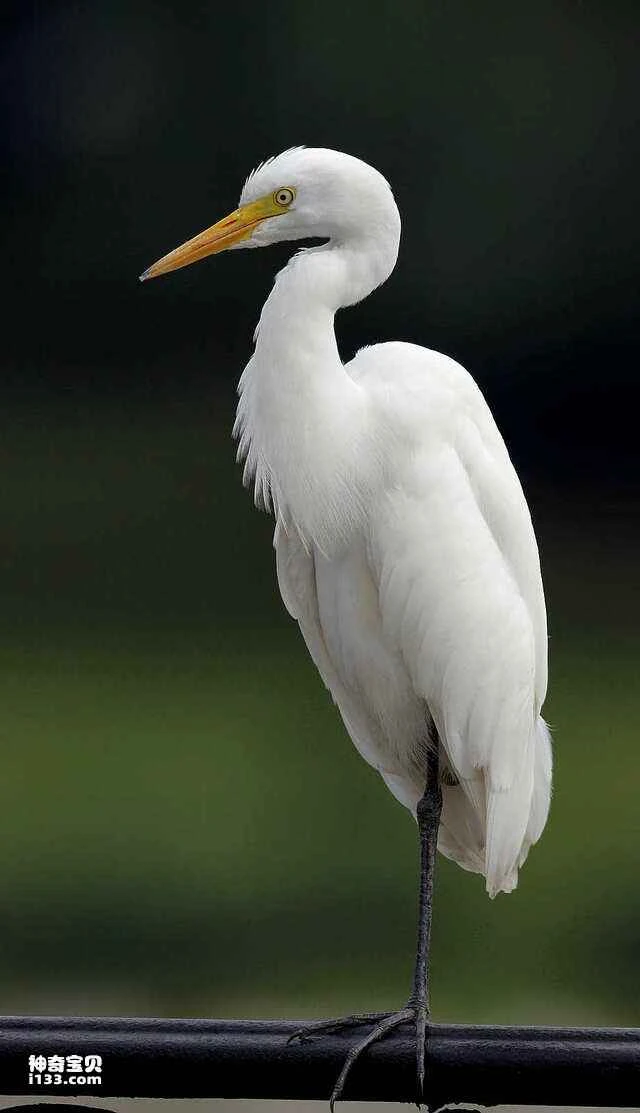
Its size is intermediate between that of the Great Egret and the Little Egret. It is entirely white with yellow lores. During the breeding season, it has needle-like plumes covering its neck and back; these plumes disappear during the non-breeding season. Its beak is shorter than its eye. The iris is yellow, the beak is black during the breeding season and yellow during the non-breeding season with a black tip, and its legs are black.
Detailed introduction

The Intermediate Egret (scientific name: *Ardea intermedia *) is a bird belonging to the genus *Ardea* in the family Ardeidae. It is also commonly known as the Spring Egret. Egrets are large wading birds. They are medium-sized, with a body length of 560–720 mm, and males and females are similar in appearance. The iris is yellow, and the bill does not extend beyond the eye, which is one of the most distinctive features differentiating this species from the Great Egret. The legs are black, the body is entirely white, and the neck is S -shaped. In summer plumage, the back and chest have soft, long, filamentous feathers, the bill is black, briefly turning pink, and the bare skin on the face is grey. In winter plumage, the bill is yellow with a black tip, and the ornamental feathers are lost.
The Intermediate Egret is distributed in Liaoning, Hebei, Beijing, Shandong, southern Henan, Shaanxi, Gansu, Tibet, Sichuan, Yunnan, and Guizhou provinces of China. It inhabits and is active in shallow waters of rivers, lakes, and other wetlands; it is usually solitary or in small groups; its diet consists mainly of insects, crustaceans, mollusks, fish, frogs, and lizards. The Intermediate Egret breeds from April to June , building a disc-shaped nest using twigs and dry grass in trees, bushes, or on the ground; it breeds once a year, laying 3-5 eggs per clutch, with an incubation period of 26-29 days.
The Intermediate Egret is highly valued for its ornamental qualities. It is a terrestrial wild animal of significant ecological, scientific, and social value under national protection in China, and is also a key protected wild animal in Shandong Province.
The Intermediate Egret is a medium-sized wading bird, a large heron, between the Great Egret and the Little Egret in size, slightly larger than the Little Egret. Its bill and neck are relatively shorter than the Little Egret's; the bill is long and pointed; the wings are large and long; the legs and toes are slender; the tibiae are partially bare; the feet have three toes in front and one behind; the middle toe has a comb-like edge on its claw. Males and females are the same color. The body is spindle-shaped, with loose plumage containing filamentous feathers; there are ornamental feathers on the chest; some have a crest on the head; and the legs are feathered.
The entire body is white; in summer plumage, there is a long row of mantle-like plumes on the back that extends beyond the tail, a faint crest on the back of the head, and a tuft of long, scattered mantle-like plumes on the chest. In winter plumage, there are no mantle-like plumes or crest, the beak is yellow with a black tip, and the legs and toes are black.
Yellow iris; black mouth; greenish-yellow exposed skin around the eyes; black feet and toes; yellow mouth in winter; black tip of mouth; black feet and toes.
Size measurements: body length 620-700 mm, bill 68-75 mm, wing 383-800 mm, tail 113-128 mm, tarsus 110-116 mm.
They inhabit and are active in shallow waters along the banks of rivers, lakes, swamps, estuaries, seashores, and ponds, as well as on riverbanks. They are also commonly found in swamps and rice paddies. They are mainly found in lush, vegetated shallows, seasonally flooded swamps, inland deltas, ponds, swamp forests, freshwater marshes, streams, wet meadows, and near flooded pastures in freshwater areas.
This species is less common in coastal habitats, but may sometimes be found in mudflats, tidal estuaries, coastal lagoons, salt marshes, tidal currents, and often in mangroves.
Migration: They begin migrating to southern China to breed in late March or early April , and begin migrating away in late September and early October. Some also overwinter in Yunnan, Guangdong, Hainan Island and Taiwan.
Habits: Usually solitary, in pairs, or in small groups, sometimes mixed with other herons, or sharing islands with black-tailed gulls. Highly wary, they fly away from humans from a distance, making them difficult to approach. In flight, their neck is tucked into an S- shape, their legs are stretched straight back beyond their tail, and their wings beat slowly, resulting in a leisurely, straight flight. Active during the day or at dusk.
Diet: It feeds on aquatic organisms, mainly aquatic and terrestrial insects and insect larvae such as fish, shrimp, frogs, locusts, and mole crickets, as well as other small invertebrates, small snakes, and lizards. It gently wades along the shallow water near the shore to forage, or stands quietly in the shallow water or on the shore waiting for prey to come, then suddenly and accurately hunts it down. After eating, it often rests on the bank or on the ridge of a field, its neck tucked in and standing on one leg.
Worldwide: Distributed in Bangladesh, Bhutan, Brunei Darussalam, Cambodia, China, Guam, India, Indonesia, Japan, Democratic People's Republic of Korea, South Korea, Lao People's Democratic Republic, Malaysia, Federated States of Micronesia, Myanmar, Nepal, Northern Mariana Islands, Oman, Pakistan, Palau, Papua New Guinea, Philippines, Russian Federation, Singapore, Sri Lanka, Thailand, East Timor, and Vietnam.
Migratory birds: Christmas Island, Maldives, Seychelles, United Arab Emirates, United States, Yemen.
In China: Gansu, Shandong, Henan, Jiangsu, Shanghai, Zhejiang, Jiangxi, Hubei, Sichuan, Guizhou, and Fujian are summer migratory birds; Yunnan is a resident bird; Guangdong, Hainan, and Taiwan are winter migratory birds.
The breeding season varies greatly depending on the region. In China, breeding typically occurs from April to June ; nests are built in forests or bamboo groves. They usually nest in flocks or with other herons. They construct shallow, dish-shaped nests using branches in trees, bushes, or on the ground. The nests are relatively simple in structure, usually made of dry branches and grass, and filled with soft, dry weeds. Each nest contains 3-6 eggs, which are blue, white, or buffalo without spots. Both parents incubate the eggs. The chicks are altricial.
Nest diameter was measured at 33.75 cm × 18.25 cm based on 12 nests. Nests built in bushes were 35.45 ( 20-50 ) cm above the ground. Each clutch contained 2-4 eggs, mostly 4. Eggs were bluish-green, measuring 47.55 mm × 32.25 mm, and weighing 27.43 ( 25.7-29.4 ) g. The incubation period was 26 ( 26-29 ) days, with a hatching rate of 59.1%-77.3% .


