Basic Information
Scientific classification
- Chinese name: Great Egret
- Scientific name: Great Egret, Heron, White-winged Heron, Winter Heron, Great White Crane, White-crowned Crane, White-crowned, Snowbird
- Classification: Wading birds
- Genus and species: Great Egret, White-crowned Crane, White-crowned Heron, White-crowned Snowbird
Vital signs data
- Body length: 820-981 mm
- Weight: 625-1100 grams
- Lifespan: 7-10 years
Significant features
Its entire body is pure white. During the breeding season, it has three rows of long, straight, sparsely barbed plumes on its shoulders and back, extending all the way to the tail. The beak can change color with the seasons.
Distribution and Habitat
They inhabit lakes, marshes, ponds, estuaries, paddy fields, and seashores. They are often seen foraging alone or in groups in shallow water. Their diet consists mainly of fish, but they also eat shrimp, frogs, tadpoles, lizards, crustaceans, and occasionally small birds and small rodents.
Appearance
The entire body is pure white. During the breeding season, the back feathers are long and well-developed, spreading like fine silk to the tail. The bare skin around the eyes is bluish-green, and the beak is black with a cleft extending beyond the eyes. Outside the breeding season, the back feathers fall off, the bluish-green skin around the eyes disappears, and the beak turns yellow. The iris is yellow, the beak is black during the breeding season and yellow outside the breeding season, and the legs are black.
Detailed introduction
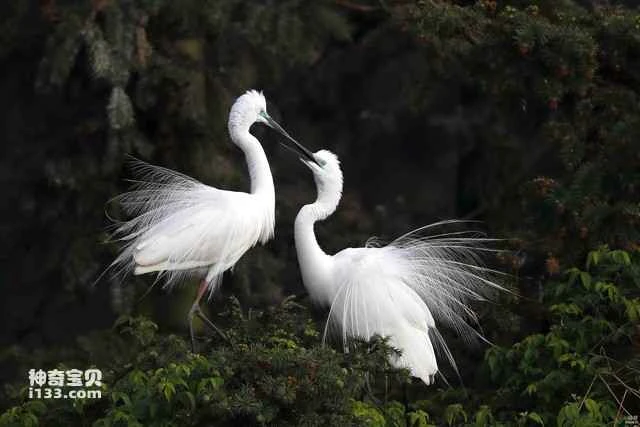
The Great Egret (scientific name: *Ardea alba *) is a bird belonging to the genus *Ardea* in the family Ardeidae of the order Ciconiiformes. It is also known as the White Egret, Prince, and White Heron. Its plumage is entirely white; its eyes are yellow; its beak is orange-yellow (black during the breeding season); it has an " S "-shaped knot on its neck; the Great Egret's beak extends beyond its eye; the skin on its face and around its eyes is green; its tarsi and legs are black. It has a dewlap covering its back and shoulders, which extends beyond its tail, but disappears after the breeding season.
Great egrets are widely distributed throughout the world. In China, they are found in Northeast China, Hebei, Jiangsu, Yunnan, Guangdong, Hainan, and Taiwan. They inhabit rivers, coastlines, marshes, wetlands, and paddy fields. They are quite wary and will fly away at the sight of humans. During the day, they mostly forage for food alone, but in areas with abundant food, they also form small groups. They feed on small fish, shrimp, aquatic insects, and shellfish. The breeding season is from April to July , with one brood per year, laying 3-6 eggs per clutch, most commonly 4. The eggs are sky blue. The incubation period is about 25 days, shared by both parents.
The Great Egret is listed in Appendix III of the Convention on International Trade in Endangered Species of Wild Fauna and Flora ( CITES ) and in the "List of Terrestrial Wild Animals of Beneficial or Important Economic and Scientific Research Value under State Protection" issued by the State Forestry Administration of China on August 1, 2000 .
The Great Egret is a large heron with a very long neck and legs. Sexes are similar in appearance, and the entire body is pure white. During the breeding season, it has three rows of long, straight, sparsely barbed plumes on its shoulders and back, extending all the way to the tail, sometimes exceeding the tail by 30-40 mm. The plume shafts are ivory white, stiffer at the base, gradually decreasing in size towards the tip, with fine, sparse barbs. The underparts are also white, with a slight yellow tinge to the abdominal feathers. The beak and lores are black, with a black line running from the corner of the beak to behind the eye. The beak is long and slender, turning entirely or partially black during the breeding season. The beak can change color with the seasons. In spring and summer, the beak is pure black, while in autumn and winter it turns entirely yellow. Therefore, when looking at pictures of Great Egrets, it is easy to identify whether they are in the breeding season. Their calls are loud croaking sounds emitted in the breeding colony. The entire body is mostly white, with similar winter and summer plumage, but lacking long plumes on the lower neck and shoulders; the beak and lores are yellow. The iris is yellow; the beak, lores, and skin around the eyes are black during the breeding season and yellow during the non-breeding season. The bare skin of the tibia is greenish or reddish, and the tarsi and toes are black.
Size measurements: Males weigh 840-1100 grams, females 625-1025 grams; males body length 897-981 mm, females 820-855 mm; male bill length 95-118 mm, females 96-104 mm; male wingspan 348-379 mm, females 330-350 mm; male tail length 115-162 mm, females 122-138 mm; male tarsi 145-170 mm, females 135-140 mm.

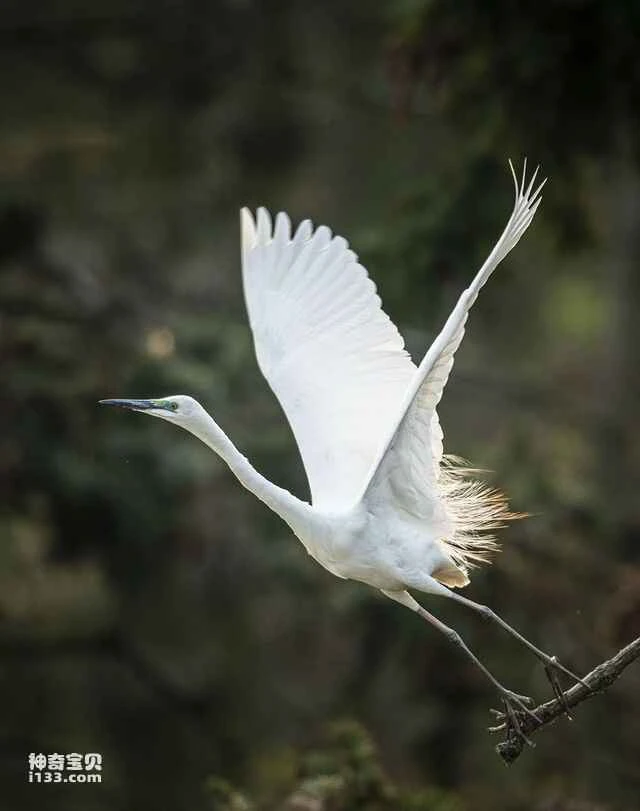
Habits: They usually move in solitary groups or small groups of about 10 individuals, but sometimes large flocks of up to 300 individuals can be seen during the breeding season. Occasionally, they are seen mixed with other herons. They are active during the day and move with extreme caution, flying away at the sight of humans. When they first begin to fly, their wing flapping is rather clumsy, with their legs dangling downwards. After reaching a certain height, their flight becomes extremely agile, with their legs extending far beyond their tails. Their heads are tucked into their backs, and their necks protrude downwards in a pouch-like shape. Their wings flap slowly. When standing, their heads are also tucked into their backs and shoulders, giving them a hunched back. When walking, they often tuck their necks in and move forward slowly, step by step.
Diet: They feed on insects of the orders Orthoptera, Coleoptera, and Diptera, crustaceans, mollusks, aquatic insects, as well as small fish, frogs, tadpoles, and lizards. They are usually found in groups on mudflats or riverbanks, mainly wading in shallow water to forage, but also often walking slowly on grassy areas near water, pecking as they go. They have great patience and superb hunting skills; once they spot food, they launch a surprise attack with their sharp beaks, quickly and accurately capturing their prey.
The Great Egret is partly a summer visitor, partly a migratory bird, and partly a winter visitor. They typically migrate to their northern breeding grounds from late March to mid- April , and begin migrating south for the winter in early October. During migration, they often form small flocks or family groups, flying in diagonal lines or at a certain angle.
Breeding season is from March to September . Nests are built in tall trees or reed beds, often in large groups, sometimes with several to dozens of pairs nesting simultaneously on a single tree. They also nest with herons, with both parents participating. The nest is relatively simple, usually constructed of twigs and dry grass, sometimes lined with a few soft blades of grass. The nest's outer diameter is 56-61 cm, inner diameter 52-54 cm, height 22-25 cm, and depth 15-20 cm. They breed once a year, laying 3-6 eggs per clutch, mostly 4. The eggs are oval or oblong, sky blue, measuring 51.5-60 mm × 34-41 mm, and weighing 29-31 grams. After laying the first egg, incubation begins, shared by both parents, and lasts 25-26 days. The chicks are altricial; newly hatched chicks have pale yellow down feathers that lie flat against their bodies, their eyes are half-open, and their beaks are orange -yellow. They weigh approximately 40-66g . After one day, their down feathers dry and turn white, and their eyes open. At this time, the parents begin feeding them. After hatching, both parents feed the chicks. During the first month of their life, the parents take turns caring for the chicks on the nest until they are able to fly.
Distributed in Afghanistan, Albania, Algeria, Angola, Anguilla, Antigua and Barbuda, Argentina, Armenia, Aruba, Australia, Austria, Azerbaijan, Bahamas, Bahrain, Bangladesh, Barbados, Belarus, Belgium, Belize, Benin, Bhutan, Bolivia, Bonaire, São Eustachians and Saba, Bosnia and Herzegovina, Botswana, Brazil, Brunei, Bulgaria, Burkina Faso, Burundi, Cambodia, Cameroon, Canada, Cayman Islands, Central African Republic, Chad, Chile, China, Christmas Island, Colombia, Comoros, Congo, Costa Rica, Ivory Coast, Croatia, Cuba, Curaçao, Cyprus. Czech Republic, Denmark, Dominican Republic, Ecuador, Egypt, El Salvador, Eritrea, Ethiopia, Falkland Islands (Malvinas Islands), France, French Guiana, Gabon, Gambia, Georgia, Germany, Ghana, Greece, Grenada, Guadeloupe, Guam, Guatemala, Guinea-Bissau, Guyana, Haiti, Honduras, Hungary, India, Indonesia, Islamic Republic of Iran, Iraq, Israel, Italy, Jamaica, Japan, Jordan, Kazakhstan, Kenya, South Korea, North Korea, Kuwait, Kyrgyzstan, Lao People's Democratic Republic, Latvia, Lebanon, Lesotho, Liberia, Libya, Macau Macedonia, Madagascar, Malawi, Malaysia, Maldives, Mali, Mauritania, Mayotte, Mexico, Federated States of Micronesia, Moldova, Mongolia, Montenegro, Montserrat, Morocco, Mozambique, Myanmar, Namibia, Nepal, Netherlands, Netherlands Antilles, New Zealand, Nicaragua, Niger, Nigeria, Northern Mariana Islands, Oman, Pakistan, Palau, Palestine, Panama, Papua New Guinea, Paraguay, Peru, Philippines, Poland, Portugal, Puerto Rico, Qatar, Romania, Russian Federation, Rwanda, Saint Kitts and Nevis, Saint Lucia, Saint Martin (French-speaking region), Saint Vincent and the Grenadines The following countries are included in the list of countries: the Grenadines, Saudi Arabia, Senegal, Serbia, Sierra Leone, Singapore, Saint Martin (Netherlands), Slovakia, Slovenia, Solomon Islands, Somalia, South Africa, South Georgia and South Sandwich Islands, South Sudan, Spain, Sri Lanka, Sudan, Suriname, Swaziland, Switzerland, Syrian Arab Republic, Tajikistan, United Republic of Tanzania, Thailand, East Timor, Togo, Trinidad and Tobago, Tunisia, Turkey, Turkmenistan, Turks and Caicos Islands, Uganda, Ukraine, United Arab Emirates, Uruguay, Uzbekistan, Venezuela, Vietnam, Virgin Islands, Yemen, Zambia, and Zimbabwe.
Migratory birds: British Indian Ocean Territory, Djibouti, Equatorial Guinea, Fiji, Finland, Ireland, Liechtenstein, Luxembourg, Malta, New Caledonia, Norway, Saint Helena, Ascension Island and Tristan da Cunha, Saint Pierre and Miquelon, São Tomé and Príncipe, Seychelles, Spain, Sweden, United Kingdom.
In China, it is distributed in Hulun Lake in northern Northeast China, the Heilongjiang River basin, and western and central Xinjiang. During migration and wintering, it is found in northwestern, western, and southwestern Gansu, Shaanxi, Qinghai, and Tibet, and occasionally in Liaoning, Hebei, Sichuan, and Hubei in Northeast China. The common subspecies breeds in southeastern Northeast China, Jilin, Liaoning, Hebei, Fujian, and Mengzi in southeastern Yunnan. During migration and wintering, it is found in Henan, Shandong, Jiangxi in the middle and lower reaches of the Yangtze River, Guangdong, Fujian, Hainan Island, and Taiwan in the southeast.
The image of the great egret is depicted on the back of the Brazilian 5 Real banknote , and it is also featured on the New Zealand $2 coin.