Basic Information
Scientific classification
- Chinese name: Grass Heron
- Scientific name: Purple egret, Flower-shaped egret, Wild heron, Long-necked heron
- Classification: Wading birds
- Genus and species: Purple egret, privet, long-necked egret
Vital signs data
- Body length: 78–97 cm
- Weight: 0.5 to 1.35 kg
- Lifespan: 25 years
Significant features
Large wading birds are characterized by three long features: long beak, long neck, and long legs.
Distribution and Habitat
Distributed in Afghanistan, Albania, Algeria, Angola, Armenia, Austria, Azerbaijan, Bahrain, Bangladesh, Belarus, Belgium, Benin, Bosnia and Herzegovina, Botswana, Brunei, Bulgaria, Burkina Faso, Burundi, Cambodia, Cameroon, Cape Verde, Central African Republic, Chad, China, Congo, Ivory Coast, Croatia, Cyprus, Czech Republic, Djibouti, Egypt, Eritrea, Ethiopia, France, Gabon, Gambia, Georgia, Germany, Ghana, Gibraltar, Greece, Guinea, Guinea-Bissau, Hungary, India, Indonesia, Iran, Iraq, Israel, Italy, Japan, Jordan, Kazakhstan, Kenya, South Korea, North Korea, Kuwait, Kyrgyzstan, Lao People's Democratic Republic, Lebanon, Lesotho, and Libya. Liechtenstein, Macedonia, Madagascar, Malawi, Malaysia, Maldives, Mali, Malta, Mauritania, Moldova, Montenegro, Morocco, Mozambique, Myanmar, Namibia, Nepal, Netherlands, Niger, Nigeria, Oman, Pakistan, Palestine, Philippines, Poland, Portugal, Qatar, Romania, Russian Federation, Rwanda, Saudi Arabia, Senegal, Serbia, Seychelles, Sierra Leone, Singapore, Slovakia, Slovenia, Somalia, South Africa, South Sudan, Spain, Sri Lanka, Sudan, Swaziland, Switzerland, Syria, Tajikistan, Tanzania, Thailand, East Timor, Togo, Tunisia, Turkey, Turkmenistan, Uganda, Ukraine, United Arab Emirates, United States, Uzbekistan, Vietnam, Western Sahara, Yemen, Zambia, Zimbabwe.
Migratory birds: Barbados, Denmark, Faroe Islands, Finland, Iceland, Ireland, Lithuania, Luxembourg, Norway, Russia, São Tomé and Príncipe, Sweden, Trinidad and Tobago, United Kingdom.
In China, it is distributed throughout the eastern and southeastern parts of the country. It is a summer migratory bird in Heilongjiang, Jilin, Liaoning, Hebei, Beijing, Tianjin, Shanxi, Shaanxi, Gansu, Ningxia, Shandong, Henan, Jiangsu, Anhui, Zhejiang, Hubei, and Hunan; a transient or summer migratory bird in Shanghai and Fujian; a resident bird in Yunnan; and a transient or winter migratory bird in Guangdong, Hong Kong, Guangxi, and Taiwan.
Appearance
Its body color is predominantly chestnut, with a black crown and two braided ornamental feathers. The neck is chestnut brown with black longitudinal stripes on the sides and white ornamental feathers on the lower part of the neck. The upperparts are grey, the flight feathers are black, and the shoulder feathers are reddish-brown. The iris, beak, and legs are yellow.
Detailed introduction
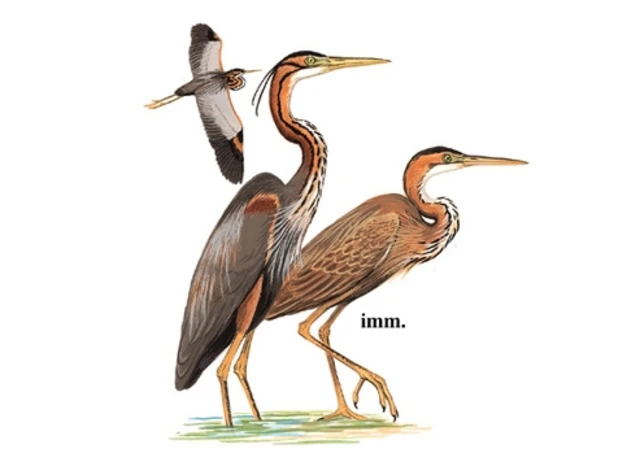 The Purple Heron (scientific name: *Ardea purpurea * ) is a bird belonging to the genus *Ardea* in the family Ardeidae. Also known as the Purple Heron, it is a widely distributed heron. They breed in Africa, central and southern Europe, and the southern and eastern Palearctic regions. Populations in the western Palearctic migrate between breeding and wintering grounds, while those in Africa and tropical Asia are primarily resident, except for occasional scattered migrations.
They are large wading birds characterized by three long features: a long beak, a long neck, and long legs. They resemble the more common grey heron in appearance, but are slightly smaller, more slender, and have darker plumage. They are also more shy birds, preferring densely planted habitats near water, especially reed beds. They hunt a variety of animals, including fish, rodents, frogs, and insects, either by stalking them or by standing in ambush.
Grey herons are gregarious breeders, building a bulky nest using dry reeds or twigs in reed beds or dense vegetation near water. They lay about five blue-green eggs, which are incubated by both parents. The chicks hatch after about four weeks and leave the nest after another six weeks. The International Union for Conservation of Nature (IUCN) notes a declining global grey heron population, primarily due to wetland drainage, but assesses their conservation status as "Least Concern."
The Grey Heron is a large bird, measuring 78–97 cm (31–38 inches) in length , with a standing height ranging from 70–94 cm (28–37 inches) and a wingspan of 120–152 cm ( 47–60 inches ) . However , it is slender and weighs only 0.5–1.35 kg ( 1.1–3.0 lbs ) . Slightly smaller than the Grey Heron, it can be distinguished by its darker reddish - brown plumage and the adult's darker grey back. The adult has a black forehead and crown, with a black stripe down the nape terminating in a slender, drooping crest. This crest is shorter than that of the Grey Heron, not exceeding 140 mm ( 5.5 inches ). The head and sides of the neck are yellowish-brown, with dark stripes and lines on the sides of the neck. The back is oily brown, with elongated feathers on the upper shoulders but none on the lower shoulders. The rest of the upper body and tail are brownish-grey. The front of the neck is lighter than the sides, with some elongated feathers at the base of the neck, featuring white, brown, and black stripes. The breast is brown with some black on the sides, while the belly and undertail coverts are black. The long, straight, brownish-yellow beak is more vibrant in color during the breeding season. The iris is yellow, and the front of the legs is brown, while the back is yellowish-brown.
The body is spindle-shaped. The forehead and crown are bluish-black, with two black braided feathers on the nape; the cheeks have a black stripe, and there is also a clear black longitudinal stripe extending down the side of the neck, with discontinuous and scattered short black longitudinal stripes visible on the foreneck; the upperparts are gray, the flight feathers of the wings are grayish-black, and the wingtips and leading edges are chestnut brown; the chin and throat are white, and there are long, silvery-gray or white spear-shaped ornamental feathers at the base of the foreneck; the chest and upper abdomen are chestnut brown at the base and bluish-black at the tip, the lower abdomen is bluish-black, and the flanks are gray; the iris is yellow, the bill is dark yellow, the tip of the bill is brown, and the bare lores are yellowish-green.

Size measurements: Weight: ♂ 775-1250 g, ♀ 1075-1160 g; Body length: ♂ 830-970 mm, ♀ 840-970 mm; Bill length: ♂ 105-130 mm, ♀ 109-130 mm; Wing length: ♂ 370-379 mm, ♀ 348-390 mm; Tail length: ♂ 118-140 mm, ♀ 110-136 mm; Tarsus length: ♂ 112-135 mm, ♀ 115-145 mm. (Note: ♂ male; ♀ female)
Its call is a deep " frarnk ," but quieter and higher-pitched than that of the grey heron. It is generally a relatively quiet bird, although a similar guttural sound can be heard from herons. It is also less robust and appears to have a somewhat sunken chest. Its head and neck are more slender than the grey heron's, with a greater serpentine curve, and its toes are longer. Unlike the grey heron, it often adopts a tilted neck posture, a posture even chicks use.
The grey heron is primarily distributed in the Palearctic region, breeding in Europe, Asia, and Africa. The western population extends eastward from Portugal, across much of Central and Southern Europe and parts of North Africa, reaching Lake Balkhash in Kazakhstan. In Africa, this bird breeds in Senegal, the east coast of Africa, and Madagascar. The eastern population extends eastward from the Indian subcontinent to eastern China and the Philippines, and northward to the Amur and Ussuri River basins, around 49 degrees north latitude. The southern population is confined to Madagascar, and a small population of grey herons in the Cape Verde Islands is considered a separate species by some authorities.
From August to October each year, western populations migrate south to tropical Africa and return north in March. Grey herons often stray beyond their normal range on their return journey, becoming vagrants in Northern Europe, including the UK. Eastern populations are mostly resident, but some birds from the northern regions fly south to South Korea, Thailand, and Malaysia. African birds are resident.
In mainland China, the grey heron is a summer migratory or transient bird in Heilongjiang, Jilin, Liaoning, Hebei, Beijing, Shanxi, Hunan, Inner Mongolia, Gansu, Shaanxi, North China, and the middle and lower reaches of the Yangtze River; a transient bird in Ningxia; a resident bird in Yunnan; and a transient or winter migratory bird in Sichuan, Fujian, Guangdong, Guangxi, Hong Kong, and Taiwan. The grey heron is relatively rare in Hunan. Some populations arrive in Hunan around the Qingming Festival and leave around the Autumn Equinox; others migrate south from the north in autumn. Large areas of reeds and aquatic plants grow around Dongting Lake, where grey herons often stop. Sometimes, they will roost and nest together with their friends, such as grey herons and egrets.
Grey herons inhabit the banks and shallow waters of lakes, rivers, reservoirs, and ponds in marshes, lagoons, rice paddies, open plains, and low hills. They are frequently found near water, but less common than grey herons. They thrive in densely vegetated areas. While they may frequently appear in coastal mangrove marshes, they typically prefer freshwater habitats, especially areas with Phragmites reed beds. They also visit mudflats, riverbanks, ditches, and canals. In the Cape Verde Islands, they are more likely to be found on open, dry hillsides.

The bird flies slowly, its neck retracted into a " Z " shape, its head tucked between its shoulders, wings beating slowly, and legs stretched straight back, protruding far beyond its tail. Its legs extend significantly behind its tail , making for a slow and unhurried flight. Its call is loud and somewhat hoarse, sounding like a "scratching" sound, though it rarely calls . This is characteristic of herons and crocodiles, distinguishing them from storks, cranes, and spoonbills, which extend their necks during flight. It is a camouflage bird, less common in open areas than the grey heron, preferring to hide in reed beds. Its long toes allow it to walk on floating vegetation, and sometimes on bushes in the same way, without attempting to grasp branches. It rarely perches in trees, preferring to rest on the ground.
The grey heron is a solitary bird, usually active alone. It is most active at dawn and dusk, roosting with other birds during the day and night, but increases its diurnal activity while raising its young. It hunts in shallow water, using its powerful beak to grasp prey. It typically waits patiently for its prey or slowly tracks it. Its diet mainly consists of fish, small mammals, and amphibians, but it also preys on chicks, snakes, lizards, crustaceans, aquatic snails, locusts , insects, and spiders. Ground beetles are its most common insect prey, followed by water beetles and aquatic larvae, as well as locusts, dragonflies, bees, and flies. A close look at the grey heron reveals that it lacks a prominent crop, but its esophagus is swollen in the middle, serving as its food storage "granary." Can't finish eating all at once? "Hoard"! When food is plentiful, it won't overeat; when food is scarce, it won't go hungry.
The grey heron typically breeds from May to July , in breeding colonies, though sometimes nesting alone. It sometimes shares colonies with other species, such as the giant heron ( Ardea goliath) or the grey heron. Nesting sites are usually chosen on the banks of water bodies with emergent vegetation such as reed beds, cattails, reed thickets, or low shrubs near large lakes or other extensive wetlands. The nest is constructed with a base of bent reeds or cattail leaves, covered with woven reed stalks, leaves, and cattails, and lined with soft materials such as reed fluff. Both parents build the nest, which takes about 7-10 days to build. The nest measures as follows: outer diameter 91.0 cm, inner diameter 43.0 cm, nest height 31.6 cm, nest depth 9.7 cm, and the edge of the nest is 131.7 cm above the water surface . One egg is laid daily or every other day. The egg is oval, averaging 56 x 45 mm ( 2.20 x 1.77 inches). Eggs laid on the first day are dark blue, lightening in color by the second day and turning grayish-blue by the third day. Typically, a female lays 4 to 8 eggs at a time, although these large nests may result from two females laying eggs in the same nest. Eggs are laid in batches over three days, and incubation may begin with the first egg or after all eggs have been laid. Both parents incubate the eggs for 24 to 28 days and jointly care for the chicks for 42 days . When the adults bring back food, the chicks tug at the adults' beaks, and the adults regurgitate food from the crops back into the nest, or the chicks feed directly from their beaks. The chicks leave the nest at around six weeks old, become independent after two months, and disperse widely.
There are an estimated 270,000 to 570,000 grey herons worldwide, and the population is likely declining slowly. The International Union for Conservation of Nature (IUCN) has assessed its conservation status as "Least Concern" because its decline is not rapid enough to warrant a more threatened category. The main threats to this bird are wetland drainage and disturbance, particularly the destruction of reed beds.