Basic Information
Scientific classification
- Chinese name: White-tailed Swallow
- Scientific name: White-tailed Tropical Bird, Long-tailed Tropical Bird
- Classification: Wading birds
- Genus and species: White-tailed pheasant, white-tailed tropical bird
Vital signs data
- Body length: 680-990 mm
- Weight: 220-410 grams
- life:
Significant features
It does not nest, is the smallest of three closely related seabirds in tropical oceans, and is also the smallest member of the order Phaetontiformes.
Distribution and Habitat
Origin: American Samoa, Anguilla, Antigua and Barbuda, Australia, Bahamas, Barbados, Belize, Bermuda, Bonaire, St. Eustachians and Saba, Brazil, British Indian Ocean Territory, Cameroon, Canada, Cayman Islands, Chile, China, Christmas Island, Cocos (Keeling) Islands, Colombia, Comoros, Cook Islands, Cuba, Curaçao, Dominican Republic, Equatorial Guinea, Fiji, French Polynesia, Grenada, Guam, Guatemala, Haiti, India, Indonesia Asia, Jamaica, Japan, Kenya, Madagascar, Malaysia, Maldives, Marshall Islands, Martinique, Mauritius, Mayotte, Mexico, Federated States of Micronesia, Montserrat, Mozambique, Myanmar, Nauru, New Caledonia, Northern Mariana Islands, Palau, Philippines, Puerto Rico, Saint Barthélemy, Saint Helena, Ascension and Tristan da Cunha, Saint Kitts and Nevis, Saint Lucia, Saint Martin (French territory), Saint Vincent and the Grenadines, São Tomé and Príncipe, Seychelles, Saint Martin (Dutch territory), Solomon Islands, South Africa, Sri Lanka, United Republic of Tanzania, Thailand, Tonga, Trinidad and Tobago, Turks and Caicos Islands, United States (Hawaii Islands), Vanuatu, Virgin Islands, Wallis and Futuna Islands.
Wandering: Angola, Ghana, Liberia, New Zealand, Panama and East Timor.
Appearance
The White-tailed Wren is a medium-sized island bird, resembling the Red-tailed Wren in appearance, and is predominantly white. Its primary flight feathers are black with white tips, and the inner webs of the primary flight feathers have broad white edges, gradually increasing in white until the seventh primary flight feather is entirely white. The outer secondary flight feathers are pure white, while the innermost secondary flight feathers and scapular feathers are black with broad white edges. The inner wing coverts are white, followed by black, and the median and greater wing coverts are white. The tail feathers have black shafts, with the two central tail feathers being elongated, white, and having black shafts.
The juveniles resemble the adults, but have thicker, more prominent black horizontal bars on their backs and lack particularly elongated central tail feathers.
The iris is brown; the mouth is orange or yellow with a black line running through the nostrils; the tarsus is yellow; and the toes and webs are black.
Size measurements: Weight 220-410 g; Body length 370-400 mm, or 680-990 mm including the elongated tail feathers; Bill 44-51 mm; Wings 252-282 mm; Central tail feathers 360-575 mm; Tarsus 21-23 mm.
Detailed introduction
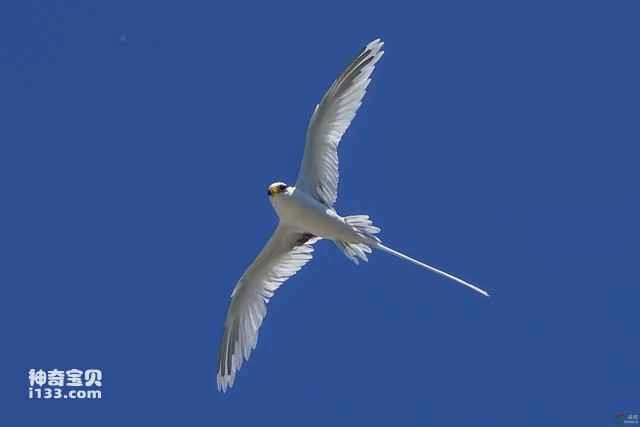
The White-tailed Tropical Bird (scientific name: *Phaethon lepturus *) is a bird belonging to the genus *Phaethon* in the family Phaethonidae. It is also known as the White-tailed Tropical Bird or Long-tailed Tropical Bird. It is a tropical bird, weighing 220-410 grams and measuring 370-400 mm in body length, or 680-990 mm with its elongated tail feathers. It is the smallest of the three closely related seabirds in tropical oceans and the smallest member of the order *Phaethontiformes* .
The plumage is predominantly white, with a slight orange tinge during the breeding season. There are prominent black spots in front of and behind the eyes, resembling two thick black eyebrows. The base of the wings and flanks are also black, and two black diagonal lines are clearly visible on the wings during flight. The two central tail feathers are particularly long and white. The iris is brown; the beak is orange or yellow with a black line running through the nostrils; the tarsi are yellow; and the toes and webbed feet are black.
The primary flight feathers are black with white tips. The inner webs of the primary flight feathers have broad white edges, and the white gradually increases until the 7th primary flight feather is completely white. The outer secondary flight feathers are pure white, the innermost secondary flight feathers and scapular feathers are black with broad white edges, the inner wing coverts are white, followed by black, and the median coverts and greater coverts are white. The tail feathers have black shafts, and the two central tail feathers are elongated, white, and have black shafts.
The juveniles resemble the adults, but have thicker, more prominent black horizontal bars on their backs and lack particularly elongated central tail feathers.
The iris is brown; the mouth is orange or yellow with a black line running through the nostrils; the tarsus is yellow; and the toes and webs are black.
Widely distributed in the ocean, it lives at sea year-round except during the breeding season, sometimes wandering very far, and its flight is more agile and swift. It feeds on various small surface fish, squid, crustaceans, and other marine animals , swooping down from heights of up to 20 meters to catch fish and squid by surface-feeding. However, this species is a poor swimmer. Its call is a high-pitched scream, keee-keee-krrrt-krrt-krrt . Males and females are similar, but males have longer tail feathers on average. Juveniles lack tail feathers, have greenish-yellow beaks, and fine stripes on their backs . It is distributed in the tropical Pacific, Atlantic, and Indian Oceans, as well as the Red Sea and the Persian Gulf, including the Mascarin Islands, Seychelles, and Andaman Islands in the Indian Ocean; the western coast of India, the West Indies, and Bermuda; the Gulf of Guinea and Ascension Island; Christmas Island; and islands in the southwestern Pacific Ocean.
Size measurements: Weight 220-410 g; Body length 370-400 mm, or 680-990 mm including the elongated tail feathers; Bill 44-51 mm; Wings 252-282 mm; Central tail feathers 360-575 mm; Tarsus 21-23 mm.
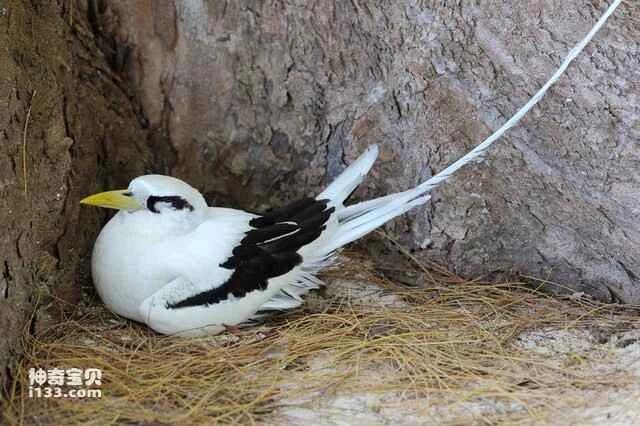
Breeding occurs on tropical ocean coasts and islands, nesting in burrows. They also nest in rock crevices, tree branches several meters above the ground, on the ground, and on cliffs near the sea. During courtship, both male and female birds frequently fly around the nest site, circling the bushes or flying back, forth, up, and down among the bushes. Sometimes, competition for mates occurs. During competition, they silently fight, biting each other's beaks above the nest site; this can be fatal in severe cases. They do not build nests and have no nesting material. Each clutch contains one egg. The egg is white with dark purplish-brown spots. The egg measures 50-56 mm × 36-41 mm. The chicks are altricial. Although the chicks are covered in down after hatching, they still need to be fed by their parents for nearly two months before leaving the nest to fly. The White-tailed Warbler does not have a fixed breeding cycle; instead, the breeding frequency depends on the climate and the availability of suitable breeding sites. This bird can breed 10 months after a successful breeding run or 5 months after a failed one.
In Bermuda, the white-tailed pheasant is commonly known as the long- tailed bird. On the Isle of Man in the UK, the word "long-tailed bird" is considered synonymous with "bad luck" and "bad weather," and the bird itself is seen as an ominous sign.


